

Source: Shentan | Author: Wang Xiangge
A black swan is a metaphor.
Before black swans were discovered in Australia, everyone believed all swans were white. Over time, the term has come to describe highly improbable, high-impact, and unpredictable events. Black swans appear without warning and change everything. For humans who rely too heavily on past experience, they strike with no advance notice.
This year, we faced a massive "black swan"—the novel coronavirus.
No one welcomes a black swan. But now that it has arrived, how should we respond to such unpredictable, sudden events?
"Crisis" and "opportunity" often go hand in hand. Instead of lamenting fate, we can turn to Nassim Nicholas Taleb's book The Black Swan. Taleb has spent his career studying luck, uncertainty, probability, and knowledge. In this book, he tackles a difficult question head-on: how to seize the opportunities presented by black swan events, adopt effective strategies, and ultimately benefit from them.
Mediocristan vs. Extremistan
To understand the "black swan," we first need to grasp two key concepts from Nassim Taleb: Mediocristan and Extremistan. Taleb coined the suffix "-stan" to mean "the land of" mediocrity (or the average).
In our world, some phenomena are strongly "average": most individuals cluster closely around the mean, with far fewer outliers; the number of individuals deviating significantly from the mean approaches zero. Other phenomena are extreme: the concept of an "average" is almost meaningless here, as many individuals deviate dramatically from any central tendency—and these deviations can be staggering. Taleb calls the former "Mediocristan" and the latter "Extremistan."
In Mediocristan, we are governed by concrete, routine, known, and predictable events.
In Extremistan, however, we are governed by singular, accidental, unknown, and unforeseen events.
In an ideal Mediocristan, any single event has a negligible impact; only collective effects matter. In Extremistan, individuals can have a disproportionate impact on the whole. Extremistan is where black swans emerge—rare events that exert an outsized influence on history. Examples include the 9/11 attacks, the 2008 financial crisis, and the Wenchuan earthquake.
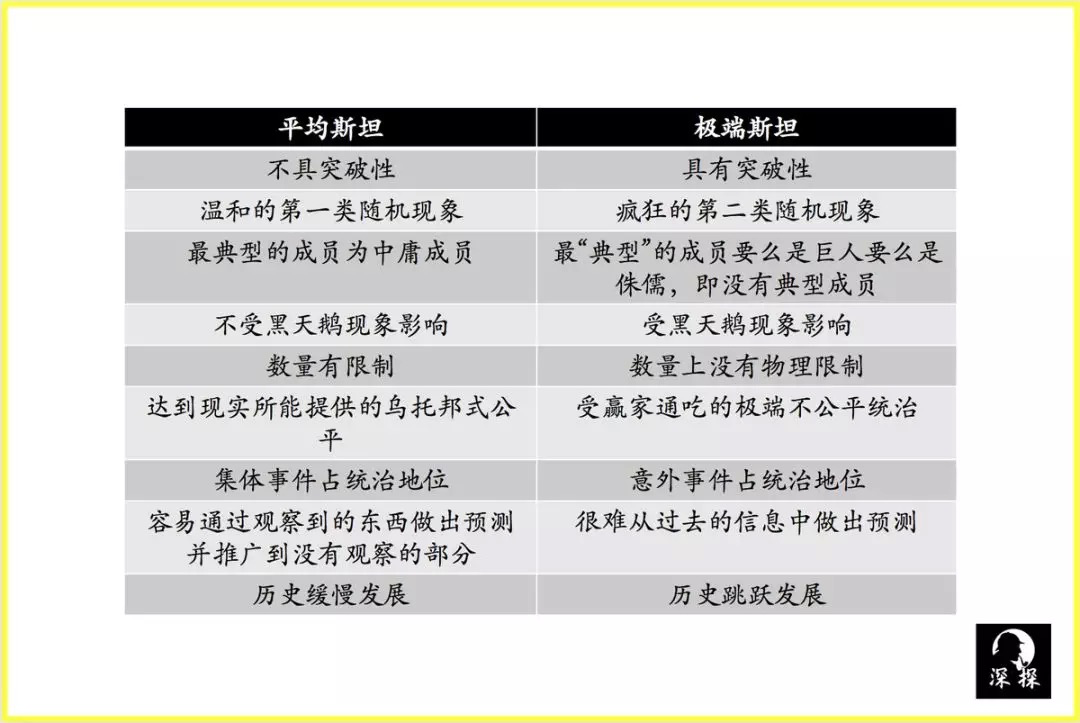
Black swan events can only occur in Extremistan.
Human height, weight, and food consumption belong to Mediocristan—they show minimal variation and are tied to physical limits. In contrast, income, wealth, book sales per author, and celebrity fame belong to Extremistan, as they typically follow power-law distributions (characterized by exponential growth).
Cognitive Biases Around Black Swans
History unfolds across two domains: Mediocristan and Extremistan. Yet our world is fundamentally shaped by Extremistan—the realm of the unknown and the wildly improbable. The emergence of humanity itself was a stroke of extraordinary luck—a rare mutation that happened to survive within Extremistan's unforgiving environment.
Today, we've grown accustomed to lifestyles rooted in Mediocristan's predictability, unconsciously importing its comfortable habits and linear thinking into the chaotic reality of Extremistan.
This mismatch creates problems, particularly in how we perceive Black Swan events:
-
Confirmation Bias: We focus on a convenient slice of observed data and assume it represents the whole unseen picture. You can't assume a farmer will feed his turkey on day 1,001 just because he did so for the previous 1,000 days—Thanksgiving might be on the calendar. Relying solely on the past pattern is classic confirmation bias.
-
Narrative Fallacy: Our brains crave simple stories over complex truths, concrete details over abstract principles, and clear causes over random chance. We instinctively weave events into coherent narratives—simplifying, solidifying, and imposing causality—rather than accepting raw, messy reality. We constantly retrofit logic onto past events, crafting plausible-sounding stories that satisfy our deep-seated need for patterns, thereby fooling ourselves.
-
Denial of Black Swans: Human psychology is inherently poorly equipped to handle Black Swan phenomena. We are wired for the ordinary, not the extraordinary outlier.
-
Silent Evidence: What we see is never the full story. History hides Black Swans, warping our sense of their probability. This "silent evidence" creates a distortion: history is written by the victors, burying the legions of failures. You only see those who succeeded on a given path, never the countless others who tried and vanished.
-
Filtering Error: We only pay attention to well-defined, specific uncertainties—tangible Black Swans. We prefer the verified, the visible, the concrete, and the known, while shunning abstract concepts and unknown unknowns. We respect what did happen but ignore what *could* have happened. We are naturally superficial, yet blissfully unaware of our own superficiality.
People systematically misjudge rare events—which is precisely how insurance companies turn a profit. We often take risks not out of confidence, but from ignorance and a disregard for uncertainty.
Responding to Black Swans
We live in Extremistan, yet forecasters base their predictions on the rules of Mediocristan. The result? We consistently fail to predict the future while remaining stubbornly blind to our own failure.
Black Swan events are the pivotal moments that reshape our world, and their defining feature is their inherent unpredictability. An asymmetry exists between past and future: when we think about tomorrow, we treat it as merely "another yesterday." Acknowledging our inability to predict doesn't mean we can't benefit from unpredictability. Instead, we should strategically position ourselves to encounter more *positive* Black Swans.
The world is accelerating toward Extremistan, where cumulative advantage (the Matthew Effect) and preferential attachment wield enormous power. Under the influence of Black Swans, intense competition breeds greater inequality and heightened uncertainty. A critical flaw in today's knowledge-driven, winner-take-all economy is that it amplifies unfairness and elevates the role of sheer luck and chance opportunity.
Meanwhile, uncertainty itself is intensifying. No one is a permanent winner, and no one is a permanent loser. The familiar bell curve is constrained—the probability of extreme deviations from the mean drops off rapidly. In contrast, power-law or Mandelbrotian distributions face no such limit and are far better models for Extremistan. Yet, practitioners in finance and economics remain stubbornly attached to the comforting illusion of the Gaussian distribution.
In summary, here are the key principles for dealing with black swan events:
Don't try to predict them. By definition, black swan events are unpredictable. Attempting to forecast the unpredictable—and acting on those predictions—only compounds potential errors.
Prioritize caution and prevention. While we can't predict disasters, we can work to prevent them. It's crucial to rigorously assess the potential damage from worst-case scenarios and implement robust safeguards—this can be the difference between survival and failure.
Look for opportunity in the crisis. A black swan event is a crisis, but within every crisis lies opportunity. The most severe crises often trigger the sharpest declines, which in turn can create the most compelling investment opportunities.
Maintain ample redundancy. This is perhaps the most critical principle. Build in enough buffer to absorb shocks from unexpected events and ensure you remain operational.
Avoid excessive debt. High leverage dramatically amplifies the damage when a black swan event strikes.
The author concludes with a simple, final rule for decision-making: “When I stand to gain from a positive black swan, I take bold risks—because the downside of being wrong is minimal. When I'm exposed to a negative black swan, I become extremely conservative.”