

This article is sourced from Bitcoin.com & Yahoo! Finance. Original authors: Kai Sedgwick & Brady Dale
Translated by Moni for Odaily Planet Daily
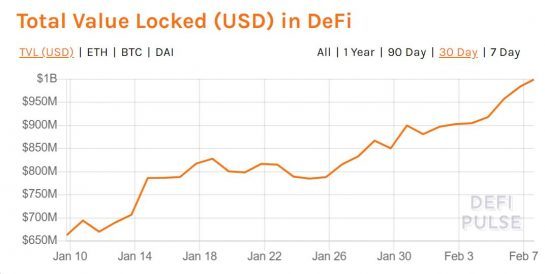
The Ethereum community has reason to celebrate: the total value locked (TVL) in decentralized finance (DeFi) applications has just crossed the $1 billion mark! To put this in perspective, that figure was under $700 million in December 2019—a surge of over 43% in less than two months. For blockchain skeptics, the numbers speak for themselves.
So, where does this $1 billion figure come from? According to DeFi Pulse—the first platform to report this milestone—it represents the total value of all cryptocurrencies held in Ethereum smart contracts used for structured "staking" activities like lending, hedging, and swaps, as of 08:00 UTC on February 7.
It's crucial to understand that this $1 billion isn't profit generated by DeFi platforms, but rather capital that users have committed. This staked collateral powers a wide range of protocols, from simple lending to complex derivatives, enabling various forms of "staking" across these decentralized products.
Rune Christensen, founder of the MakerDAO protocol, stated through a spokesperson that surpassing $1 billion in TVL highlights the global demand for more efficient and decentralized financial services. MakerDAO currently leads the DeFi Pulse rankings as the largest ETH-collateralized DeFi protocol. At the time of writing, it accounts for 60.78% of DeFi's total value locked. Numerous decentralized lending, derivatives, and trading protocols rely on liquidity from Maker's Sai and Dai stablecoins, which are themselves backed by Ethereum.
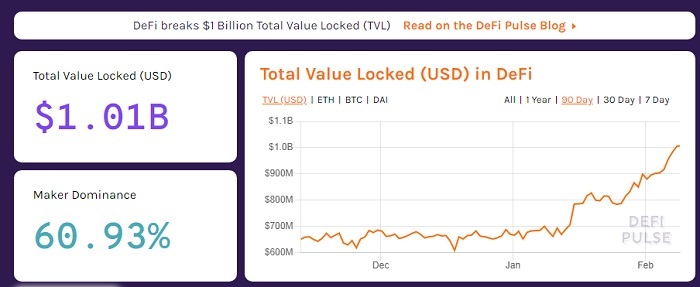
DeFi Pulse hailed the $1 billion milestone as "a significant milestone for DeFi" on its official blog. Spencer Noon, an investor at DTC Capital, also emphasized DeFi's immense growth potential, adding:
"No other smart contract platform comes close to DeFi in terms of shared developer mindset, application tooling, and infrastructure. I believe DeFi can thrive anywhere. Perhaps most surprisingly, we're finally seeing a credible use case that could give Ethereum a long-term monetary premium, especially since ETH remains the dominant collateral asset in decentralized finance today."
Centralized Exceptions Set Their Sights on DeFi
Lending remains the core of decentralized finance today, with half of the top ten dApps—Maker, Compound, Instadapp, dYdX, and Bzx—falling under the DeFi umbrella. However, some centralized exchanges are now turning their attention to this lucrative sector.
This week, Binance launched the 13th phase of its lending product, offering interest rates of 6% for USDT, 8% for BUSD, and 15% for ERD. DeFi lenders like Cred and Squilla Loans also cater to users unfamiliar with DeFi protocols by providing seamless experiences. For instance, Squilla allows borrowers and lenders to get instant quotes simply by entering their desired loan amount and term. While many DeFi applications are actively improving their user experience and offering competitive rates, they may still struggle to compete with the deep pockets of centralized exchanges.
Breaking Down the "$1 Billion"
DeFi Pulse aggregates the total amount of ETH and ERC-20 tokens locked in all public DeFi protocols every hour, displaying the resulting "total value locked" (TVL) figure prominently on its homepage chart.
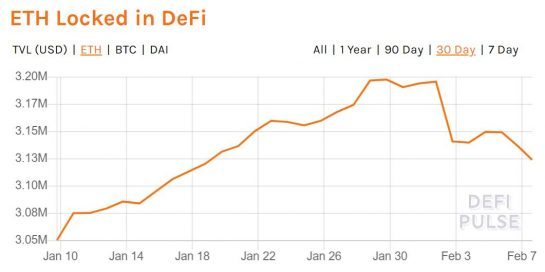
Naturally, a significant portion of that $1 billion comes from Ethereum itself, as roughly 70% of DeFi's locked value is denominated in ETH. However, because DeFi Pulse expresses TVL in USD, the figure is highly sensitive to cryptocurrency price swings—which explains its frequent fluctuations. In other words, even if no new ETH is deposited, a rising ETH price alone will inflate the TVL. Indeed, ETH surged 21% last week.
In fact, if we measure DeFi's locked value not in USD but in raw ETH terms, we see a decline over the past seven days. Jake Brukhman of CoinFund commented:
"It's clear that some DeFi milestones are driven by ETH price appreciation. But regardless, we've moved past the bear market inflection points of 2018 and 2019 and are now positioned for a bull market in 2020."
Cryptocurrency investor and Ethereum advocate Ryan Sean Adams also tweeted:
"Software eats money. Software eats banks. The next decade will be wild."
Of course, for Bitcoin maximalists, this DeFi milestone means little—they believe Bitcoin leads the entire crypto market's appreciation. Bitcoin developer Peter Todd remarked:
"Decentralized smart contracts let people avoid responsibility for debt, so caution is warranted."
An anonymous Bitcoin supporter further questioned how much of the $1 billion locked in DeFi consists of illiquid initial coin offering (ICO) tokens, and how much is inflated by hype from ConsenSys, the Ethereum Foundation, or Ethereum's founders.
Cryptocurrency legal commentator Preston Byrne bluntly stated that DeFi doesn't have $1 billion in locked value—if Dai's circulating supply is accurate, then at least $300 million worth of ETH must be locked in Dai, as early investors chose not to sell and trigger tax liabilities. In his view, DeFi hasn't locked $1 billion; it has locked physical ETH tokens because many early investors are holding onto them, waiting for the bull market and betting on ETH's appreciation.
Preston Byrne offered a vivid analogy:
"There's a difference between saying Jeff Bezos's net worth is $100 billion and saying Jeff Bezos has $100 billion in cash."
Moreover, it's unclear whether DeFi's rapid growth can be sustained. Take Kickstarter, the renowned crowdfunding platform: founded in 2009, it reached $1 billion in funded projects by 2014—but six years later, it still hadn't hit $5 billion. Of course, DeFi's growth trajectory is undoubtedly steeper than that of traditional crowdfunding platforms.
Robert Leshner, founder of leading DeFi protocol Compound, noted that this milestone signals users' growing desire for better ways to use their cryptocurrencies—reducing reliance on centralized exchanges. In Leshner's words, "Satoshi Nakamoto would be very proud of DeFi's progress."
In reality, "$1 billion" is a relatively small figure no matter how you look at it. For context, the U.S. commercial loan market alone is worth $800 billion, according to research firm IBISWorld. This shows just how far DeFi still has to go.