

By Qin Xiaofeng | Edited by Hao Fangzhou | Odaily Planet Daily
BitUniverse market data shows that at 11:20 AM Beijing Time today, BTC surged past the $10,000 mark, briefly touching $10,100 for a daily gain exceeding 2.5%. As of this writing, BTC is trading above $10,000 on all three major exchanges.
The price rally has been accompanied by a significant spike in cryptocurrency trading volume in recent days.
Odaily Planet Daily notes that both BTC and overall crypto market trading volumes have recently hit consecutive highs. On January 15, the total daily crypto market volume reached a record $16.6 billion, with BTC's daily volume also hitting an all-time high of $4.6 billion. Furthermore, the average daily trading volume over the past two weeks has far surpassed levels seen during the bull markets of June 2019 and January 2018.
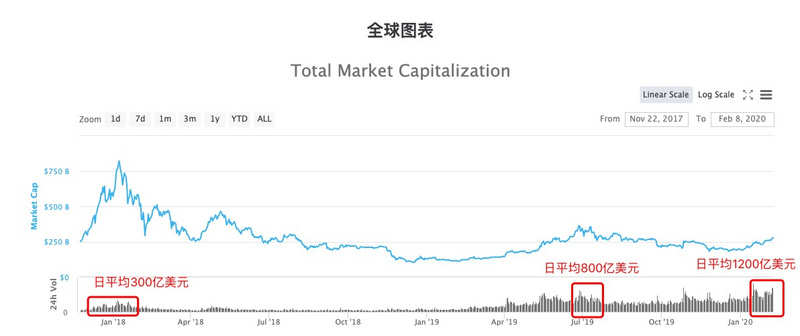
This rally has legs—there's still time for investors to get in.
Year-to-date, BTC has already rallied more than 40%.
Several market participants view the recent uptrend as solid and sustainable, with today's breakout above $10,000 sending a bullish signal.
"This high-volume breakout above $10,000 essentially marks the start of this bull cycle. While a short-term pullback is possible, last year's low of $6,433 is almost certainly the bottom for this run," said Li Zhe, Partner at Clipper Coin Capital and Conflux Community Ambassador.
"Looking ahead, bulls are likely to dominate the market in the near term. Unlike the October 2019 rally driven by short-term 'animal spirits' (Odaily Planet Daily note: irrational investment behavior triggered by extreme euphoria or fear), this rally has been gradual and sustained, resembling the healthier bull market momentum of Q2–Q3 2019," explained Jinze, Senior Analyst at Binance Research. "Based on volume and technical analysis, key near-term resistance levels are at $10,300, $11,500, and $13,500."
Cao Junliang of Molecule Group shares this view. He notes that BTC's steady climb from $7,000, rather than a sharp spike, suggests institutional players are accumulating positions. "This kind of steady uptrend often precedes an acceleration phase. However, I expect some consolidation or minor pullbacks, likely oscillating around the $10,000 level."
"Immediate overhead resistance sits near the previous high of $10,400—a zone with heavy trading activity from September 2019. The first notable support levels below are $9,500 and $9,200," said OKEx analyst Yansong. "Retail investors should hold their spot BTC and consider placing buy orders near these support levels. Chasing the rally at current prices doesn't seem overly risky."
With BTC consolidating, is now the time for retail investors to enter?
Li Zhe believes BTC's upward trajectory will continue. With the May halving approaching, surpassing the 2017 bull market peak of $20,000 is only a matter of time. "In terms of price targets, one key level is last year's secondary high of $14,000, which could be breached around the May halving. Next is the $20,000 milestone, which we hope to see before year-end. Historically, however, new all-time highs often occur the following year—in 2021. So retail investors who haven't entered yet still have ample opportunity this year."
Lorry, Head of Industry Research at digital asset infrastructure provider Amber Group, is also bullish. "This rally was initially sparked by the U.S.–Iran conflict and driven by spot demand, then fueled further by halving coins like BSV and ETC, fully reigniting market enthusiasm. Weekly charts suggest the rally isn't over—buying opportunities may emerge after a pullback."
Cao Junliang added that retail investors still have excellent opportunities ahead of the halving and should continue holding BTC. "The halving will discourage many holders from selling, reducing sell-side pressure and supporting sustained price appreciation."
Key Sectors to Watch: Halving Coins, Exchange Tokens, and ETH
Beyond BTC, numerous other tokens—including ETC and BCH—are scheduled to halve in 2020, leading industry observers to dub this the "Halving Year." Below is the full list of scheduled halvings—worth bookmarking:
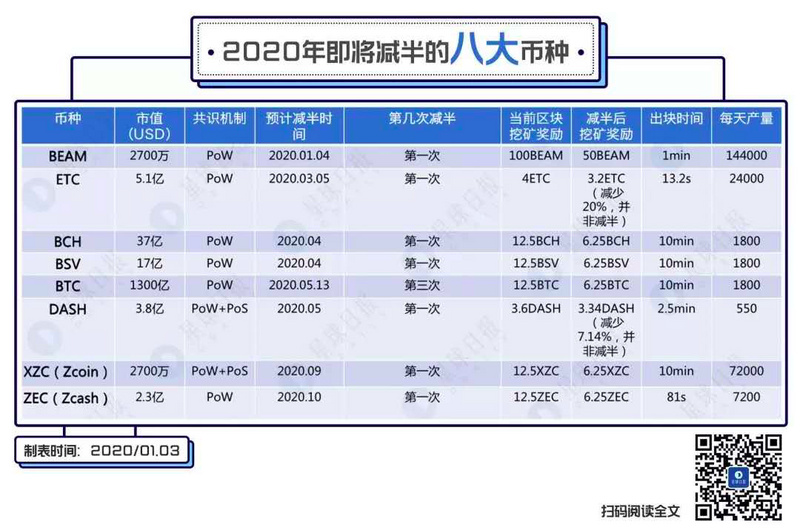
Recently, as BTC's price climbed, halving coins have also posted strong gains. BSV leads the pack with a year-to-date gain of 278%, followed closely by DASH. Detailed performance data is shown below:
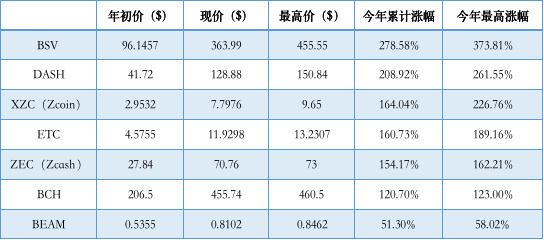
"The fundamental logic behind halving coins is a short-term supply-demand imbalance. Their upside potential depends on circulating supply and the scale of prior profit-taking. Long-term performance, however, ultimately hinges on fundamentals—such as whether new nodes have been added and beneficial network connections formed," Li Zhe explained.
OKEx analyst Yansong added that hype around halving events has likely peaked, and as halving dates approach, selling pressure is mounting—with ETC being the first affected. "Currently, BCH appears relatively stable despite uncertainty around miner taxes. Meanwhile, BSV's extreme volatility makes direction difficult to call; it could potentially retest the $400 level again."
Lorry emphasized that this halving cycle has been underway for roughly two months, and prices typically peak just before the halving occurs. "Investors might consider halving coins that haven't rallied strongly yet—such as BTC and BCH. As long as BTC's halving cycle remains incomplete, other assets are unlikely to enter bearish territory. Further upside will depend on new capital inflows."
Beyond halving coins, exchange tokens—which performed strongly in 2019—also deserve close attention this year.
For instance, the top three exchange tokens have posted the following year-to-date gains: BNB (+69.56%), OKB (+46.72%), and HT (+43.33%)—roughly in line with BTC's performance.
"Exchange tokens remain highly compelling this year, given their healthy development trajectory and favorable investment profile. Moreover, rising market activity and trading volumes directly boost exchange revenues, which in turn lifts token valuations," Cao Junliang explained.
"As market activity picks up, exchange tokens are emerging as the second most certain opportunity after BTC. Annual profits in the hundreds of millions provide solid intrinsic value support for these tokens," Li Zhe added, expressing similar optimism.
Beyond halving coins and exchange tokens, ETH is another key focus for 2020. Year-to-date, ETH has gained 75%, outperforming BTC.
According to CoinMarketCap data, ETH's average daily trading volume over the past two weeks has exceeded $10 billion—far surpassing levels seen during the bull markets of June 2019 and January 2018.
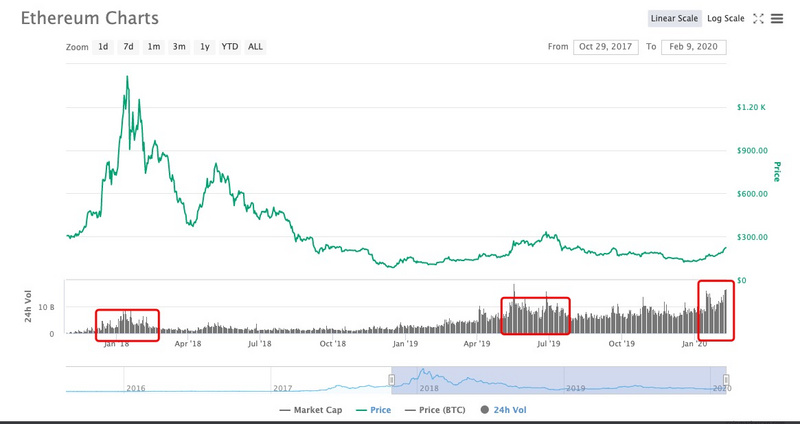
Meanwhile, ETH has shown remarkable strength over the past two weeks, closing in the red on only a single day.
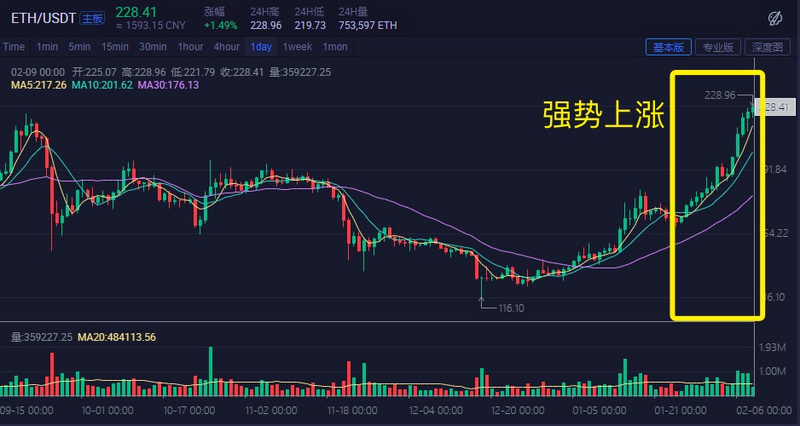
Fundamentally, 2020 brings not only the anticipated rollout of ETH 2.0 but also the potential launch of ETH futures on major traditional exchanges.
In a recent Bloomberg interview, U.S. Commodity Futures Trading Commission (CFTC) Chairman Heath Tarbert confirmed that ETH futures are actively being developed. Tarbert first hinted last October that ETH futures could debut in 2020, emphasizing the CFTC's openness to approving new products.
"ETH's momentum is exceptionally strong—it has even outperformed BTC recently. With the total value locked (TVL) in DeFi projects surpassing $1.1 billion, ETH is attracting fresh speculative interest," Yansong noted. "Backed by these catalysts, ETH could be this year's dark horse."
Risks Remain
As BTC's rally continues, investors who missed the initial move may be tempted to jump in. However, several risks demand caution.
First, a BTC pullback is a distinct possibility.
Lorry pointed to data suggesting a near-term correction: "Short-term selling pressure is building. The long/short ratio on Bitfinex is around 4:1, while BitMEX's total futures open interest has hit an all-time high. USDT borrowing rates across major platforms are nearly exhausted—Gate.io's rate briefly spiked to 32%. Buy-side liquidity in spot markets is drying up. Technically, the market has already rotated from BTC to major altcoins and then to small-cap coins. Multiple short-term indicators show sustained overbought conditions, so managing short-term risk is prudent."
Yansong added that while timing a correction is difficult, violent pullbacks are common in bull markets, making careful position sizing essential. "The premium on OKX's quarterly contract is about 3.3%, suggesting there's still room to run. The long/short ratio sits near 1.8, not yet at an extreme level above 2.0. However, analysis of the 'Elite Long/Short Average Position Ratio' shows a clear trend of large players accumulating short positions: the average short position size currently exceeds the average long by 7%. Open interest remains a key concern—both OKX and BitMEX report BTC open interest hovering around $1.1 billion, which explains why many traders hesitated to add longs recently. This morning, after BTC broke $10,000, we saw the first liquidation exceeding $7 million, the largest single liquidation event in the past week. Notably, there was no cascading liquidation, which shows how visible this risk accumulation has become."
Second, despite impressive gains for halving-related tokens and exchange tokens, a true "Altcoin Season" may not yet be here.
"It's important to remember that last year's Q2–Q3 mini-bull run didn't see the repeated 'Altcoin Season' phenomenon of 2017, where high-risk altcoins skyrocketed late in the cycle. This time, BTC's market dominance hasn't fallen significantly, suggesting market euphoria hasn't fully spilled over into the broader altcoin space. Overall sentiment and momentum still don't compare to the peak of 2017," Jinze explained.
Li Zhe added that retail investors should still prioritize position control and risk management: "Focus on BTC, diversify with major altcoins, and avoid leverage."