

By: Parker Lewis, Head of Business Development at Unchained Capital
Author: Parker Lewis | Translator: Perry Wang
In the world of Bitcoin adoption, two feelings are nearly universal: first, that you bought in too late; second, that you wish you'd bought more.
There are exceptions, of course, but Bitcoin has a unique way of distorting our psychology. People come to realize that a hard cap of 21 million is astonishingly small. And as more people understand that Bitcoin's fixed supply is credibly enforced—and that monetary networks tend to converge on a single medium—those 21 million units feel even scarcer.
This growing credibility in Bitcoin's monetary properties, combined with the natural tendency for monetary convergence, fuels greater demand. That demand, in turn, intensifies the scarcity effect of its fixed supply.
Consequently, Bitcoin's value as money continues to appreciate. The deeper you dive into Bitcoin, the clearer this becomes. Yet to an outsider, the landscape is cluttered with thousands of similar-looking cryptocurrencies. Sure, Bitcoin is the leader today—but with so many alternatives, how can we be sure it won't become the next Myspace: an early pioneer destined for obsolescence? What if something new comes along to displace it?
Could Bitcoin actually become the world's dominant currency? The idea might sound absurd—but if you assess it from the top down and weigh the probabilities, it remains a plausible outcome.
Today, Bitcoin competes with over 1,000 other cryptocurrencies, most of which seem nearly identical. Its market cap sits at around $150 billion, dwarfed by a global financial system supporting $25 trillion in debt. Gold alone holds about $8 trillion in purchasing power (roughly 50 times Bitcoin's). Can a protocol born from the ashes of the 2008 crisis, just over a decade old, realistically evolve from zero to become the world's primary money? It sounds improbable, perhaps even too far-fetched to take seriously. But if you examine it from the bottom up, grounded in first principles, those thousand-plus competitors fade into noise. When multiple factors align, a few core ideas can transform a seemingly complex and indistinguishable phenomenon into something simple and clear. Picking the right solution from a thousand options seems impossible—or at least highly impractical. Yet if you can eliminate 999 of those options using one or two foundational principles, finding a reasonable answer becomes dramatically more feasible.
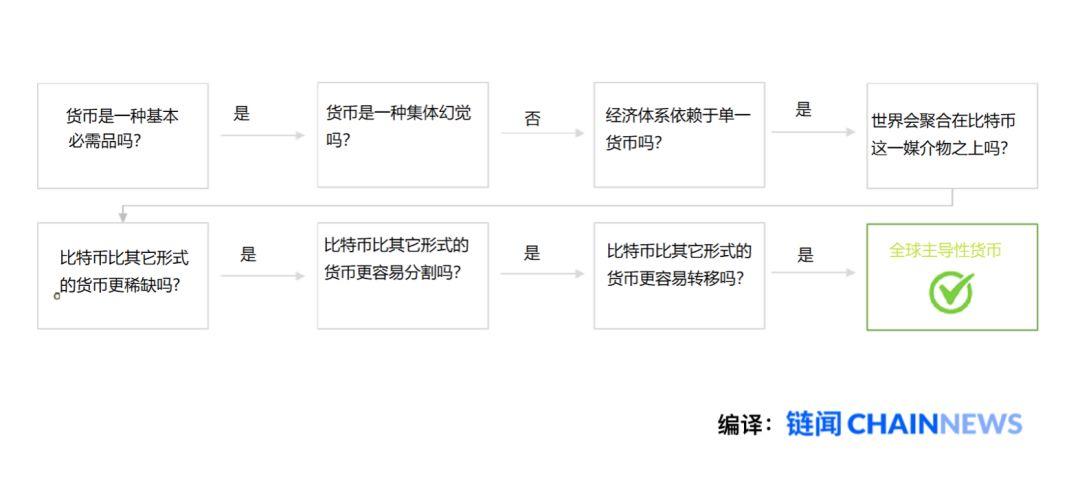
This is the path to cut through the noise and focus on what matters. People may reach different conclusions, but this approach helps us understand why Bitcoin has consistently outperformed every other form of money—and whether it will continue to do so.
Money is a fundamental necessity—not a collective hallucination or a mere social construct. People choose Bitcoin because its unique properties make it superior to all other forms of money. And since money solves an intersubjective coordination problem, monetary systems naturally converge on a single medium.
Or, to be more precise, economic systems emerge *from* a single monetary medium due to money's functional role. Bitcoin's inherent properties are driving this market convergence because it represents a step-function improvement as a tool for transmitting and measuring value. Once you accept that money is a necessity and that monetary systems naturally converge, the next question is straightforward: does Bitcoin perform this monetary function better than anything else?
Money Is a Necessity
We know civilization cannot exist without money. There would be no airplanes, cars, or iPhones. Our ability to meet even basic human needs would be severely compromised. Without functioning money, millions of people could not coexist peacefully in cities, states, or nations. Money is the economic good that ensures food appears on grocery shelves, gas fills tanks, electricity powers homes, and clean water flows from taps.
Money makes the world work. Without it, the world as we know it would cease to function. This is a profoundly underappreciated role—poorly understood because we rarely stop to think about it. In developed nations, reliable money is simply assumed. The essential goods and services coordinated through money are taken for granted.
Consider a local supermarket or even a small convenience store as an example of aggregated demand. The number of human contributions and specialized skills required to sustain such a store is staggering. The coordination within the store itself, the packaging of items, the technology providers, logistics systems, transportation networks, and payment systems—all extend down to every product on the shelf. Then consider the inputs required for each of those items. The supermarket is merely the retail endpoint; every input has its own intricate supply chain. This is just one modern marvel. Deconstructing the inputs for telecommunications networks, power grids, or water management systems is equally complex. Every economic network and its participants are interdependent. Food producers rely on others for energy, telecom, logistics, and clean water—and vice versa. Nearly all economic networks are interconnected, made possible solely by money's coordinating function. Each person contributes their skills based on self-interest and preference: receiving money today for value delivered, then spending that money later to acquire specific value created by others.
None of this happens by accident. Some claim money is a collective hallucination or that its value stems solely from government decree. In reality, money is a human invention: a tool designed to facilitate trade and satisfy a specific market need.
As an intermediary for present and future transactions, money makes this possible. There's no central directive—market participants, evaluating the relative values of diverse goods, ultimately select money as the optimal instrument for converting present value into future value. While individual consumption preferences vary widely and constantly evolve, the need to exchange is universal, and its function is uniform. For each person, value generated today is stored via money for future consumption. The value we place on housing, cars, food, or leisure changes over time and differs between individuals. Yet the need to consume—and to express preferences—is constant, applying to everyone on an intersubjective basis.
Money exists to convey these preferences and, ultimately, to transmit value. All value is subjective (not intrinsic), and money forms the foundation for expressing value—and, more importantly, expressing relative value.
Currency is a form of collective cognition—a common language that benefits everyone in conveying personal preferences. It aggregates and measures the preferences of all individuals in an economy at any given moment. Without a universally accepted constant, value cannot be communicated efficiently. Money serves as that constant—the benchmark against which all other goods are measured. Without it, consensus on the value of anything would stall. Only by comparing against a constant can we discern the relative value of two goods. Billions of individuals with unique preferences produce billions of goods and services. By converging on money, all these preferences aggregate and communicate, allowing a price system to emerge. Only by measuring and expressing the value of all goods through a common intermediary (money) can we determine the value of one good (or resource) relative to another.
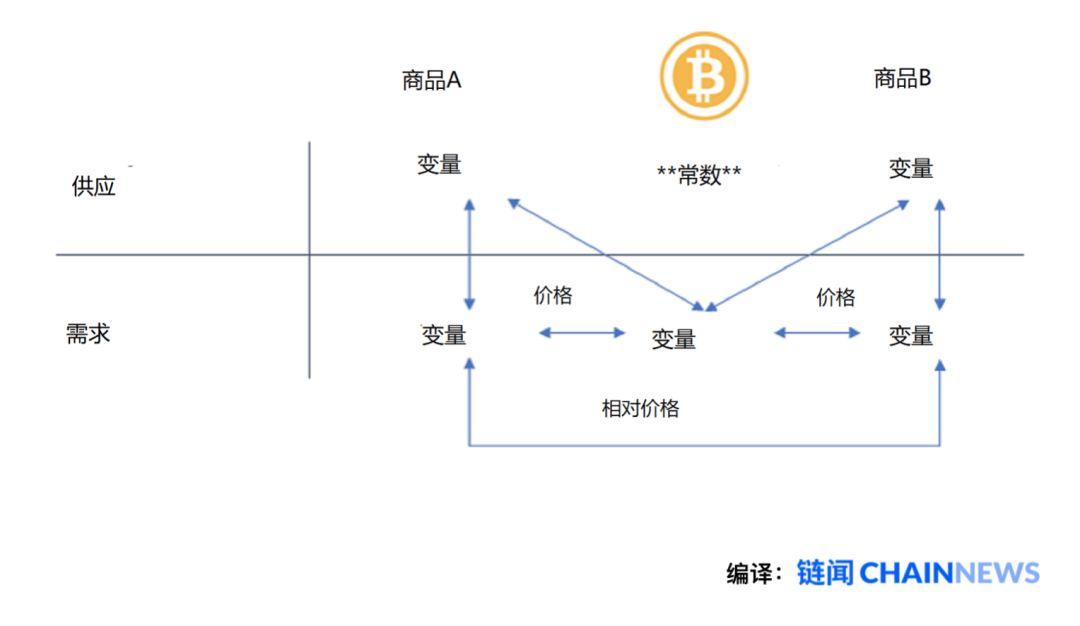
Without a common currency, the concept of price doesn't exist. Without price, economic calculation at any scale becomes impossible. With it, individuals act independently—guided by information transmitted through the price system—to better satisfy their own needs by understanding the needs of others. This price system enables the formation of supply and demand structures. It becomes a necessity because it transmits information otherwise unavailable for meeting basic human needs.
Imagine consuming goods without identifiable prices. How would you know how much to produce to get what you want? You'd soon realize that without prices, you couldn't assess the value of your own production or understand the value of others' goods and services. It becomes a vicious cycle. This is precisely why money, through the price system, establishes an economy's foundational structure. Though often called the root of all evil, money may be humanity's greatest accidental invention—certainly not one created by conscious design.
I use the word "miracle" deliberately to jolt readers from complacency—from the tendency to attribute outcomes solely to visible mechanisms. I believe that if this were a consciously designed system—if people guided by price signals understood that their decisions carried significance far beyond immediate goals—this mechanism would rightly be hailed as one of humanity's greatest achievements.
Yet its misfortune is twofold: it is not a product of conscious design, and those guided by it are typically unaware of why they do their work. Those who advocate for "conscious direction"—who refuse to believe anything can evolve without deliberate design (even beyond human comprehension)—should remember this: the precise challenge is extending the scope of resource utilization beyond any single mind; eliminating the need for conscious control; and providing incentives so individuals do the right thing without anyone telling them what to do.
Friedrich Hayek, “The Use of Knowledge in Society”
All Economic Systems Converge on a Single Monetary Medium
A popular view in Silicon Valley suggests we could see hundreds, or even thousands, of currencies in the future. Machines will handle all the calculations! AI and quantum computing will take care of everything. A slightly more tempered version argues that 95% of cryptocurrencies will probably fail, leaving only a handful of "interesting" projects standing. "It's genuinely hard to know which ones will succeed." "Just like venture capital, most will fail, but the winner will win big." This is the narrative you often hear in the Valley—it draws a convenient analogy from the history of corporate investing. In reality, it's evasive rhetoric that lacks foundational principles, applying an outdated framework to a fundamentally different kind of problem.
Comparing the trajectory of Bitcoin to that of technology startups might seem like a reasonable mental model, but the two are not comparable. It's illogical to assume that competition between two (or more) monetary media resembles competition between two firms. Companies engage in a capital-driven arms race; they need money to coordinate economic activity. How do they get it? By using money to coordinate the production of goods and services, then selling those outputs to earn more money (profit). At their core, firms compete for funds from the same pool to accumulate capital. Money is the lubricant that keeps the wheels turning. Without it, coordinating the diverse skills required and producing goods through complex modern supply chains would be impossible. And none of this works without the widespread acceptance of a common monetary form.
A single medium of exchange allows the economic scale to expand as more people adopt it. A larger economy means greater gains from trade and specialization—and, perhaps more importantly, enables longer and more complex production structures.
Saifedean Ammous, “The Bitcoin Standard”
Within production supply chains, money serves a function distinct from any good or service. The key difference lies between satisfying preferences (producing goods and services) and coordinating preferences (money). Satisfying preferences depends on coordinating them, which in turn relies on the price system. A price system only emerges as a derivative when everything converges on a single monetary medium. Without a price system, there can be no division of labor—at least not at the scale needed for complex supply chains. This is the foundational principle most easily overlooked when imagining a multi-currency world. Any price system is derived from a single currency. Unless large numbers of people produce diverse goods and services and communicate their values through a common intermediary, the very concept of a "price" wouldn't exist. For money and prices to function, convergence on a single medium is a prerequisite. More precisely, economic systems emerge *from* a single monetary medium—they don't just converge *upon* it. Countless individuals converge on a monetary medium, and the result is an economic system.
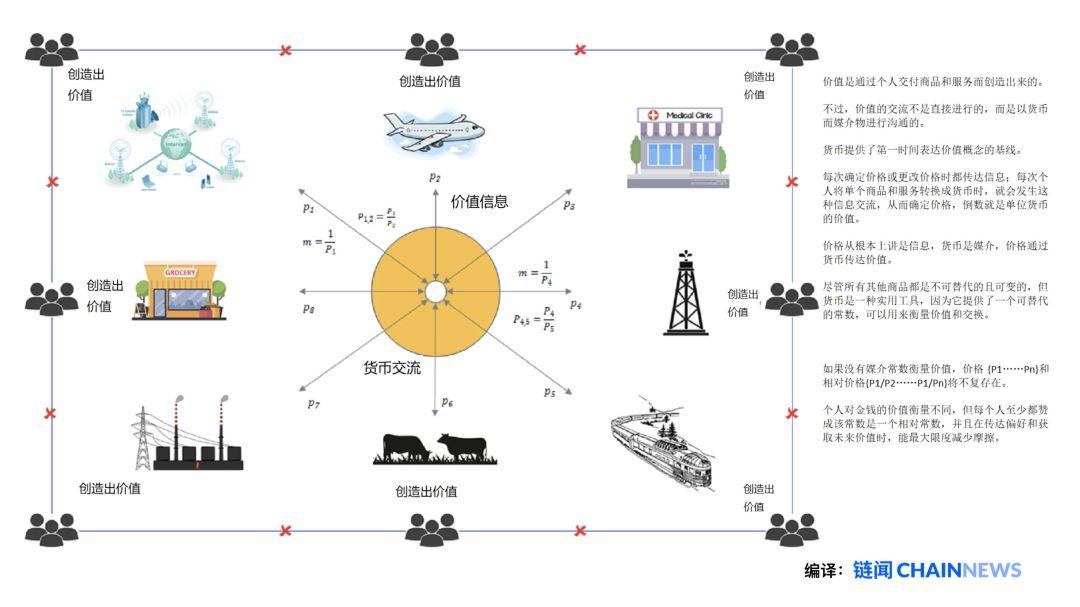
The value of all other goods and services lies in consumption, but the value of money lies in exchange. When you convert your value (the subjective output of your time, labor, and physical capital) into a monetary good, what you're buying is the benefit of future exchange. Everyone's consumption preferences are unique, yet money provides all market participants with one universal function: bridging the present and the future (whether a day, a week, a year, or longer). Every exchange of current value contains a temporal component, extending until the next future exchange. At the moment of trade, everyone must decide which currency best preserves the purchasing power of the value created today: A or B? While an individual might hold one or multiple currencies, efficiency increases dramatically if only one exists. Some currencies preserve future purchasing power better than others. Everyone intuitively grasps this and makes decisions based on the inherent characteristics that distinguish one currency from another. Although an individual's preference for a currency is influenced by others' preferences, each person independently evaluates the relative advantages across currencies. It's no coincidence that markets converge on a single medium—everyone is trying to solve the same problem of future exchange, and these preferences are interdependent.
The ultimate goal is a consensus that enables everyone to communicate and transact with the broadest, most relevant set of trading partners. Overall, this constitutes an objective assessment of tangible goods, grounded in intersubjective demand. The key is identifying an item universally accepted as suitable because it is: i) a relative constant, ii) measurable, and iii) usable in exchange. The existence of such a constant creates order where there was none before—but the constant must also serve simultaneously as both a measuring tool and a medium of exchange. These combined properties are typically described as scarcity, durability, fungibility, divisibility, and portability—properties uniquely satisfied by money. Few goods possess all these attributes; each is unique, and its inherent properties make it better or worse suited for certain economic functions. A is always different from B—and monetary goods that possess this full set of properties so perfectly are so rare that the differences between them are never trivial.
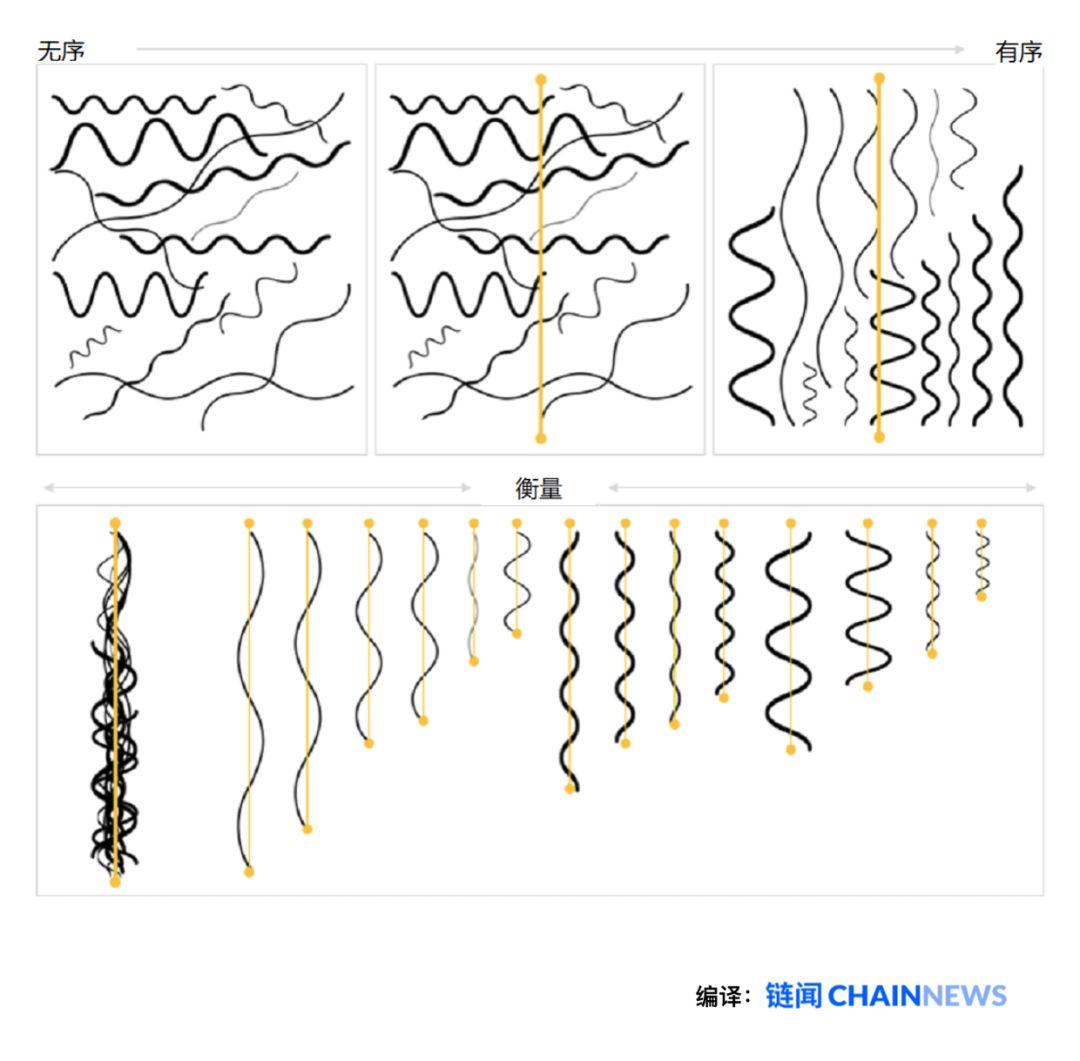
More practically, people agree to express value through a single monetary good because it serves both individual and collective interests. This is precisely the problem: how to communicate value to other market participants. Without consensus, the entire system grinds to a halt. Yet it is the monetary good's own properties that foster this convergence and consensus. The idea of a world with thousands of currencies completely ignores these foundational principles. Only massive convergence on a single medium yields the information actually required. As more and more people adopt a shared medium to facilitate exchange, that medium's value increases. The fundamental reason is that as more people converge on it, the medium accumulates more information—and its utility rises accordingly.
We can think of every person as a potential trading partner. When everyone adopts the same universal medium as the standard for value, all existing participants in the monetary network gain new trading partners—and joining the network confers the same benefits. Mutual advantage expands the range of choice.
As the monetary network expands, more goods are priced using this common medium of exchange. More goods prices mean more relative prices. Increasing information converges on this universal medium, enabling everyone within the network (and the network itself) to coordinate resources more effectively and respond to shifting preferences. As this universal medium conveys more information about more goods produced by more individuals, the constant becomes more valuable—and inherently more reliable. As more variable information flows through this universal medium, the constant itself becomes more stable.
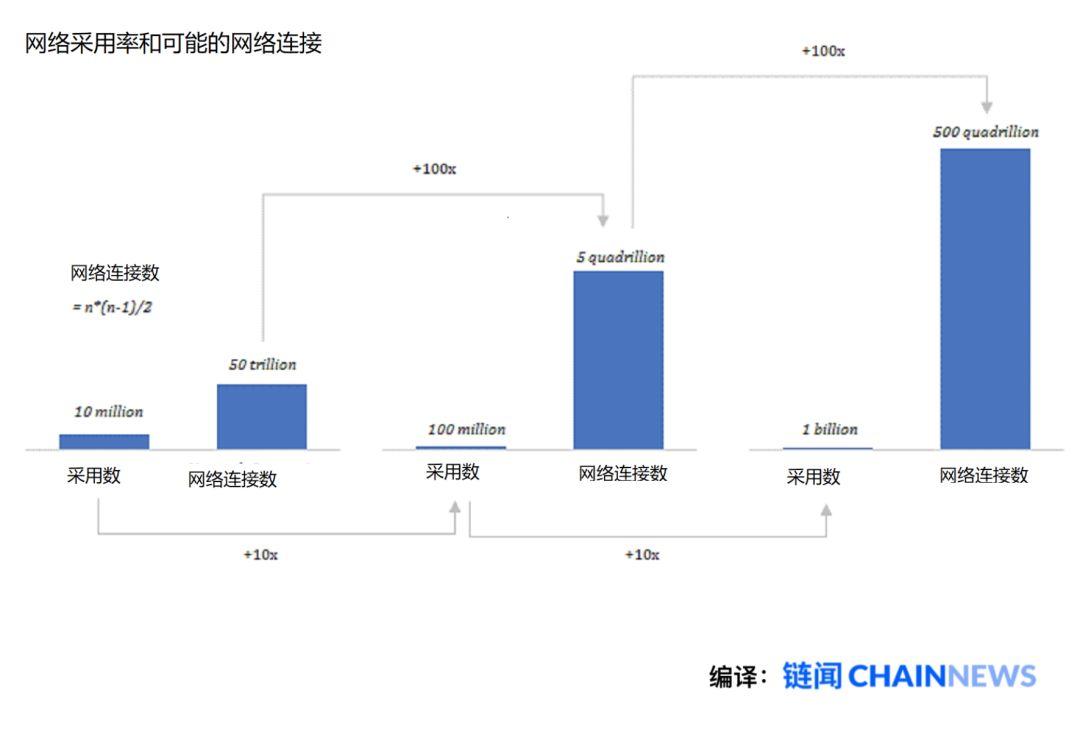
When adoption of a given monetary network increases by an order of magnitude (10x), the number of possible network connections may increase by two orders of magnitude (100x). This demonstrates not only the mutual benefit of adoption but also the consequences of converting value into a smaller monetary network. If the network size shrinks by one-tenth, its potential connections can fall to 1%. Network distributions aren't uniform—but a larger monetary network translates into a more reliable constant for conveying information: denser, more relevant information, and broader optionality. When individuals consider which medium to use, the monetary network's size—and expectations about its future growth—become critical factors in this intersubjective A/B test. While the number of people with whom one can maintain social relationships is inherently limited (the Dunbar number, commonly cited as ~150), monetary networks face no such constraint. It is money that enables humanity to transcend this limit. A monetary network allows millions (if not hundreds of millions) of strangers to contribute value at its endpoints—with minimal direct connections required.
Ultimately, the monetary network accumulates the value of all other networks—because without it, no other network effects could exist. Without a universal currency to coordinate economic inputs and initiate positive price feedback loops, complex networks cannot form. Any monetary network requires a universal currency as its foundation—only with it can other value networks emerge. It provides the common language for expressing value, ultimately enabling trade and specialization—and organically creating the capacity to allocate resources beyond the scope of "conscious control" (to borrow Hayek's term). When you aggregate the network effects across social networks, logistics networks, telecommunications networks, power grids, etc., their sum equals the value of the monetary network. A monetary network not only underpins the formation of all other value networks—its currency also serves as the key granting access to all derivative networks within it. That universal currency is both the engine and the fuel.
Yes, the U.S. dollar, euro, yen, pound sterling, franc, renminbi, ruble, lira, peso, and others coexist today—but this is not the natural outcome of an open, globalized economy. In fact, every fiat currency in existence today represents a fraction of gold; the world previously converged on gold as the monetary standard.
No fiat currency would exist without forceful government intervention—and no fiat currency would have emerged had gold not previously existed as the (sole) monetary medium. All fiat systems merely demonstrate gold's failure as a monetary medium—a point neither modern monetary theorists nor gold advocates will ever admit.
The fiat system is nothing more than a walking zombie. The gold standard was formally abandoned in 1971; since then, territorially-based fiat systems represent only a temporary deviation from the free-market forces governing money. Modern fiat systems persist only in a state of suspended animation—because the problems inherent to fiat itself remain unsolved. Bitcoin is precisely that solution. Since its creation, people have been converging on Bitcoin as a new monetary standard; this trend will continue as related knowledge spreads organically.
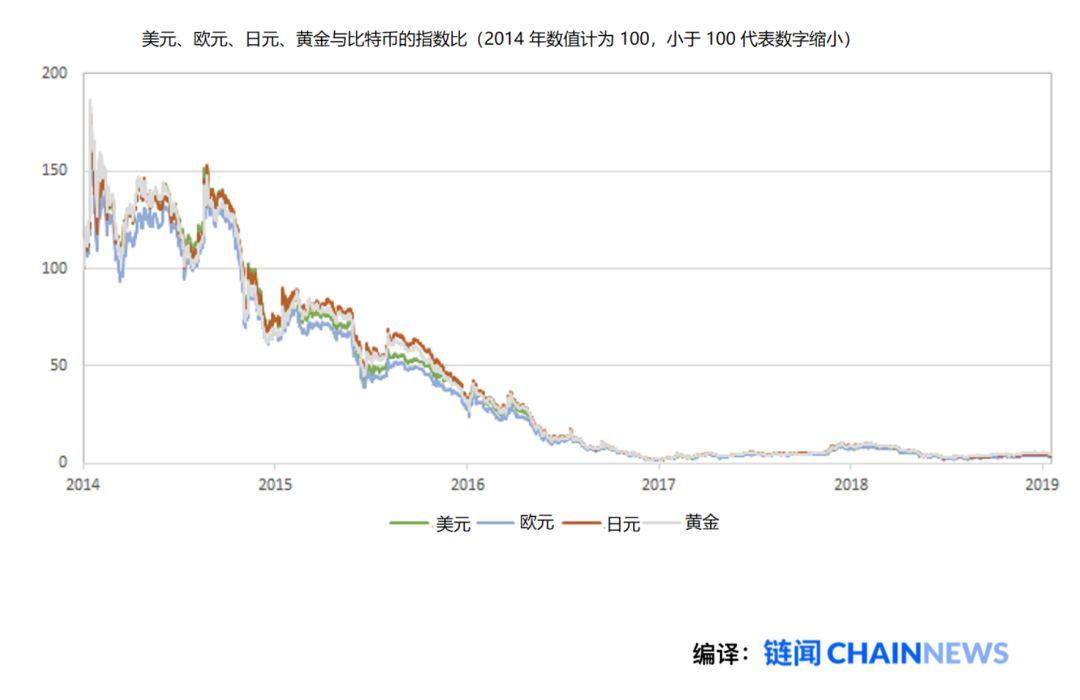
All Roads Lead to Bitcoin
The Ultimate Constant: Finite Scarcity
Markets are increasingly converging on Bitcoin, driving its value higher because it offers a superior constant compared to any other form of money. Bitcoin's monetary policy is optimal and reliably enforced in a decentralized manner. Its supply is permanently capped at 21 million BTC, and the entire system operates without requiring any trust.
This hard cap is maintained by network consensus in a decentralized way. No one needs to trust anyone else, yet everyone independently upholds this rule. By combining both functions, Bitcoin is becoming the scarcest monetary asset ever created. This finite scarcity is a property no other form of money has achieved—or ever will—and it is the fundamental driver of Bitcoin's demand.
But scarcity has two dimensions. While the fixed supply cap is the primary draw, it is demand that creates scarcity—a point often missed. Demand is what makes scarcity a practical constant in trade. Under the dual forces of rising demand and perfectly inelastic supply, Bitcoin grows increasingly scarce.
Scarcity from a fixed supply generates demand, and increasing demand intensifies scarcity. This sounds like an infinite loop—and it is. If there are 21 million BTC globally but only one person values them, Bitcoin would be neither scarce nor useful. But if 100 million people value Bitcoin, then 21 million starts to feel scarce. And if the network scales to 1 billion users, 21 million becomes extremely scarce—and Bitcoin, as a constant, gains far greater utility.
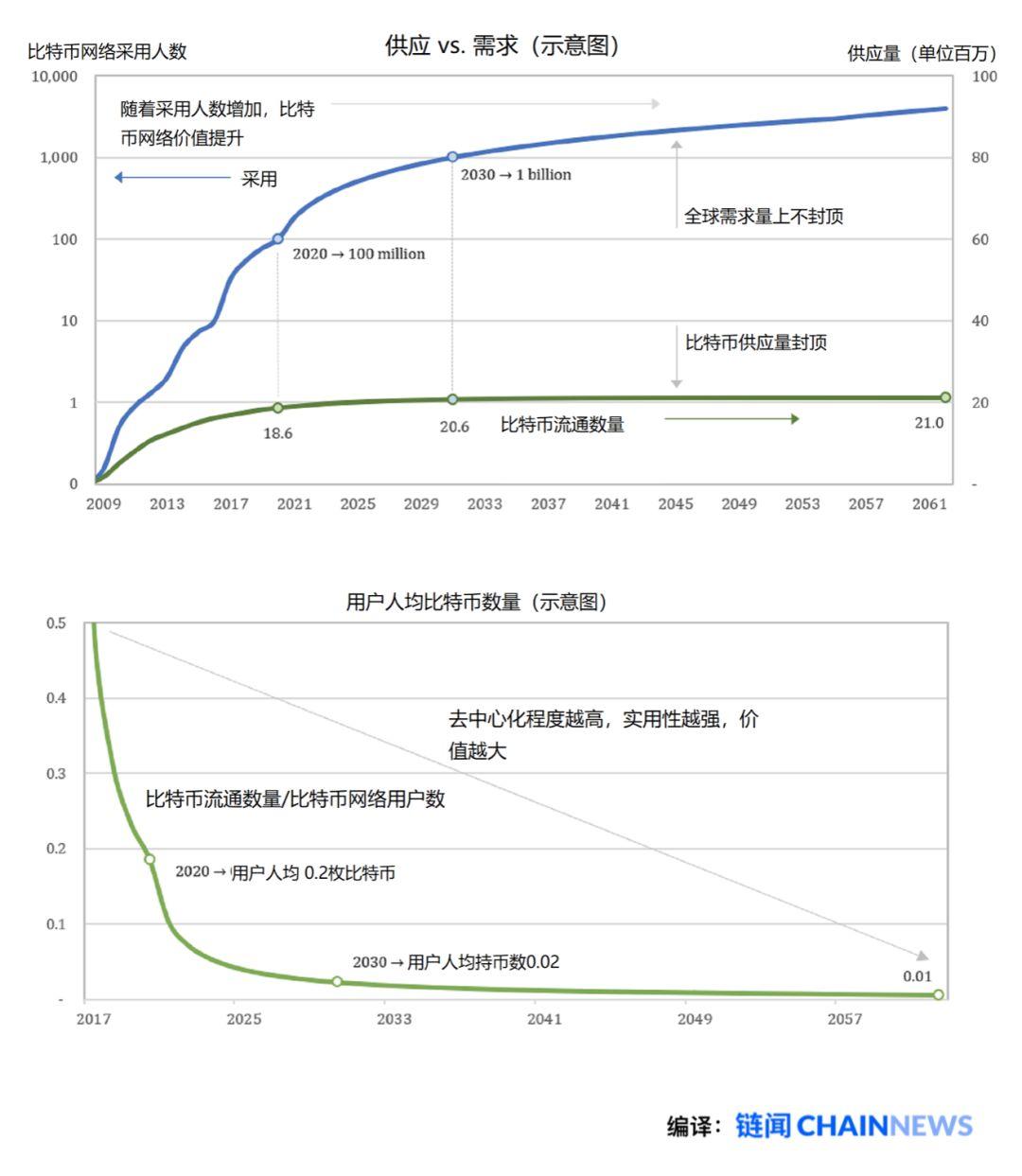
Due to its fixed supply, continuously rising demand naturally leads to more dispersed Bitcoin ownership. The number of BTC in circulation is finite; as more people hold BTC, the "pie" gets divided into ever-smaller slices. As more individuals recognize Bitcoin's value, the network not only becomes more useful—but also more secure. As more participants use this reliable constant to communicate value, the network's utility grows. And as more people participate in the network's consensus mechanism, the entire system becomes more resistant to corruption and more secure.
It's important to note that blockchains aren't inherently tied to a fixed supply, and Bitcoin's credible supply schedule doesn't stem from software alone. The credibility of the 21 million cap arises from decentralized governance and a growing number of network participants. The 21 million figure becomes more trustworthy as more participants join the consensus; as each participant controls a smaller share of the network, the cap evolves into a more reliable constant. As the user base grows, security and utility rise together. Below is a global distribution map and relative density of Bitcoin users (with a heatmap of network nodes below). As coverage and density expand across each market, Bitcoin's status as a constant strengthens.
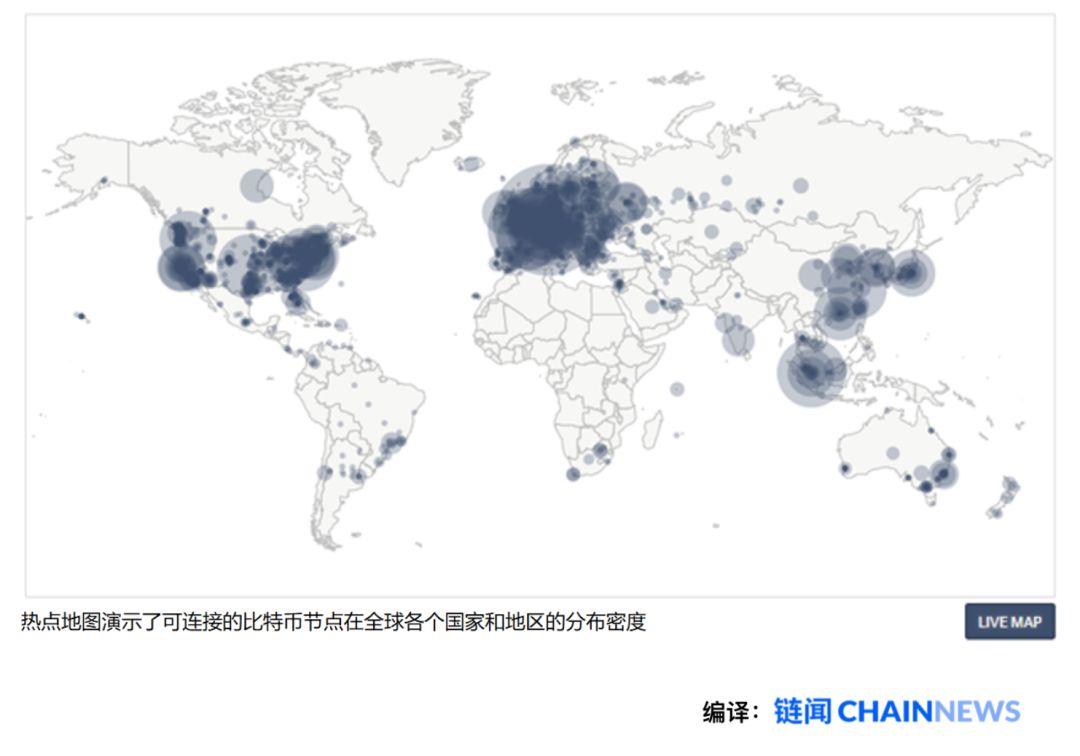
As more people join the Bitcoin network, the 21 million figure becomes increasingly credible. For Bitcoin users, finite scarcity represents Bitcoin's most fundamental distinction from all other forms of money (fiat currencies and competing cryptocurrencies). All other monies either become increasingly centralized over time (e.g., USD, EUR, JPY, gold), or were excessively centralized from the start (e.g., all other cryptocurrencies), making them incapable of competing with Bitcoin's hard cap. Centralization inevitably introduces reliance on trust—and ultimately, trust places any currency's supply at risk, weakening demand and marginalizing its utility as a medium of exchange.
While all other monies rely on trust, Bitcoin delivers a trustless constant. The credibility of the 21 million supply cap stems from Bitcoin's decentralized architecture—and over time, Bitcoin grows even more decentralized. Other monies can only aspire to emulate Bitcoin, but this is practically impossible because markets converge on a single medium—and Bitcoin holds the first-mover advantage. All other monies ultimately compete against a perfect constant—one that never changes and requires no trust.
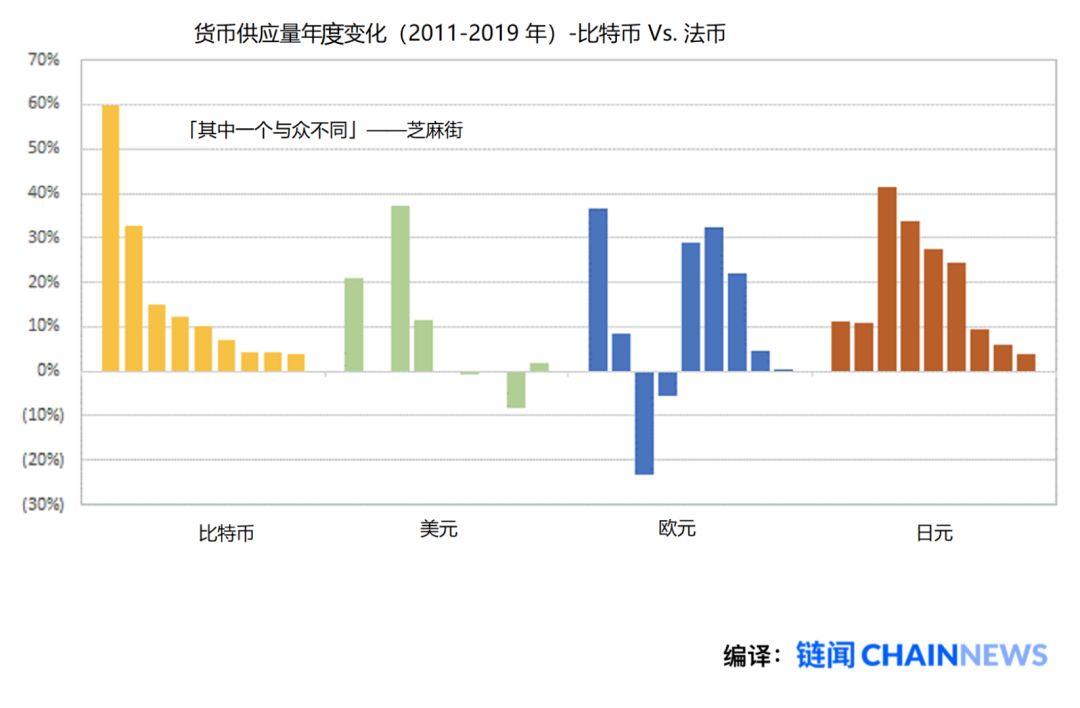
Every transaction involves competition among various forms of money. If an asset's primary (or sole) function is to be exchanged for goods and services—and it doesn't generate income like productive assets (e.g., stocks or bonds)—it must compete as a monetary instrument. Consequently, any such asset competes directly with Bitcoin in identical use cases—and no currency can offer a more reliable constant, given Bitcoin's existence and finite supply.
Because markets converge on a single medium, Bitcoin's scarcity is reinforced on both the supply and demand sides. Meanwhile, due to the reflexivity of monetary competition, all other currencies face opposing forces. The differences between two monetary commodities are significant—and individual decisions to use one medium over another have real consequences. Money is an intersubjective phenomenon: choosing one monetary medium explicitly rejects others, causing one network to gain value (and utility) at the expense of another. As Bitcoin grows scarcer and its status as a constant stabilizes, other currencies become less scarce—and more volatile.
Monetary competition is a zero-sum game. Relative scarcity, supply-and-demand dynamics, and other factors constitute the fundamental distinctions between two monetary media—and these differences only widen and become more pronounced over time.
But remember: scarcity for its own sake isn't the goal of any currency. Rather, the currency that delivers the greatest constant most effectively facilitates exchange. The scarcest monetary commodity best preserves value from present to future transactions. Relative prices and values of all other goods represent the information people seek from money's coordinating function—and in every transaction, each party has an incentive to maximize value from today into the future. Bitcoin's finite scarcity provides the strongest guarantee for preserving current transactional value into the future. As more people recognize Bitcoin as the most relatively scarce monetary commodity, its price stability emerges as an inherent feature.
The Best Measuring Tool: Divisibility
While scarcity is foundational, not all scarce goods serve as money. To convey value effectively, a monetary commodity must be relatively stable, easily measurable, and functional for transactions. A ruler may be an effective measuring tool—but it is neither scarce nor easily divisible into larger or smaller units for trade. In commerce, a scarce and measurable monetary commodity serves to measure all other goods; monetary units that are easily subdivided and transferred possess real-world utility in transactions.
Bitcoin combines finite scarcity with divisibility down to eight decimal places (0.00000001, or one hundred-millionth of a BTC), enabling the transmission of any value amount. Within the broader context of money, scarcity or divisibility alone isn't necessarily valuable. But when combined—especially when each subdivision is fungible (i.e., each unit is interchangeable and indistinguishable from any other)—these properties make Bitcoin not only a perfect constant but also an effective tool for measuring value and enabling transactions.
In code, one BTC is represented as 100,000,000 sub-units—the smallest unit being 1 satoshi (or "sat"). Technically, 1 BTC equals 100,000,000 sats. With the current BTC price around $9,000, 1 sat is worth approximately one-twentieth of a cent. Essentially, anyone can convert any amount of value into Bitcoin. Bitcoin—like any currency—aims to store value across a series of transactions.
Today, you earn BTC for the value you create, save it, and later spend it to acquire value from others. Money serves the same essential function, regardless of the amount. Because BTC is divisible, it can measure any value and support any level of adoption. People create value across a vast spectrum, and divisibility ensures everyone can use BTC as a savings tool—whether storing $50 or $50,000. An effective medium of exchange must be capable of measuring the full range of human production, and BTC fulfills this role perfectly. It can be divided and transferred in arbitrarily small or large amounts, making it universally usable for any good or service.
In a monetary A/B test, if A > B, then any quantity of A will perform the monetary function better than any quantity of B. Over time, whether you hold $50 or $50,000 worth, A's purchasing power relative to B will increase. Don't be misled by tokens on Coinbase that appear "cheap" while BTC seems "expensive." Remember: BTC can be subdivided into smaller or larger units to store any amount of value.
One BTC is a subjectively defined unit, just like a unit of any currency. What the market tests is whether A or B exhibits superior monetary properties. This is an intersubjective decision: network value is the output, not the input, as markets signal which network best performs the monetary function through price. The inputs are individuals' assessments of each currency's attributes. If, in your view, BTC is A, then there is no such thing as "too expensive." BTC may be overvalued or undervalued at any moment, but each new adopter increases the network's value (recall the earlier point about trading partners and network connections).
BTC's high divisibility allows a nearly infinite number of individuals to transact and transfer value across its network. If A outperforms B and A supports unlimited adoption, demand for network B will ultimately vanish.
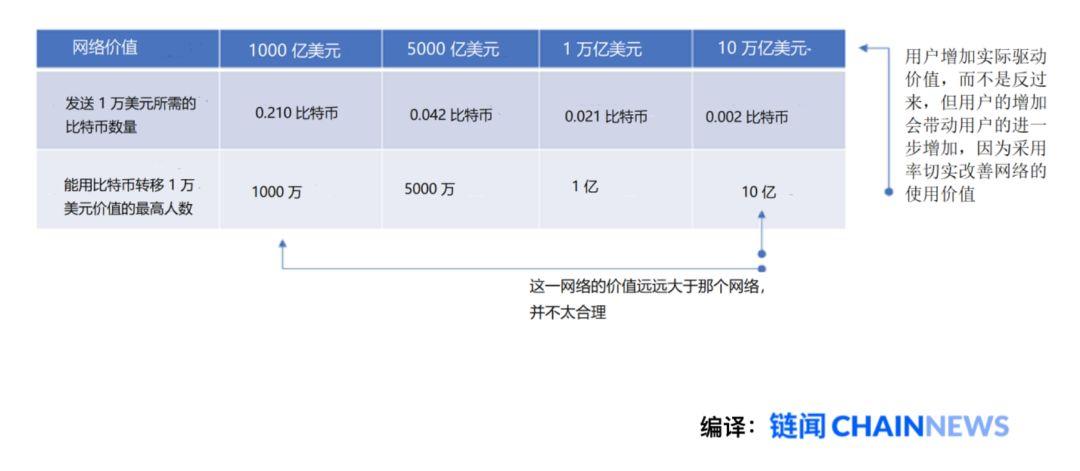
As individuals independently evaluate this A/B test, more people will adopt BTC, and BTC will, on average, be subdivided into increasingly smaller units. This is the result of rising demand against a fixed supply, a process that increases the network's value. As more people recognize BTC's value, the network itself becomes more valuable. Fundamentally, 0.1 BTC worth $1,000 is more valuable than 1.0 BTC worth $1,000, even though their dollar value is identical. A higher total BTC value enables more transactions and trade, but that value arises precisely because more people choose BTC as their medium of exchange. Each person holds progressively smaller nominal BTC units, yet each unit gains purchasing power over time. In every transaction, participants transmit their own value onto the network—at the direct expense of competing networks. Through this process, a new price emerges for the value each individual creates and measures, allowing BTC to accumulate richer information from a broader set of trading partners.
Although goods and services may not yet be priced directly in BTC, each time someone converts value into BTC, a pricing system gradually forms. Even when using USD as an intermediary, the value produced by an individual somewhere in the world gets expressed in BTC units. As more people do this, that value converges, on average, into ever-smaller BTC units. Consequently, progressively smaller nominal BTC units can be used by more people to transfer equivalent value. As BTC becomes a more widely adopted unit of account, its ability to measure relative value only strengthens.
Because BTC can measure all value and support unlimited adoption, it renders all other value-transfer networks unnecessary in the long run. The monetary form with the lowest rate of change ultimately conveys the most perfect information. Finite scarcity combined with divisibility creates an exceptionally powerful medium of exchange. Moreover, due to its absolute scarcity, BTC has the lowest ultimate rate of change. It can be subdivided into fractions far smaller than one cent, enabling more precise value measurement than any other currency.
The Ultimate Transaction Tool: Transferability
With this foundation, the decisive advantage becomes clear: BTC can be transferred irreversibly over a communications channel without any trusted third-party intermediary. This stands in stark contrast to digital fiat payments, which depend entirely on trusted intermediaries.
Overall, BTC is a constant superior to all other monetary forms—highly divisible, measurable, and transferable over the internet. Can you name another asset that combines all these properties: finite scarcity (the ultimate constant), divisibility and fungibility (a measurement tool), and the ability to be sent over a communications channel (ease of transfer)? This is the challenge facing all other monetary commodities in the race to become the dominant global currency.
The only way to truly grasp this rare competition is through firsthand experience. Anyone can run a BTC node on a home computer to access the network permissionlessly. From anywhere in the world, you can open a computer and transfer a finitely scarce resource to anyone else without permission or reliance on a trusted third party. This grants individuals extraordinary power. Hundreds of millions can collectively achieve this without trusting any other participant—an outcome so unprecedented it defies full comprehension.
BTC is often called digital gold, but this analogy is flawed. BTC combines the advantages of physical gold and digital USD while avoiding their limitations. Gold is scarce but hard to divide and transfer; USD transfers easily but lacks scarcity. BTC is finitely scarce, highly divisible, and easily transferable. Unlike gold and all fiat systems—which rely on trust—BTC is trustless. It optimizes the strengths and weaknesses of these systems, which is why markets have been, and will continue to, converge on BTC for monetary functions.
Bitcoin Will Displace All Other Currencies
Anyone who accepts these three core conclusions—i) money is a fundamental necessity, ii) money is not a collective hallucination, iii) economic systems converge on a single medium—will consciously seek the optimal monetary form. It must store future value and enable individuals to convert their time and skills into an array of choices unimaginable to prior generations. Ultimately, a reliable monetary form delivers freedom: the freedom to pursue personal interests (specialization) and the freedom to exchange the value you create for value created by others (trade).
Whether people consciously ask themselves these questions or not, they will answer them through action—arriving at the same conclusion as those who do. Conscious and subconscious actors reach identical conclusions because fundamental truths remain unchanged. Money's function is singular: to serve as a medium for present and future transactions, providing a baseline for communicating subjective value across populations, from which participants benefit through trade and specialization. Money is a necessity. Certain identifiable properties determine how well an asset fulfills the transactional function, and transactions are, at their core, an intersubjective problem.
Owning BTC is becoming the entry cost to participate in the largest, most diverse economy humanity has ever known. BTC is global and accessible without permission. As the common language for all participants, network users can communicate and transact with one another. The more trading partners exist, the greater the value each unit of currency provides to every holder. While jurisdictional friction may occasionally impede transactions, using a shared universal currency eliminates the root cause of friction in value communication. BTC's capped supply ensures its pricing mechanism accumulates and transmits more complete information with minimal distortion. As more people choose to store value in BTC, its capped supply becomes more credible, and its pricing mechanism grows more reliable and meaningful. A new user of the monetary network both contributes value and captures value through adoption—which is why it's never too late to enter BTC, and why BTC is never too expensive.
BTC's complexity is not the point. Ultimately, it boils down to an A/B test. The demand for sound money is real, and individuals across society will converge on the monetary form that best fulfills the exchange function. No currency is scarcer than BTC; scarcity acts like gravity, driving user growth and value transmission. Today, most billionaires don't understand BTC. It is an equal-opportunity intellectual challenge, but even those who don't understand it will ultimately rely on it.
Fundamental questions surround BTC: its price volatility, apparent slowness, scaling challenges, infrequent use in payments, energy-intensive mining, and more. Stability will follow mass adoption; all other known limitations will be resolved. Finite scarcity—combined with measurability, divisibility, and transferability—creates a function of value. That is BTC's innovation.
Currency A has a capped supply. Currency B does not. Currency A's value relative to Currency B continues to rise, and its purchasing power for goods and services increases, while Currency B's purchasing power declines. Which would you prefer? A or B? Choose wisely—your opportunity cost is your time and value. Many reasons explain why people choose A over B, but what truly matters is basic common sense and survival instinct. BTC will displace all other currencies because economic systems converge on a single currency, and BTC possesses the most credible monetary properties.
I believe we will not have a sound money until we take the right to coin money away from governments—and I mean, we cannot seize it from governments by force; all we can do is introduce something new that governments cannot prevent, through some clever, circuitous means.
Economist Friedrich Hayek
This article reflects my personal views and is not affiliated with Unchained Capital or my colleagues.