

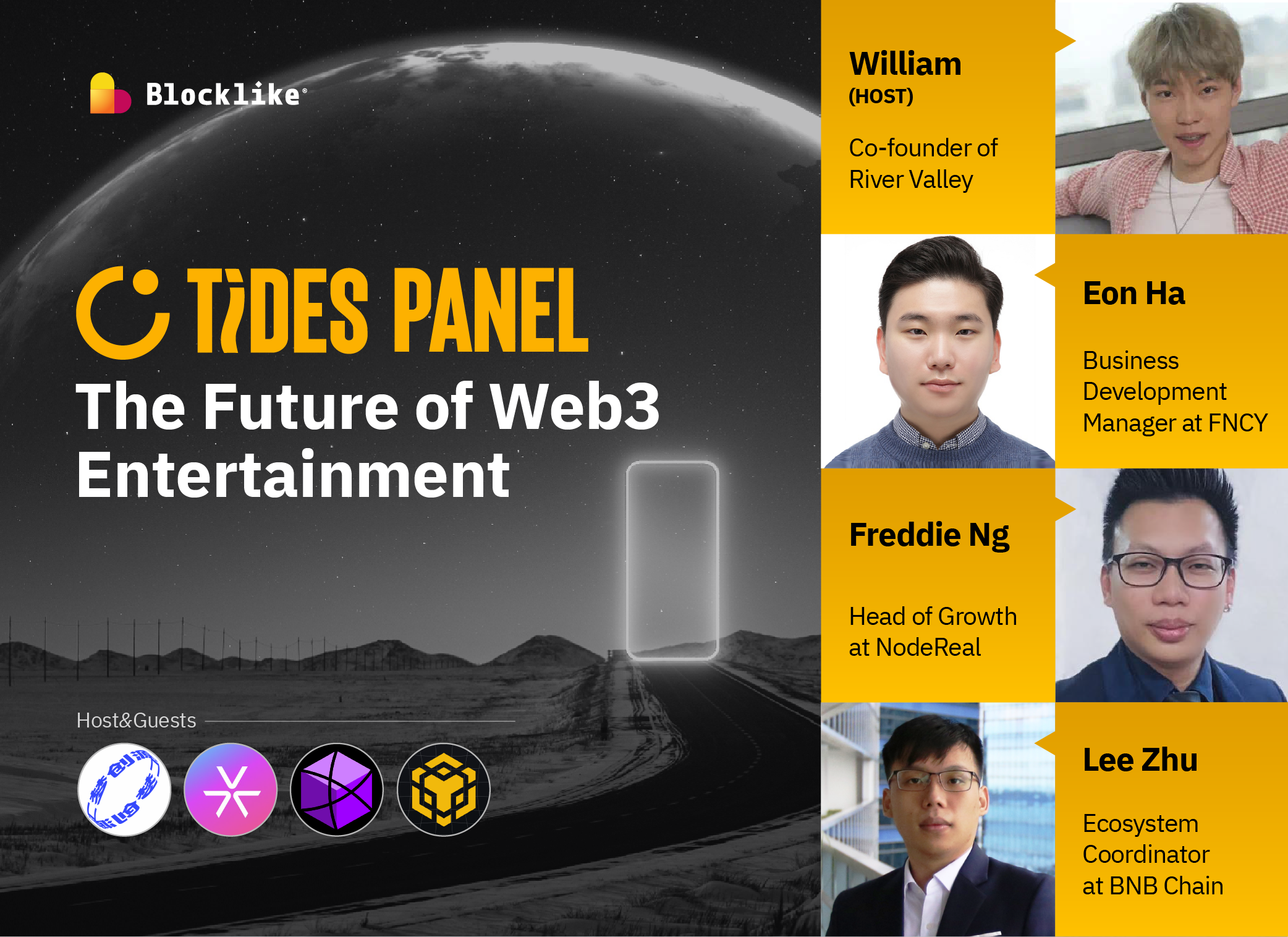
On January 6 at 12:00 PM, Blocklike hosted a "Blocklike Roundtable" on Binance Live titled "The Future of Web3 Entertainment," drawing over 30,000 viewers. Moderated by William, the panel featured three industry leaders: representatives from the Web3 entertainment platform FNCY, Web3 infrastructure provider NodeReal, and BNB Chain.
The speakers shared updates on their projects' current progress and future plans. From the perspectives of Web3 builders and participants, they dove deep into key questions: How is Web3 reshaping the entertainment industry and user habits? What defines Web3 entertainment products, and what's their current state? And crucially, how can Web3 overcome barriers to attract more users from Web2?
FNCY is a Web3 entertainment platform built on its own native mainnet. It offers diverse content—including games, web novels, and comics—with a mission to seamlessly integrate blockchain into daily life. The platform is designed for everyone, requiring no technical expertise to enjoy its services.
NodeReal is a one-stop Web3 infrastructure and solutions provider focused on delivering high-performance services to enable mass adoption. It currently supports eight major blockchain ecosystems, including BNB Chain, Ethereum, Aptos, Polygon, and Optimism, serving over 10,000 developers globally via its API. Its enterprise-grade solution, Semita, offers scalable, customizable, end-to-end services tailored for large applications—particularly GameFi, DeFi, and Web2 game studios transitioning to Web3. FNCY is a prime example: NodeReal provided comprehensive support across chain design, deployment, and ongoing maintenance.
BNB Chain is a community-driven, decentralized, and censorship-resistant blockchain ecosystem composed of the BNB Beacon Chain and BNB Smart Chain. Fully EVM-compatible, it fosters a multi-chain environment and ranks as the world's largest smart contract blockchain by both transaction volume and daily active users.
The Accelerating Convergence of Web3 and Entertainment
The internet's birth revolutionized industries like film, music, and gaming. Now, the evolution of Web3 is set to propel entertainment to the next level. We're seeing a growing number of Web3 applications and products emerge, each reshaping how people experience entertainment.
Eon Ha, Business Development Manager at FNCY, noted that the shift from Web1 to Web2 was like moving from a one-way street to a two-way street, while Web3 represents a highway—a highway of ownership, immersive social experiences, and value creation. Web3 allows user-generated content to be recorded on the blockchain with security and transparency. Socially, it dramatically enhances immersion and connectivity, while empowering more users to monetize their creations—a process known as value capitalization. Using Netflix as an example, Eon Ha explained that a Web3-native version would let users truly own content, watch films and shows with friends in the metaverse, and even introduce "watch-to-earn" incentive models.
Freddie Ng, Head of Growth at NodeReal echoed Eon Ha's view, adding that Web3 fundamentally reshapes user incentives compared to the traditional model. For example, NFT ownership grants holders exclusive rights—a powerful driver for Web3 adoption and its ability to attract large audiences. Freddie also emphasized that Web3 empowers creators not just to own their content, but to monetize it directly.
Lee Zhu, Ecosystem Coordinator at BNB Chain described Web3's core as reading, writing, and executing—with execution giving users direct control over assets, enabling trustless interactions. On entertainment, he pointed to gaming: the 2021 boom in Play-to-Earn (P2E) games showed how value stems from player-owned assets. Unlike traditional games, he noted, shutting down a Web3 game doesn't destroy user assets; players can relaunch the game or build new experiences with the same assets—a transformative shift for the industry.
Acquiring Users and Capturing Market Share
With countless Web3 products launching daily, how should markets and users decide? What standards must Web3 platforms—especially in entertainment—meet?
Eon shared his platform's approach, stressing that a strong Web3 entertainment platform must offer a seamless experience with simple operations—so even users new to blockchain can easily access and enjoy it. As a service provider and builder, FNCY also prioritizes community education. Eon confirmed that FNCY will keep exploring diverse educational methods and commit to genuine transparency with its users.
Freddie offered a technical perspective from a blockchain infrastructure provider. Beyond seamless experiences and reliable service, he emphasized that Web3 applications require rigorous testing as a baseline. Gas fees also remain a critical challenge that platforms and infrastructure providers must address.
As a tech company, NodeReal aims to enhance Web3 gaming infrastructure for mass adoption. With FNCY, NodeReal has collaborated since the project's start—customizing tokenomics and gas mechanisms, and building blockchain explorers, cross-chain bridges, and APIs. More details are in NodeReal's enterprise solution, Semita. Ultimately, NodeReal seeks to empower large-scale blockchain applications—from GameFi and DeFi to traditional game studios—through high-performance infrastructure and scalable solutions like "Application Chain," delivering revolutionary user experiences.
Lee Zhu focused on user experience. He noted crypto's steep learning curve—users face many technical terms but often lack time or interest to delve deeper. Using StepN as an example, he pointed out that many users don't even realize it's a blockchain app; its interface and flow feel like any Web2 app, letting users engage without understanding the underlying tech—effectively introducing blockchain "by stealth." Lee believes the main challenge for Web3 entertainment platforms and DApp builders is eliminating user friction.
Opportunities and Challenges Coexist
While brands and enterprises increasingly adopt Web3 and attract new users, significant barriers still keep many Web2 users from entering Web3 ecosystems.
Freddie identified scalability as a key bottleneck for mass Web3 adoption. Current foundational tech—especially public blockchains—still can't reliably support large-scale transactions. That's why NodeReal is implementing solutions like Application Chain and ZK Rollups. Freddie also stressed that Web3 providers must balance usability and security. With infrastructure like MPC wallets emerging, the Web3 market is poised for growth—and widespread adoption will follow.
Lee Zhu echoed this view. He stressed the need for robust infrastructure and the importance of clearly communicating blockchain's core concepts—like decentralization and transparency—so people can truly grasp its value. Eon added a user-centric perspective, noting that the industry constantly introduces new complexities. Even experienced users face hurdles, which is why service providers must prioritize simplicity in their products and content. Ultimately, projects need to deliver seamless user experiences.
On the current state of blockchain, all three panelists agreed the industry is still in its infancy. As it matures, education will be crucial. Every player—from public chains and infrastructure providers to solution builders and other Web3 projects—has a role in improving UX, simplifying processes, and lowering barriers to entry. Only through sustained innovation and effort can the industry achieve mass adoption.
Regarding future plans, Eon shared that FNCY is in talks with several brands and projects. They are actively developing a membership rewards ecosystem and a blockchain platform for user-generated web novels and comics. Metaverse content is a key priority on their roadmap. Going forward, FNCY aims to aggregate more entertainment content and offer users diversified services.
Freddie stated that NodeReal will continue providing blockchain solutions to more projects, empowering global developers to BUIDL more efficiently. They also plan to deepen collaborations with Web2 enterprises, offering tailored solutions and best practices for their transition to Web3. Additionally, NodeReal is expanding into decentralized storage to enhance security, scalability, and performance for developers.
Lee Zhu explained that BNB Chain, as an ecosystem, is pushing forward with technical R&D while exploring new blockchain concepts. On the business side, they are in discussions with multiple partners to forge new collaborations. For ecosystem growth, BNB Chain is committed to supporting more projects to help them scale and find product-market fit.
We live in an era of rapid technological advancement, where countless fields are being reshaped by emerging tech. As Web3 accelerates, traditional sectors like entertainment—a core part of daily life—are entering new phases of development. Web3 is transforming the entertainment landscape. While the industry is young and faces challenges, the panelists reaffirmed their commitment to leveraging blockchain technology. Through persistent effort, they aim to realize Web3's promise of a more open, decentralized, and secure future, driving the maturity of both products and the industry at large.