

For years, monolithic blockchains have been the industry standard since the dawn of cryptocurrency. But that's changing fast. In 2023, propelled by Ethereum's successful Merge and the explosive growth of the Layer 2 Rollup ecosystem, the entire Ethereum system began shifting toward a modular architecture.
Modularity means splitting core blockchain functions—like consensus, execution, data availability (DA), and settlement—across separate, specialized chains instead of bundling them all into one. A Rollup, for instance, is a blockchain that posts its transaction data to another chain, inheriting that chain's security and data availability. For a deeper dive into the technical principles, check out our articles: “A Comprehensive Guide to Modular Public Chains and Their Competitive Landscape” and “Amber Group: Why Modular Blockchains Are the Future?”
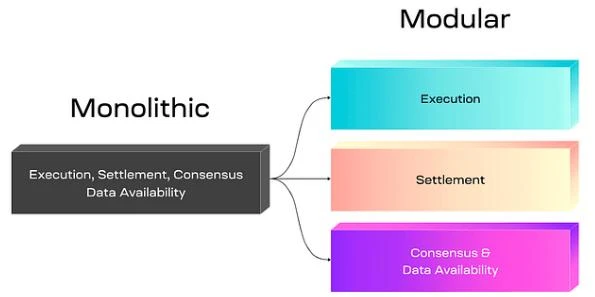
The appeal of modular blockchains lies in their scalability, flexibility, and developer-friendly nature for building applications. They are poised to become the next-generation infrastructure, playing a pivotal role in driving broader blockchain adoption and technological advancement.
The space gained significant momentum after Celestia launched its Modular Fellows research program on August 10, 2022. This initiative catalyzed a wave of new projects like Eclipse, AltLayer, Sovereign, and Dymension, which have since attracted strong investor interest and recently closed fresh funding rounds.
Other notable modular projects, categorized by use case, include ZKCross (focused on zkWASM), Astria (a modular network with a shared decentralized sequencer), and Rooch Network (a Move-based modular execution layer). This article outlines the key features and latest developments across these emerging modular blockchains.
Eclipse
Eclipse is a customizable Rollup provider that works with multiple Layer 1 blockchains. It lets developers deploy their own Solana Virtual Machine (SVM) rollups, using any chain for security or data storage.
In August 2022, Eclipse raised a $6 million Pre-Seed round led by Polychain Capital, with participation from Polygon Ventures and Accel. Just a month later, it secured $9 million in seed funding led by Tribe Capital, joined by Infinity Ventures Crypto and CoinList.
Notable deployments on Eclipse include:
Cascade: Launched by Injective on March 30, this integration brings the Solana Sealevel Virtual Machine (SVM) to the Cosmos ecosystem. It allows Solana developers to quickly port their smart contracts and dApps to Injective. Cascade is currently live on the Injective testnet.
Nautilus Chain: This chain combines Solana's speed with Ethereum's decentralization and security, supporting parallel transaction processing. It evolved from Zebec Chain and launched its testnet on March 16.
Polygon SVM: A custom Rollup that brings Solana's SVM into the Polygon ecosystem, giving developers on Polygon another virtual machine option.
AltLayer
AltLayer is a scalable, application-specific execution layer system that derives security from underlying L1/L2 chains. Designed as a modular, pluggable framework for multi-chain and multi-VM environments, its core innovation is a system of disposable, optimistic-rollup-like execution layers called "Flash Layers." These are designed for one-time use, maximizing resource efficiency.
On July 1, 2022, AltLayer raised $7.2 million in seed funding co-led by Polychain Capital and Jump Crypto, with participation from Balaji Srinivasan, Gavin Wood, and Ryan Selkis. Co-founder Jia Yaoqi and Chief Product Officer Tan Jun Hao, both National University of Singapore graduates, were previously co-founders of Zilliqa. AltLayer is now part of Binance Labs' sixth MVB Accelerator cohort.
On April 13, AltLayer opened free trials of its no-code Rollup Launchpad, allowing anyone to deploy their own Layer 2 network. The Launchpad also integrates an AI tool called FlashGPT to help developers build Solidity smart contracts faster.
Sovereign
Sovereign is building an ecosystem of interoperable, scalable rollups that can run on any blockchain. Its SDK provides all the standard blockchain components—peer-to-peer networking, databases, and RPC nodes—so developers can focus solely on their application's business logic.
On January 30, 2023, Sovereign raised $7.39 million in seed funding led by Haun Ventures, with participation from Maven 11, 1kx, Robot Ventures, and Balaji Srinivasan. Co-founder and CEO Cem Özer previously worked on the Ethereum Teku development team, leading the productionization of the Ethereum 2.0 Beacon Chain client.
Sovereign's key differentiator is its sovereign zk-rollup design, and its SDK is built for easy integration with various DA layers. While it hasn't yet integrated with a specific zkVM, Sovereign launched its account module on Celestia's testnet on March 24 to simplify rollup state management for developers.
Dymension
Dymension is a modular settlement-layer platform providing the essential tools and infrastructure for rollups in the Cosmos ecosystem. It introduces a new scaling paradigm with its "RollApps" framework, enabling online communities and applications to operate as decentralized, autonomous, and cryptographically secure economies.
On February 9, 2023, Dymension raised $6.7 million in seed funding co-led by Big Brain Holdings and Stratos, with participation from MatchboxDAO and Shalom Meckenzie.
According to The Block, Dymension's co-founder and CEO Yishay Harel stated that an incentivized testnet is slated for Q2 2023, followed by a mainnet launch in Q3. The project also plans to raise approximately $20 million ahead of the mainnet launch.
Astria
Astria is building a modular blockchain that allows rollups to share a decentralized sequencer network. Its mission is to enable anyone to deploy censorship-resistant rollups without relying on centralized sequencers.
On April 4, 2023, Astria raised $5.5 million in seed funding led by Maven 11, with participation from 1kx, Figment Capital, Delphi Digital, and Lemniscap. Co-founder and CEO Josh Bowen was previously a software engineer at Celestia.
Astria EVM uses its shared sequencer network for fast, censorship-resistant transaction ordering and leverages Celestia for data availability. The project aims to position Astria EVM as a liquidity and bridging hub for Celestia, helping to bootstrap its rollup ecosystem.
Rollkit
Rollkit is a modular rollup framework that gives developers the freedom to deploy rollups across the entire modular stack, including sovereign and settlement rollups. Originally developed by Celestia Labs in 2021, it has since spun off into an independent project.
To help guide its development, Rollkit will begin hosting developer calls in April. For now, developers can start building with Rollkit on Celestia's Mocha testnet.
Caldera
Caldera specializes in building high-performance, customizable, application-specific Layer 2 blockchains. Its platform allows anyone to launch and operate their own dedicated, high-performance rollup.
On April 4, 2023, Caldera raised $9 million in a funding round led by Sequoia Capital and Dragonfly, with participation from 1kx, Alliance DAO, SevenX Ventures, and others. Co-founder Matt Katz is a Stanford graduate who previously held software development internships at Skiff, Fractal, and Warp.
Caldera launched its testnet on Goerli and Polygon Mumbai on March 31. The team clarified that this testnet is purely for demonstrating the functionality of Caldera chains and is not an incentivized testnet. It is for demonstration purposes only and may be reset at any time.
Rooch Network
Rooch is a Move execution layer that connects multiple blockchains to Web3. It provides scalability for public chains and delivers a Move execution environment and settlement protocol for Web3 applications. Its core team members hail from the Starcoin project.
Rooch's engineering team has already built OMO, a general-purpose simulator featuring step-by-step proofs capable of arbitrating interactive fraud proofs on any Layer 1. The project also lists Celestia, EigenLayer, and Polygon Avail as potential data availability layers.
ZKCross
ZKCross is a multichain zkRollup execution layer powered by zkWASM. By decoupling the execution and settlement layers, it provides a trusted, universal multichain execution layer for all blockchains, secured end-to-end by ZKP protocols. Developers can also use ZKCross to rapidly build and deploy native multichain products.
According to Rootdata, ZKCross has received investment from IOSG Ventures and Cogitent Ventures. It has also been selected for Binance Labs' Season 6 MVB Accelerator program.