

We recently discussed a topic on Space: Will Hong Kong’s Securities and Futures Commission (SFC) follow the aggressive approach of the U.S. Securities and Exchange Commission (SEC) in defining securities—and then regulating, investigating, and fining accordingly? The answer lies not just in what regulators say (their stated missions), but more importantly, in what they actually do. A straightforward way to understand this is to examine the operational mandates and personnel structures of both the SEC and the SFC.
U.S. Securities and Exchange Commission (SEC)
First, let's look at the SEC's structure. At the top is the Commission, consisting of the Chair and four Commissioners. Beneath this are six Divisions, the Office of the Inspector General, and eleven Offices. The agency also operates eleven regional offices, which report to both the Division of Enforcement and the Division of Examinations.
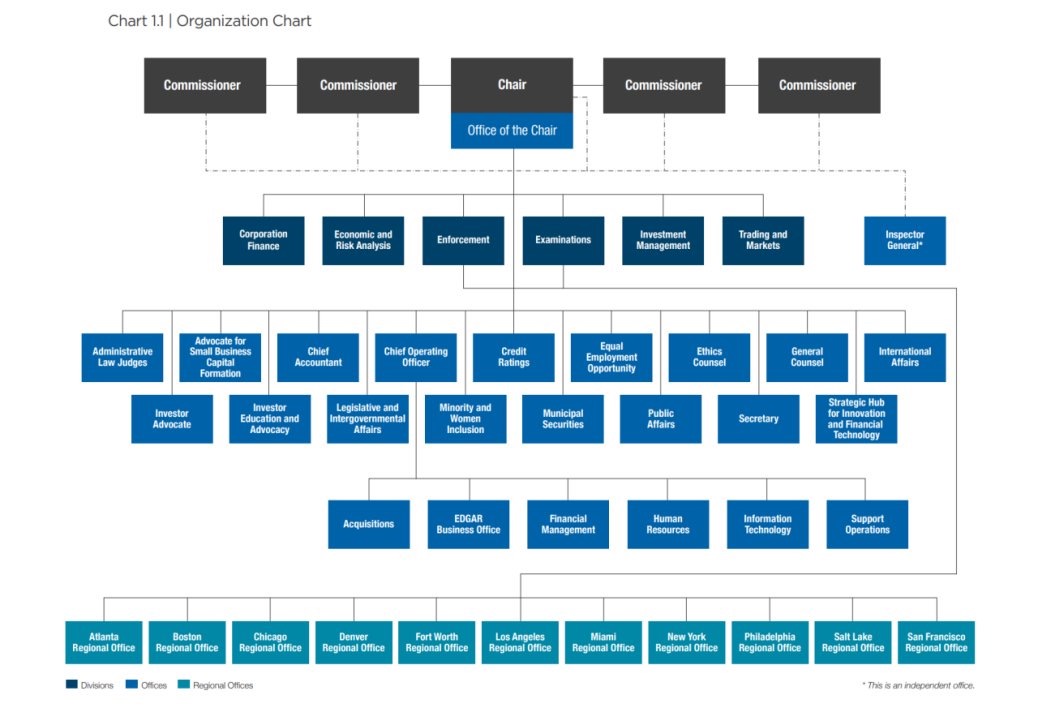
The organizational chart alone makes it clear that the Division of Enforcement and the Division of Examinations are the agency's most critical units. This is confirmed in the SEC's own descriptions, where Enforcement and Examinations are listed as the top two priorities.
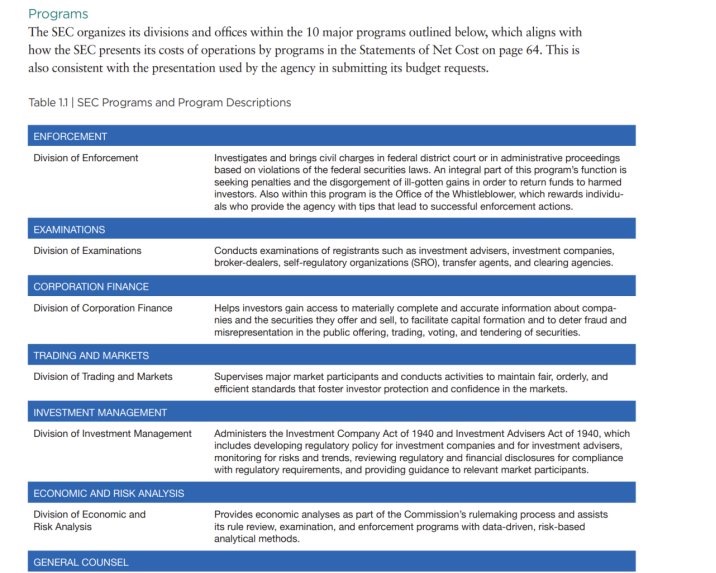
The financial data is even more revealing. The SEC's funding comes from three primary sources:
1) Congressional appropriations (the federal budget);
2) Transaction and application fees;
3) Money from forfeitures and penalties.
Forfeiture and penalty receipts are split into two categories:
A. Funds earmarked for victim compensation: These are deposited into the U.S. Treasury's General Fund.
B. Funds not tied to victim compensation: These finance the Investor Protection Fund, whistleblower awards, and investigations by the Office of the Inspector General.
Looking at the SEC's balance sheet from its FY2022 Annual Report, total assets grew from $12.2 billion to $14.1 billion—an increase of $1.9 billion. Of this, $400 million came from investment holdings, while accounts receivable rose by $1.5 billion. Most of this growth is directly linked to forfeiture and penalty income, with investment returns already net of regulatory costs.
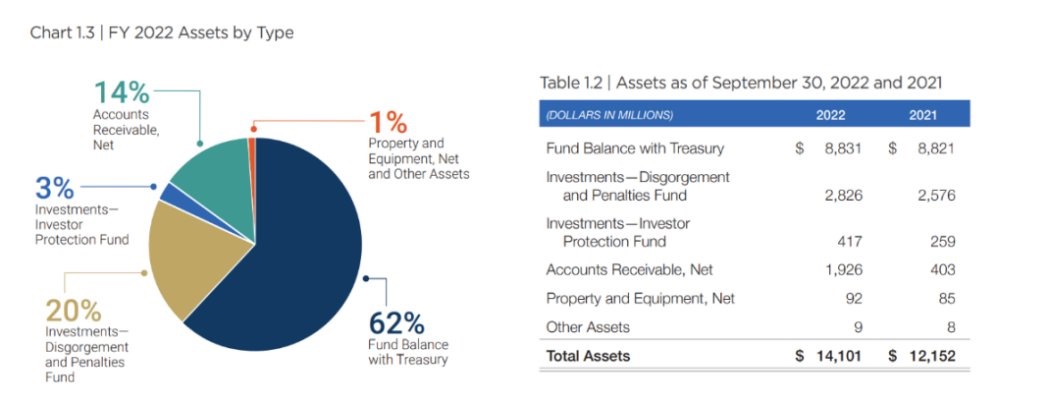
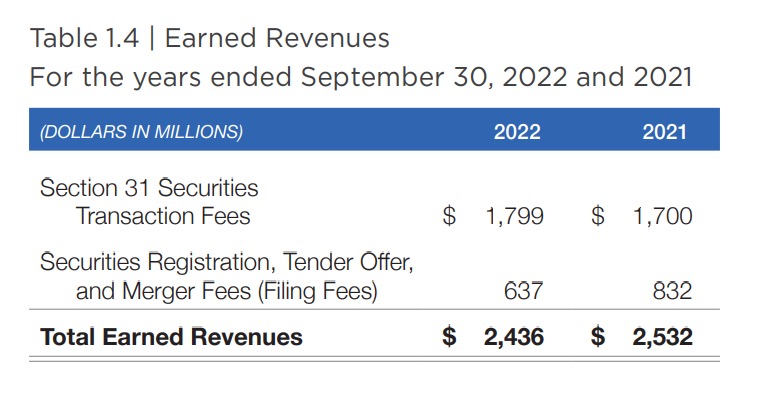
Beyond forfeiture income, the SEC received a $50 million reserve fund from the Office of Management and Budget (OMB) and a $390 million allocation for the Investor Protection Fund in FY2022. Transaction fees brought in about $1.8 billion, and application fees added another $640 million. Clearly, fines and penalties have become a cornerstone of the SEC's revenue.
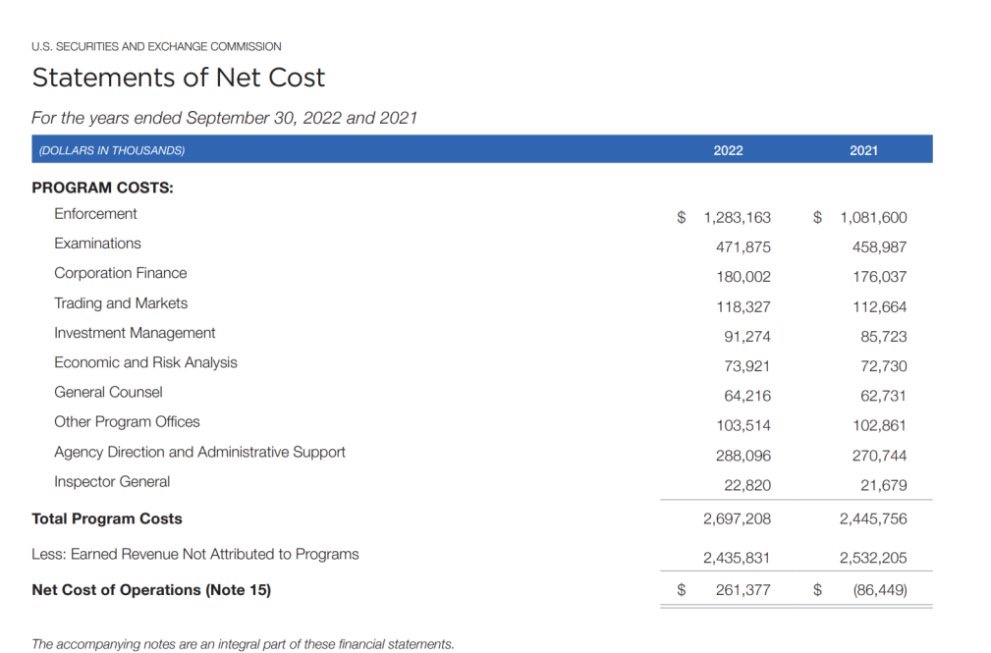
On the spending side, Enforcement and Examinations accounted for the largest share of net expenditures—$1.75 billion, or 65% of the SEC's total spending. This investment translated into action: the SEC initiated 760 enforcement actions in FY2022, a 9% year-on-year increase, including 462 new or "standalone" cases.
These actions generated significant revenue. Total ordered payments—including civil penalties, disgorgement, and pre-judgment interest—reached a record $6.439 billion, up from $3.852 billion in FY2021. Civil penalties alone hit a record $419.4 million.
This system also fuels generous whistleblower incentives. In FY2022, the SEC awarded roughly $229 million across 103 awards—the second-highest amount and number in its history. It also received a record 12,300 whistleblower tips. Against this backdrop, Chair Gary Gensler's request to Congress to expand the SEC's staff from 4,685 to 5,139 seems perfectly logical.
In short, the SEC operates on an ex-post enforcement model. It allows market participants to operate with relative freedom, then investigates, builds cases, and imposes penalties where it can. This explains why the SEC has declared that "everything except BTC" could be a security. Broadening the pool of potential enforcement targets is the logical first step. Whether action is taken—or litigation succeeds—depends on many other factors.
Hong Kong Securities and Futures Commission (SFC)
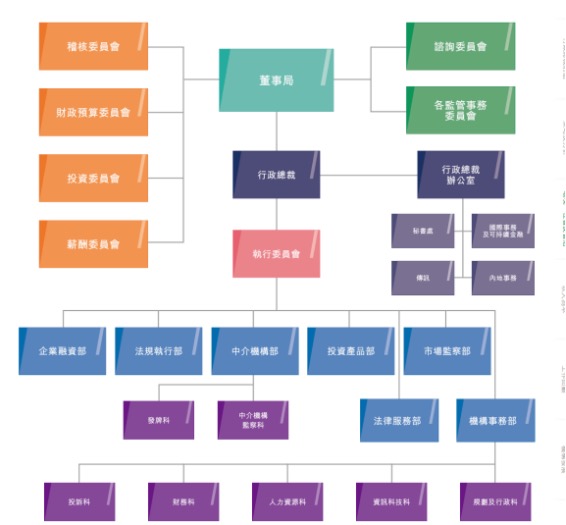
The SFC's structure is quite different from the SEC's. Only two units are directly involved in frontline regulatory oversight: the Market Inspection Unit and the Intermediaries Supervision Unit within the Intermediaries Department. The Intermediaries Department also houses a Licensing Unit, which is central to Hong Kong's well-known licensing regime.
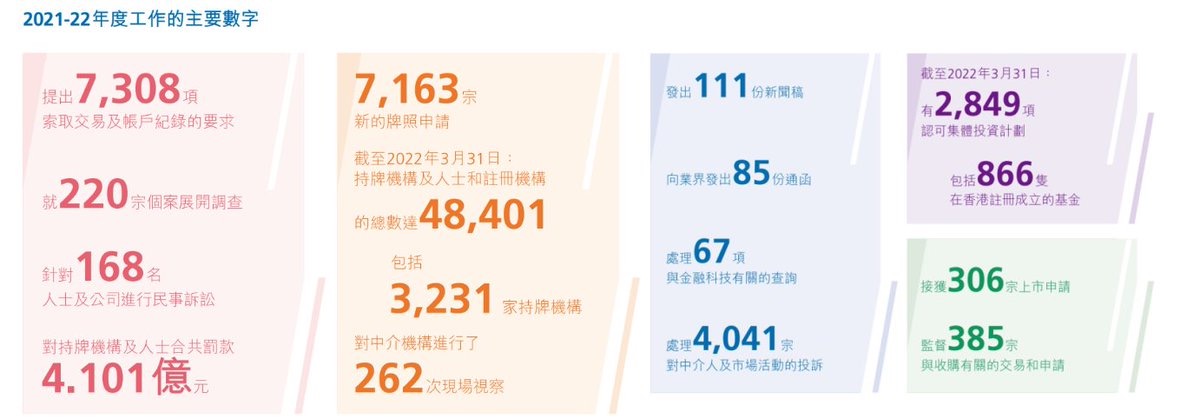
According to the SFC's 2021–2022 Annual Report on Key Activities, the commission launched 220 case investigations and initiated 168 civil proceedings, imposing total fines of HK$410.1 million on licensed entities and individuals. Beyond enforcement, licensing is a major activity: the SFC received 7,163 license applications and processed over 38,000 license-related submissions through its WING electronic platform during the period.
While the SFC states it will "take decisive enforcement action against unlicensed platform operators where appropriate," its actual enforcement cases remain heavily focused on traditional financial misconduct—insider trading, market manipulation, corporate fraud, intermediary negligence, and internal control failures.
Financially, the SFC's structure is much simpler. In FY2021–2022, its total revenue was HK$2.247 billion, with "transaction levies" making up 95.3% and other participant fees accounting for the remaining 6.7%. Notably, forfeiture and penalty income does not feature in its revenue breakdown. On the expenditure side, personnel costs consumed 75.7% of total spending. The SFC employed 913 staff as of 2022.
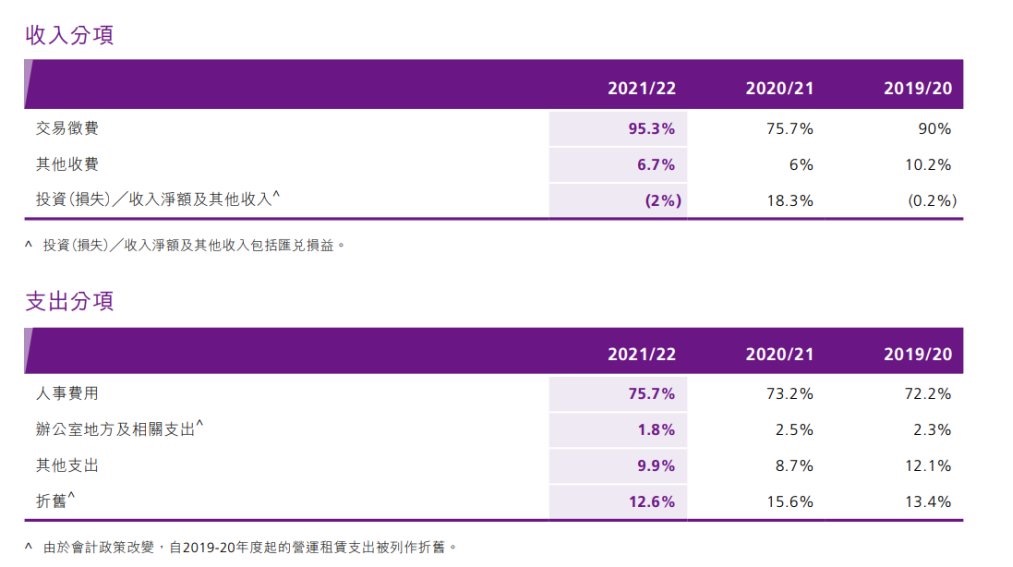
The data also shows that the idea of the SFC being primarily funded by licensing fees is a misconception. In reality, most of its revenue comes from market activities. With application and annual fees for licensed corporations ranging from HK$4,700 to HK$129,700 per regulated activity, and fees for licensed individuals between HK$1,790 and HK$5,370, the contributions from 3,231 licensed entities and over 40,000 licensed individuals make up only a small fraction of the SFC's total income.
Historically, the SFC has lacked the same enforcement drive as the SEC. It also operates with far fewer resources: with just 903 staff, it oversees the complex operations of the Hong Kong Exchanges and Clearing (HKEX) and the Hong Kong Futures Exchange (HKFE), processes a high volume of license applications, conducts ongoing supervision and inspections—and even promotes initiatives for the "public good." Given these constraints, it's highly challenging for the SFC to dedicate significant manpower and resources to proactive enforcement actions.
The figures above make it clear that the SFC's regulatory approach differs from the SEC's. Fundamentally, both regulators follow the principle of "same business, same rules, same risks." While the SEC has taken a hard line on cryptocurrencies, it applies that same rigor across the traditional financial sector. Similarly, the SFC is not expected to single out cryptocurrencies for uniquely harsh treatment.

In short, a large-scale, SEC-style enforcement crackdown is highly improbable from the SFC. For entrepreneurs, as long as their operations don't clearly violate Hong Kong's existing laws, regulatory pressure shouldn't be a primary worry. That said, the "Hong Kong market" or the strategy of "proactively getting licensed" isn't right for every project. Securing and maintaining a license involves substantial costs. It's worth remembering that many Web3 activities can still be conducted in Hong Kong without one.
While there's no need to fear SEC-level pressure, I'd still urge every eager participant to pause and ask themselves one sobering question: Do we really need that license?
References
https://www.sec.gov/news/press-release/2022-206
https://www.sec.gov/files/sec-2022-agency-financial-report.pdf#chairmessage