Early-stage investing demands a forward-looking mindset. We often hear that "the future is already here"—but what does that future actually look like? How will it unfold? While certainty is elusive, investors must constantly ask themselves: What will the world look like next year? In five years? In ten?
How will society, the economy, technology, commerce, the environment, and even our personal lives evolve? This kind of future-gazing is crucial for both investors and entrepreneurs. In recent years, concepts like Web3, DAOs, and the metaverse have captured the spotlight, widely seen as the building blocks of that arriving future.
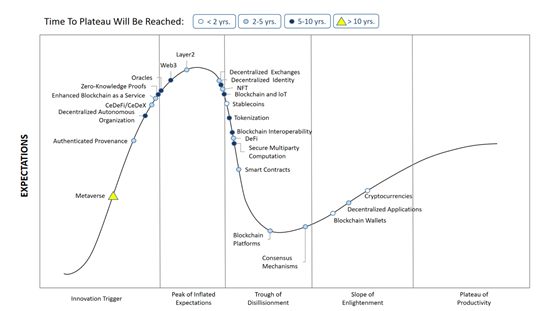
Consider Gartner's July 2022 forecast on the technology lifecycle for blockchain ecosystems. It suggests the metaverse is still over a decade away from mainstream maturity, while DAOs and Web3 are projected to need another 5–10 years. From an early investment standpoint, this is precisely the time for investors to position themselves and for founders to start building their strategies.
The internet has come a long way. Centralized platforms and institutions solved many problems, boosted efficiency, and accelerated growth—largely by harnessing powerful network effects. Yet Web2, while solving old issues, created new ones: data leaks, opaque handling of user information, privacy violations, and even theft threatening financial security.
The asymmetric advantages of centralized platforms—including monopolistic power—have eroded user freedom and trust. Innovations like distributed databases, smart contracts, privacy-preserving computation, self-sovereign digital identity, and decentralized storage aim to tackle these very challenges, pushing the internet toward its next evolution: Web3.
Beyond Web3, DAOs and the metaverse form the embryonic framework of a new future. Together, they are catalyzing innovative infrastructure, deconstructing old business models, and rebuilding economic systems, commercial paradigms, and operational frameworks—ultimately advancing human civilization. In this vision, Web3 is the foundational infrastructure, DAOs are the future's economic organizing principle, and the metaverse is the future's lifestyle.
Today, many projects call themselves "Web3," but most only explore concepts or implement basic technical layers. These are pieces of the puzzle, but Web3 is much more. It's like the parable of the blind men and the elephant: each describes a part, but the whole remains elusive. In fact, the "whole" is still being defined—constantly evolving and innovating.
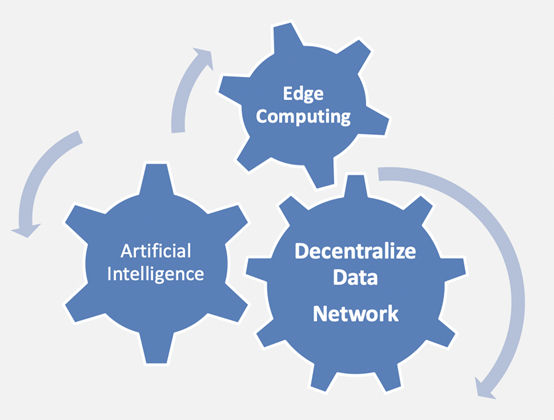
Nevertheless, three fundamental drivers are propelling Web3 forward.
First is artificial intelligence (AI) and smart contract technology. Some might say AI is old news—and it's true the field is decades old. But historically, its applications were niche, like video recognition. A baseline level of AI is a foundational pillar for Web3. Concepts like the Semantic Web and Spatial Web, discussed in academia, rely on AI. In all Web3 applications, data must be processed intelligently—from light to heavy AI—and stronger AI enables better user experiences.
Second is distributed computing, often called edge computing, though here the scope is broader. Since Web3 data is distributed, privacy-preserving computations often need to happen locally. Each node must handle computation and storage robustly for the system to function. Thus, edge computing is a critical foundational layer.
Third is the distributed data network. Here, "network" refers to the architecture of data itself—requiring blockchain-like protocols and consensus. Data sourcing, validation, and verification must be automated through code on distributed database architectures.
These three components form Web3's core pillars. Imagine, three years from now, a fully autonomous car powered by advanced AI. The vehicle itself is an edge computing node—processing data from other nodes and transmitting its own. Meanwhile, the driver looks through an AR-enhanced windshield, immersed in a personalized metaverse.
Web3's core logic is simple: user sovereignty, which equates to decentralization. Many call Web3 "decentralized," but its essence is user sovereignty. Achieving this technically requires innovative infrastructure. Once that matures, native Web3 applications can flourish. So Web3 aims not just for user sovereignty, but also to spawn entirely new business models and commercial ecosystems.
Beyond logic, we can think of Web3 like a traditional operating system. Its base layer comes from distributed ledger and database tech—akin to an OS's file system and I/O subsystem, corresponding to blockchain's Layer 1 for data structure.
Distributed storage parallels the file system; distributed computing mirrors the CPU; and distributed data transmission functions like I/O.
CPU, file system, and I/O are all essential OS components—and they're also foundational to Web3. Looking ahead, will a single unified protocol build Web3? Probably not. Web3 should be modular, protocol-based, layered, and composable—like LEGO bricks. With enough interoperable pieces, anyone can assemble a product or service.
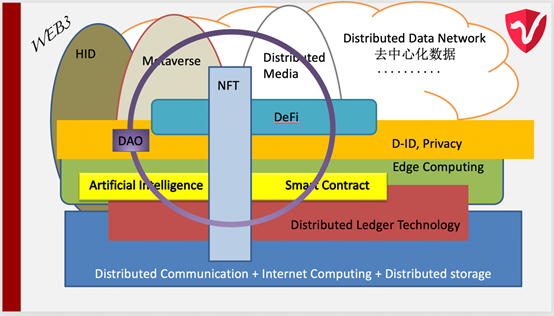
Beyond core infrastructure, Web3 introduces two key enablers previously out of reach: decentralized digital identity and privacy-preserving computation—two tightly linked middleware layers.
Digital identity isn't new. In Web3, DID (Decentralized Identity) is indispensable—like a national ID card. Without it, you can't be recognized or validated. Identity is the base layer; without it, there are no assets. In native Web3 networks, identity is often a wallet address, but addresses aren't unique IDs. Decentralized identity supports multiple IDs that can be split and recombined. Each ID's reputation and credit must be verified through its interaction data, accruing to the ID itself. Multiple IDs, through various combinations, can unlock diverse applications and business models.
Beyond native Web3 IDs, traditional Web2 identities also need upgrades with privacy protection and privacy-preserving computation. This field traces back to Zero-Knowledge Proofs (1985) and Multi-Party Computation (MPC), building on work by Andrew Yao. Combined with homomorphic encryption and federated learning, privacy-preserving computation now has practical uses not just in Web3, but also in healthcare, finance, government, and supply chains across the wider web.
Once Web3's technical architecture is clear, the next frontier is applications built on it—where all data comes from and is processed by the distributed network. This gives us today's DApps: NFTs, DeFi, the metaverse, creator economies, decentralized media, social networks, and credit systems.
Another pivotal element in Web3 is new organizational forms. DAOs represent a quintessential Web3-native model. At their core, DAOs transform the traditional "shareholder" into a "stakeholder," embodying "each for all, and all for each." Their functionality can adapt via programmable smart contracts aligned with organizational goals—like assembling LEGO, where members collaboratively build rules. Each member's rights, responsibilities, and benefits are determined by contributions, credit, participation, and more—forming a unique soulbound identity.
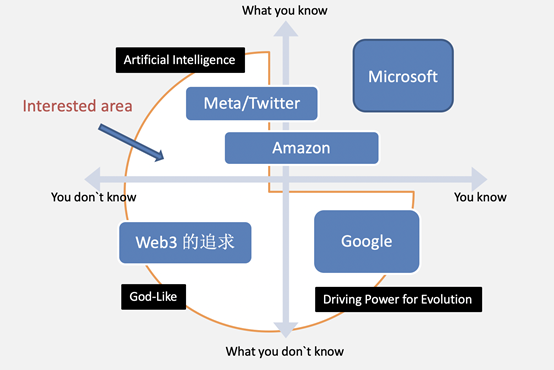
Ultimately, Web3 shapes the future through decentralization—practically, user sovereignty. But let's stretch our imagination: perhaps Web3 is pursuing the unknown unknowns. Traditionally, "known knowns" are knowledge; "known unknowns" can be addressed with Web2 tools like search engines. "Unknown knowns" are handled by platforms like Amazon or Facebook using AI. Then come the "unknown unknowns"—and therein may lie Web3's greatest opportunity. We look forward to co-creating that future.