

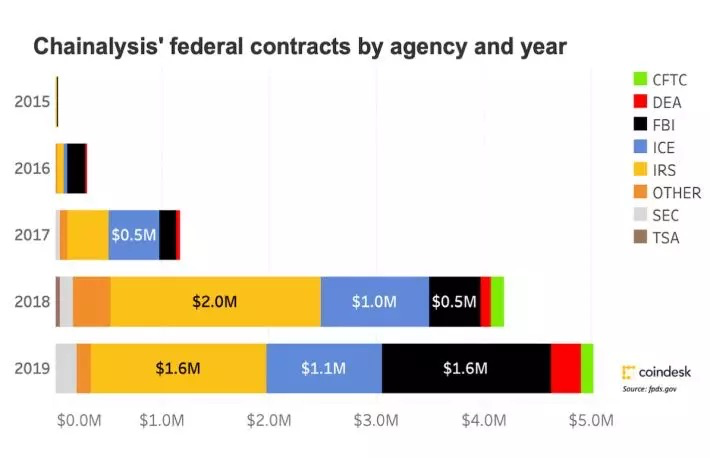
U.S. federal agency contracts awarded to blockchain analytics firm Chainalysis from 2015 to 2019. (Source: CoinDesk Research)
In 2015, Chainalysis secured a modest $9,000 data software contract with the U.S. Federal Bureau of Investigation (FBI).
Just five years later, the company has become the cryptocurrency industry's equivalent of Palantir—a data analytics powerhouse securing multi-million dollar annual contracts with the U.S. government and leading the emerging field of blockchain surveillance.
Chainalysis is now the largest cryptocurrency data analytics contractor for the U.S. government, partnering with at least 10 federal agencies, departments, and offices.
Federal agencies are investing heavily in these capabilities to untangle the complex transaction networks of Bitcoin and other cryptocurrencies in their fight against crime.
A CoinDesk review of 82 federal procurement records reveals that since its founding in 2015, federal agencies have spent at least $10,690,706 on Chainalysis's tools, services, and training. When contract extensions are included, the total federal revenue for Chainalysis exceeds $14 million.
No other firm comes close to Chainalysis in either the number of U.S. federal contracts or the breadth of its government partnerships. Public data shows that CipherTrace, led by CEO David Jevans, has primarily secured R&D contracts totaling around $6 million. UK-based Elliptic has only one disclosed contract—a $2,450 deal with the Internal Revenue Service (IRS).
Through its contracts with Chainalysis, the U.S. government can more effectively prevent individuals from using cryptocurrencies to evade detection. Bitcoin's pseudonymous system is inherently traceable, with billions of dollars moving across a public ledger that anyone can scrutinize.
Although Chainalysis data indicates that illicit activity represented just 1.1% of Bitcoin's total transaction volume in 2019, that share is growing—surging 180% year-over-year.
The U.S. government has responded by ramping up its spending on Chainalysis each year. In 2019 alone, it paid the company over $5 million—a 20% increase from 2018 and a staggering 22,558% jump from 2015, when Chainalysis worked with just two agencies: the FBI and the IRS.
Today, Chainalysis holds contracts with numerous federal bodies, including the FBI, the Drug Enforcement Administration (DEA), Immigration and Customs Enforcement (ICE), the Securities and Exchange Commission (SEC), the Commodity Futures Trading Commission (CFTC), the Financial Crimes Enforcement Network (FinCEN), the IRS, the U.S. Secret Service (USSS), the Transportation Security Administration (TSA), and even the Department of the Air Force.
Most agencies have signed six-figure contracts, though spending varies. The TSA signed a $40,000 deal in 2018, while the IRS—Chainalysis's largest federal partner—has committed $4.1 million over the past five years, including $3.6 million since 2018.
ICE ranks second with $2.6 million in contracts, followed by the FBI at $2.4 million.
However, the FBI plans to increase its spending by millions over the next two years, poised to overtake the IRS as Chainalysis's top federal client. On December 18, 2019, the FBI paid $377,500 for access to Chainalysis's "cryptocurrency tracking tool" and is slated to spend at least $3,628,775 by 2022.
For context, a 2017 Vice report noted that the New York-based startup had already earned $330,000 from the FBI, $88,000 from the IRS, and $58,000 from ICE.
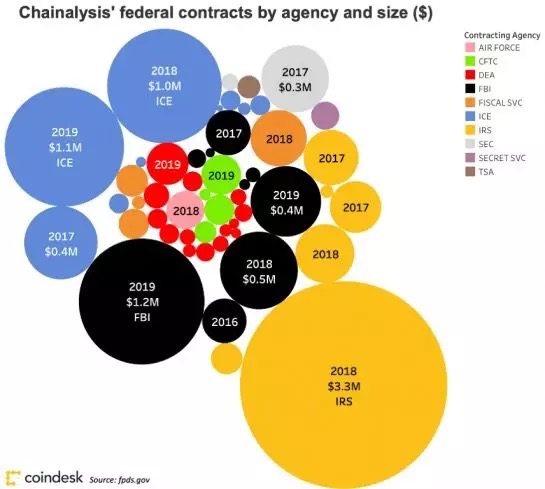
Federal agencies are making significant investments in Chainalysis. Some, like the IRS, have renewed contracts for years, spending about $1.6 million annually on the same agreement for a total of $3.3 million. (Source: CoinDesk Research)
What exactly are these agencies buying?
Pinpointing what each agency purchases from Chainalysis is challenging. Many contracts lack detailed descriptions: 29 mention various product licenses, five reference the "Reactor" software, and others are vague (e.g., the Department of the Air Force's $110,000 spend on "Bitcoin cryptocurrency transactions").
Despite raising $30 million in a Series B round a year ago, Chainalysis has launched only three products: Reactor, KYT, and Kryptos. Reactor, its flagship transaction visualization software, has been available for over a year.
"While private-sector clients also use Reactor, we've specifically developed two new products—KYT (Know Your Transaction) and Kryptos—for this customer segment," said Jonathan Levin, Chainalysis co-founder and Chief Strategy Officer.
Reactor is the company's flagship product. It visualizes cryptocurrency activity on blockchains and flags addresses linked to illicit transactions.
Casey Bohn, a high-tech crime research specialist at Virginia's National White Collar Crime Center, regularly trains law enforcement on Reactor and other Chainalysis tools. He notes that Reacter helps reduce the manual burden of parsing blockchain data.
"Reactor is relatively easy to use—not overly complex," Bohn said. "Once you get the hang of it, it simplifies what would otherwise be highly intricate work."
Bohn has trained officials from federal, state, and local governments—including personnel from the 10 agencies with Chainalysis contracts—on using the software. He explains that these officials have a keen interest in blockchain analysis.
"All these investigative agencies have dedicated units," Bohn pointed out, that focus on the cryptocurrency space.
For instance, the IRS Criminal Investigation (CI) division's Cyber Crimes Unit—a five-year-old team investigating cryptocurrency-related tax crimes—is a primary Chainalysis customer. The unit has spent $3.3 million on "case support and training" over the past four years.
The IRS did not respond to this inquiry. However, in its 2019 Annual Criminal Investigation Report, Jim Lee, Deputy Chief of the IRS Criminal Investigation Division, suggested that not only his division, but other IRS departments as well, have a growing "need" for cryptocurrency tracking capabilities.
Lee stated: “U.S. Attorneys require IRS Criminal Investigation involvement in any case involving financial crime. In fact, if money is involved, it becomes a federal matter—and thus falls under our jurisdiction. Tracing cryptocurrency transactions is a perfect example.”
Don Fort, Chief of the IRS Criminal Investigation Division, was more direct about the division's relationship with Chainalysis. He revealed that Chainalysis helped both the IRS and the Department of Justice crack a case involving a Korean child pornography website.
Other agencies, however, have not been as open about their cryptocurrency tracking activities. Most declined to comment. The U.S. Financial Crimes Enforcement Network (FinCEN), the Federal Bureau of Investigation (FBI), and the Drug Enforcement Administration (DEA) all refused to provide details.
A DEA spokesperson said simply: “The DEA does not discuss investigative techniques.”
Public records further indicate a general reluctance among agencies to disclose partnerships with private firms.
In 2018, Vice filed a Freedom of Information Act (FOIA) request with U.S. Immigration and Customs Enforcement (ICE) seeking documents related to a $13,188 software purchase from Chainalysis. Five months later, ICE released a heavily redacted document acknowledging that its Homeland Security Investigations (HSI) unit used the Reactor software.
The document stated: “Public disclosure of ICE’s partnership with Chainalysis would also jeopardize its ongoing information-sharing arrangements with other logistics and financial industry companies.”
From Small to Large
Chainalysis’s first product was built specifically for cryptocurrency investigators. Co-founder Jonathan Levin said the company initially signed contracts primarily with specialized units within larger agencies.
“We started by contracting with small units inside agencies that handled cybercrime and money laundering,” Levin said. “We found these agencies needed tools to combat a wide range of crimes and illicit activities—which increased our appeal and expanded our role.”
This strategy created a snowball effect, helping Chainalysis secure a growing number of federal procurement contracts—likely far more than the figures disclosed publicly. Levin noted that many of these contracts were not published in the Federal Procurement Data System.
“Roughly half of our revenue comes from the public sector, and half from the private sector,” Levin said. Public-sector revenue includes U.S. state-level agencies and government bodies overseas.
Cybercrime researcher Boen pointed out that, in many respects, the $16 million expenditure is relatively small. He noted that the U.S. government spends several times that amount on other private-sector tech solutions—like Cellebrite, which helps law enforcement access locked mobile devices. According to Federal Procurement Data System records, Cellebrite has secured over $40 million in government contracts since August 2015.
However, within the niche of cryptocurrency tracking technology, Chainalysis appears to hold a near-monopoly in the federal government market.
Translation: Min Min | Editor: Lin Yi