

To be or not to be? That is the question facing countless cryptocurrency projects today.
In 2019 alone, 518 cryptocurrencies were declared dead. Of the thousands of public blockchains that once existed, only about 200 remain active.
At the same time, crypto Ponzi schemes have gone from peak popularity to collapse. Bankruptcy, exit scams, and arrests have become the common fate for many such fraudulent platforms and exchanges.
Nearly all the "scam artists" who preyed on retail investors have vanished from the scene, while legitimate teams dedicated to building foundational technology are finally gaining solid ground.
A quiet but significant reshuffling is now underway.
01 Star Projects Grind to a Halt
Several high-profile blockchain projects shut down in 2019. Perhaps the most notable was ONO.
ONO was founded by Xu Ke, a post-95s internet celebrity.
She first gained notoriety in 2012 after a car accident. At the scene, she was dressed provocatively, admitted to drunk driving, and presented an international driver's license, claiming she had just returned from the U.S.
Later, Xu Ke launched a social app and publicly dated a famous esports player. Labels like "internet celebrity," "rich second-generation," and "post-95s female entrepreneur" came to define her public persona.
In 2018, she entered the blockchain space with ONO—a decentralized social app targeting Gen Z users (post-95s and post-00s).
ONO's marketing was filled with vague, grandiose claims: "Users can freely share valuable content, chat, learn, exchange ideas, and participate in ecosystem development—creating and capturing traffic value while enjoying equal rights."
"Invest in celebrity projects—they have traffic," Li Xiaolai bluntly stated in a leaked audio recording that went viral. He invested nearly $7 million in ONO.
But ONO didn't last.
In July 2019, the ONO app suddenly stopped working, and key opinion leaders (KOLs) could no longer withdraw their earned ONOT tokens.

Panicked investors soon discovered that ONO's official WeChat account had gone silent and its office appeared abandoned.
Three weeks after going dark, the same WeChat account began posting weekly reports for something called Nuozhou Group.
Some investors claimed Xu Ke had moved on to a new venture—with Nuozhou Group as the parent company of her new firm.
Regarding the suspension, Xu Ke explained that ONO would undergo a "closed upgrade" by the end of 2019, relaunching with an "innovative model" and a "complete mainnet plan."
"The team is still operational—just streamlined and ready to go," she said.
To this day, however, the ONO app remains inaccessible.
Industry insiders point out that ONO's only flaw—as a project seemingly designed to exploit retail investors—was its timing; it simply launched too late.
ONO followed the classic token sale and ICO playbook. It completed its first funding round in June 2018.
"By then, the 'retail investors' had already been completely harvested by others," one industry practitioner commented.
Even Xu Ke admitted that shortly after ONO's fundraising ended, ETH prices crashed—resulting in a 66% loss when measured in fiat currency.
Today, ONO is history, and Xu Ke has returned to her roots as an internet celebrity. Of her ten most recent Weibo posts, seven are selfies or inspirational quotes. She ignores all questions from netizens about ONO's status.
On January 6, she posted screenshots of her Alipay and bank statements on Weibo. They showed her total Alipay spending for 2019 was RMB 7.11 million, with bank card expenditures reaching RMB 15.73 million.

"Congratulations, Ms. Xu—you've become the 'female Jia Yueting,'" one netizen joked.
02 518 Projects Meet Their End
So, how many blockchain projects actually died in 2019?
According to data from DeadCoins.com, 518 cryptocurrency projects were declared dead last year.
Within the crypto community, DeadCoins.com is often called the "cryptocurrency graveyard." It has cataloged all deceased cryptocurrency projects since September 2017, totaling 1,840. In 2018, 647 projects ended; in 2019, that number fell by 20%.
The site classifies projects into four categories based on their demise: Deceased (terminated), Hack (hacked), Scam (fraud), and Parody (copycat).
In 2019, 58% of the dead projects were labeled Scam—ending in collapse, exit scams, or arrests.
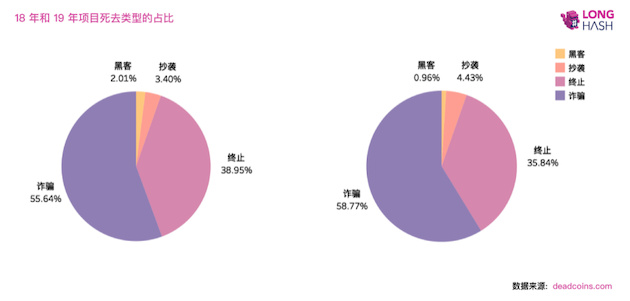
Data source: DeadCoins.com | Chart: LongHash
Ponzi schemes are the ultimate exit scam.
"In 2019, we saw at least 20 major crypto Ponzi schemes pop up every month," recalled one former participant.
Most collapsed quickly. Beyond the infamous cases like PlusToken, BHB, and Youbank, more than 200 other schemes rug-pulled investors that year.
Hacks are another common killer of blockchain projects.
In 2018, BEC—a token linked to Meitu—was exploited. Despite having a total supply of 7 billion, hackers minted an additional 5.7 trillion tokens out of thin air, crashing its price to zero overnight.
In March 2019, the DragonEx exchange was hacked, losing $6.02 million in digital assets—a devastating blow for a small platform.
Reports indicate the breach occurred when a customer service agent opened a malicious file, allowing hackers to steal the exchange's private keys. DragonEx later filed for bankruptcy in Singapore.
Regulatory crackdowns have also shuttered countless exchanges.
On December 10, 2019, China's state broadcaster CCTV reported that regulators had closed six newly identified domestic crypto trading platforms since the start of the year.
The report added that authorities had targeted 203 overseas exchanges in seven separate actions and shut down nearly 10,000 non-bank payment accounts involved in crypto trading. On WeChat, about 300 mini-programs and official accounts promoting crypto trading were also removed.
Under intense pressure, many exchanges announced they would stop serving Chinese users. As arrests mounted, employees at numerous small exchanges resigned and fled.
Some exchanges, like Rong’an and Taiyang, opted for a "soft exit" when regulators came knocking.
Data from the Interchain Pulse Research Institute shows at least 20 relatively well-known exchanges either shut down or voluntarily ceased operations in 2019.

List of Defunct Cryptocurrency Exchanges (Source: Interchain Pulse Research Institute)
"Small domestic exchanges are no longer viable—we've already shut ours down," Xiao Zhi, an operations staffer at a Shenzhen-based exchange, told Yiben Blockchain.
The fierce competition among thousands of crypto exchanges in 2018 is now a distant memory.
Some projects met tragic, self-inflicted ends. The collapse of BitE, a blockchain data analytics platform, was particularly shocking.
In June 2019, founder Hui Yi died by suicide, leading to the company's dissolution.
Rumors suggest that during the bear market, BitE's data business generated limited profit, prompting a move into crypto asset management. Before his death, Hui Yi allegedly took on highly leveraged positions—reportedly up to 100x—suffering massive losses.
"Two-thirds of domestic blockchain projects died in 2019," blockchain practitioner Zhang Wei told Yiben Blockchain.
03 The Great Shakeout Begins
In reality, many blockchain projects failed to live up to the hype—public chains are a prime example.
A popular industry mantra once claimed, "Whoever wins the public chain race will rule the world." As the foundational operating system for the blockchain ecosystem, the victor would control the gateway to this new digital frontier.
Public chains were also the most crowded sector. According to the "Blue Paper on Technical Evaluation and Analysis of Public Chain Projects" by Tiande Technology and ChainTower Think Tank, over 20,000 public chains launched globally in 2017 and 2018.
But in 2019, public chains began scaling back or halting development altogether.
Take ELF. In October 2019, its team abruptly disbanded its community without explanation, and its founder had been absent from public view for some time—fueling rumors of an exit scam. Although the team later issued a denial, investor doubts persisted.
So what's the core issue for public chains?
Many in the industry point to a lack of real-world utility.
In mid-2018, the highly anticipated EOS mainnet launched, boasting millions of TPS and hailed as "Blockchain 3.0."
Yet a year later, its ecosystem was still dominated by gambling DApps, with no breakout applications in sight.
In September 2019, Jiang Guofei, Ant Financial's Vice President and Head of Ant Blockchain, noted in an interview that the biggest challenge for public chains is the absence of applications beyond speculation. In contrast, purpose-built consortium chains see broader adoption.
"Many public chain tokens still have a listed price, but there's virtually no trading or real usage—they're effectively zombie projects," Zhang Wei told Yiben Blockchain.
Against this backdrop, many blockchain developers shifted focus—from public chains to industry-specific and government-facing solutions with clearer practical value.
"After the national endorsement of blockchain in October 2019, governments and enterprises unlocked significant budgets for blockchain projects," Zhang Wei said. "Both enterprise (To B) industrial blockchain and government (To G) e-governance initiatives have been booming."
He added that in 2018, blockchain teams at BAT (Baidu, Alibaba, Tencent) typically landed "major contracts worth around RMB 5 million each." By the second half of 2019, deals worth tens of millions of RMB became commonplace.
"Industrial blockchain will undoubtedly push forward in 2020," he affirmed.
As the crypto market cools, the broader blockchain ecosystem is maturing—ushering in an era where quality projects rise, and the weak fall away.
The cryptocurrency space in 2019 was rife with Ponzi schemes, but as all extremes eventually reverse, the projects that preyed on retail investors ultimately collapsed.
At the same time, blockchain's underlying technology began capturing widespread attention. After years of quiet, dedicated development, its moment had finally arrived.
We're now seeing more blockchain applications deployed across various industries, leading to a natural purification of the sector.
In 2020, the industry is poised to embark on a more sound and sustainable development path.
*Some interviewees in this article are referred to by pseudonyms.