


On March 11, Silicon Valley Bank (SVB), managing over $200 billion in assets, officially collapsed after suffering a massive deposit run that left it insolvent. Then, on March 19, Credit Suisse—the 167-year-old Swiss banking giant—faced a severe liquidity crisis and was “fire-sold” to UBS Group for CHF 3 billion. Within just over one week, two major banks imploded consecutively. Coupled with the recent failures of Silvergate Bank and Signature Bank, the global banking sector now appears to be confronting a large-scale liquidity crisis. Given that the 2008 global financial crisis originated from the collapse of subprime mortgage-backed securities held by banks, could the recent string of bank failures signal the onset of a new economic crisis? And how will this banking turmoil impact the cryptocurrency industry?
Root Cause of the Crisis — The Fed’s Aggressive Rate Hikes Shatter the “Short-Term Liabilities, Long-Term Investments” Model
SVB’s massive deposit run stemmed from an announcement made on March 8. That day, SVB disclosed on its official website that it had urgently sold $21 billion in securities, resulting in an $1.8 billion loss. Simultaneously, the bank announced plans to raise $2.2 billion in equity financing to cover the shortfall. Upon hearing the news, depositors and investors panicked and began withdrawing funds en masse—amplified further by social media—culminating in a severe bank run. Just three days after the announcement, SVB succumbed to the overwhelming tide of withdrawals and declared bankruptcy.
If SVB’s collapse can be described as a “self-inflicted werewolf explosion,” then Credit Suisse’s implosion reflects “deep-rooted, systemic deterioration.” The Federal Reserve’s successive interest rate hikes have exacerbated Credit Suisse’s asset-liability mismatch problem. According to Credit Suisse’s 2022 annual report, its losses alone exceeded $7 billion for the year. After SVB’s collapse, market concerns about Credit Suisse’s liquidity intensified. At that critical juncture, Saudi National Bank—the largest shareholder of Credit Suisse—publicly declared it would not provide additional capital, delivering the final blow.
Both banks’ collapses are clearly linked to the Fed’s aggressive monetary tightening. As recently as 2020, U.S. dollar interest rates hovered near zero, enabling both banks to attract massive deposits and deploy those funds into long-duration fixed-income securities. This “short-term liabilities, long-term investments” model is widespread across the banking industry and constitutes a core profit driver. However, beginning in 2022, the Fed launched an aggressive hiking cycle, pushing benchmark rates close to 5%. This sharply increased short-term funding costs, rapidly straining cash flows at certain banks—and ultimately triggered their collapse. In essence, the Fed’s aggressive rate hikes have completely dismantled banks’ traditional “short-term liabilities, long-term investments” profit model.
Epicenter of the Storm — Calm Surface, Turbulent Undercurrents in Banking
Following SVB’s collapse, the U.S. Department of the Treasury and the Federal Deposit Insurance Corporation (FDIC) rolled out rescue measures—including guaranteeing depositors full access to their funds held at SVB—and initiated a public auction of SVB’s assets at steep discounts to attract bids from other banks, aiming to contain spillover risks. Similarly, on March 19, the Swiss Federal Council urgently announced that, following intense negotiations and mediation, Credit Suisse had been successfully acquired by UBS Group. Everything appeared to be moving toward resolution—was it truly so?
At its March 22 monetary policy meeting, the Fed opted to hike rates by another 25 basis points. Multiple institutions now project one more hike before year-end, potentially pushing the benchmark rate to its highest level since 2007. Yet Lawrence McDonald, former Lehman Brothers vice president, warned that the Fed must cut rates promptly—and significantly expand deposit insurance coverage—or risk triggering a repeat of the 2008 global crisis sparked by Lehman’s collapse.
This view is no alarmist exaggeration. The FDIC has already activated its “Systemic Risk Exception” clause—a provision allowing the FDIC to waive the $250,000 per-depositor insurance cap and fully reimburse depositors’ principal. Notably, however, the FDIC’s Deposit Insurance Fund currently holds only $128 billion—while SVB’s bad debt hole alone exceeds tens of billions of dollars. The Systemic Risk Exception was last invoked in 2007, when the Fed, alongside ten major financial institutions, established a $70 billion stabilization fund to inject ample liquidity and rescue failing firms—yet still failed to prevent the ensuing financial crisis.
The $250,000 deposit insurance ceiling serves not only as protection for small- and medium-sized depositors but also as a cornerstone of systemic stability. Its current suspension signals that the U.S. Congress may be deploying all available tools early in the crisis to suppress contagion. Yet once a chain reaction begins, banking distress could rapidly spread from large institutions to regional and community banks. Compared to their larger peers, smaller banks—with relatively modest deposit bases—often face weaker regulatory oversight and less rigorous stress testing.
According to data released by the Federal Reserve on March 24, regional and community banks collectively lost over $120 billion in deposits within just one week. Beneath the calm surface of the banking sector, turbulent undercurrents are intensifying—and a new crisis is brewing.
A Sanctuary — Bitcoin and Other Crypto Assets Soar
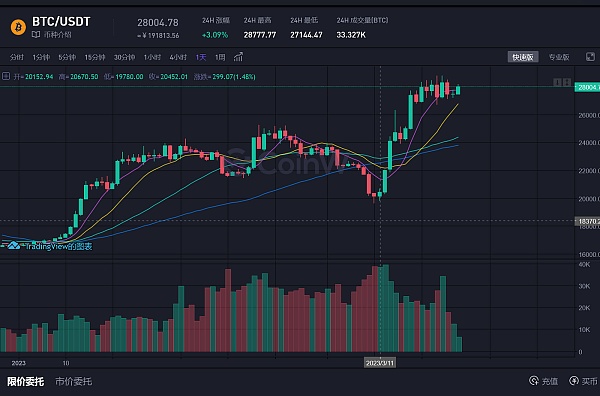
While traditional banking faces mounting peril, the crypto ecosystem has been thriving. According to Bybit exchange price data, Bitcoin hit its lowest point on March 11—the same day SVB announced its bankruptcy—before rebounding over 40%, briefly surging past the $29,000 mark. Other major cryptocurrencies have likewise experienced strong rallies. Overall, the crypto market appears largely insulated from banking failures—and, in fact, banking turmoil may even be fueling bullish momentum.
Let’s revisit Bitcoin’s origins: Following the 2008 collapse of Washington Mutual Bank, the first Bitcoin whitepaper was published. On January 3, 2009, Satoshi Nakamoto even embedded the following message in Bitcoin’s genesis block: “The Times 03/Jan/2009 Chancellor on brink of second bailout for banks.” Bitcoin’s emergence and rise were directly rooted in public distrust of the traditional banking system and skepticism toward centralized financial institutions.

In the wake of SVB’s and Credit Suisse’s collapses, Bitcoin has re-emerged into public consciousness bearing the label “bank rescuer.” Historically, crypto assets—including Bitcoin—were widely perceived as high-volatility risk assets. Yet amid the banking crisis, Bitcoin and other digital assets are regaining recognition as credible hedges. First, the market capitalization of Bitcoin and other major cryptocurrencies has grown dramatically: today’s multi-trillion-dollar crypto market can absorb substantial inflows. Second, with the continuous maturation of new narratives—including the metaverse, NFTs, and Layer 2 scaling solutions—the crypto ecosystem is gaining greater predictability, encouraging longer-term holding behavior among investors.
Returning to the crisis itself, its impact on the crypto industry falls into two main categories. First, stablecoins. SVB’s collapse directly undermined confidence in the “stability” of crypto stablecoins. Regulated stablecoins like USDC typically hold reserves in traditional banks—and bank failures directly threaten their ability to maintain strict 1:1 pegs. During this crisis, USDC and similar stablecoins temporarily de-pegged. Nevertheless, stablecoins remain a fundamentally sound business model: they attract user deposits without paying interest, making them highly cash-flow-stable over time. Post-SVB, regulated stablecoin issuers will likely prioritize further diversification of reserve assets and strengthen oversight of off-chain holdings.
Second, the banking crisis is reinforcing the concept of “crypto-native” or “crypto-denominated” value perception. In the traditional world, most users perceive “withdrawing funds” as converting Bitcoin, ETH, or other cryptocurrencies into fiat currency for real-world use. But as banking failures mount and crypto payment infrastructure expands, more people are deepening their understanding of crypto-native valuation. Indeed, an increasing number of individuals now believe in decentralization so strongly that they view purchasing Bitcoin or ETH with fiat as equivalent to “cashing out”—not “depositing.” Throughout human history, transitions between silver standards, gold standards, real estate standards, and now crypto standards reflect not only evolving perceptions of value but also broader societal progress.
In summary, the consecutive collapses of SVB and Credit Suisse will likely cause continued short-term pain. Beneath the placid surface of the banking sector, crises are simmering—and a new crisis is taking shape. For the crypto industry, however, these banking failures serve two constructive purposes: first, accelerating improvements in stablecoin reserve management; and second, deepening public understanding of decentralization and strengthening consensus around crypto-native value frameworks. While overall capital market uncertainty may increase in the near term, the long-term outlook remains promising: as one whale falls, myriad life forms emerge. The crypto market will continue enhancing its antifragility—and ultimately grow stronger amid uncertainty.