

ChainDD's "Dedao Think Tank" presents "2022–2023 Global Cryptocurrency Market Annual Report: A New Beginning," a comprehensive review and analysis of the crypto market's performance last year.

The report begins with an overview of the global market's total capitalization and the top 30 cryptocurrencies. It then delves into the hottest Web3 sectors of 2022 and examines the turbulent year for centralized exchanges (CEX), spotlighting challenges faced by giants like FTX and Binance. Finally, it surveys the evolving regulatory landscape for crypto across key global jurisdictions. Our goal is to provide investors, entrepreneurs, developers, and other market participants with clear, professional insights to support their decision-making.
The full report is divided into four chapters:
Chapter I: The 2022 Global Cryptocurrency Market: A ~64.51% Year-on-Year Decline
Chapter II: Web3 and the Transformation of the Internet
Chapter III: CEX Turbulence: Bankruptcies and Black Swans
Chapter IV: Global Crypto Policy: A Regional Review
Dedao Think Tank will release one chapter daily in the coming days. Below is the full content of Chapter II.
In this chapter, we analyze the rise of Web3 at the intersection of the global internet and crypto markets, summarize 2022's Web3 investment landscape, and share insights from industry experts.
Chapter II: Web3 and the Transformation of the Internet
—1—
Background: The Evolution from Web 1.0 to Web 3.0
Before Web 1.0 emerged in 1993, the U.S. National Information Infrastructure plan laid the groundwork for the Information Age, securing American leadership through Web 1.0 and 2.0. Thirty years on, the internet is shifting toward Web 3.0. This nascent market was valued at $3.2 billion in 2021 and is projected to grow at a 43.7% CAGR over the next decade. Capital markets are betting heavily: in 2022, global Web3 startups raised $25.2 billion—a staggering 700% year-on-year increase.
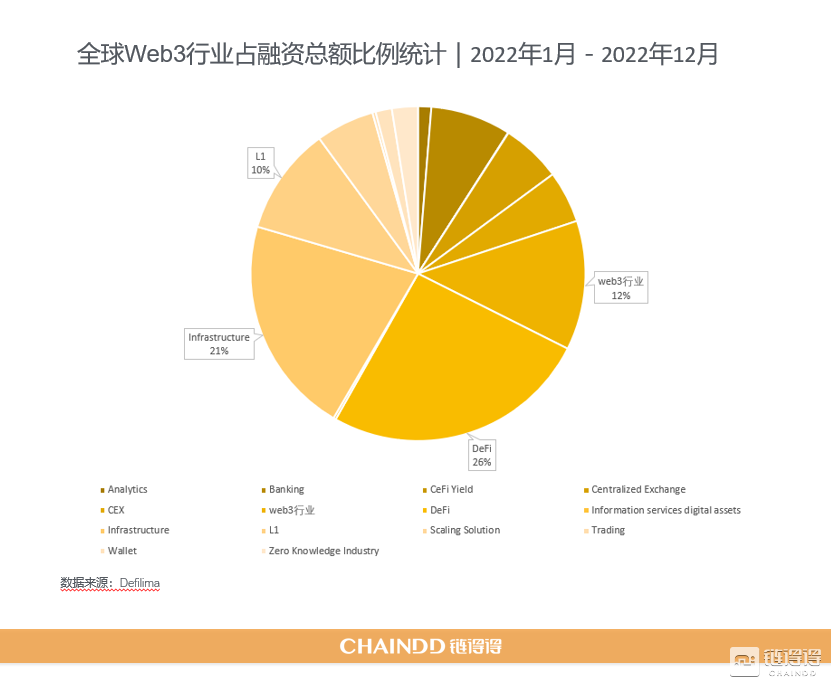
Of the 679 recorded blockchain fundraising rounds in 2022, Web3 projects secured over $5.6 billion, accounting for roughly 12% of the industry's total.
Web3 innovation is also gaining strategic government support as nations vie to lead future infrastructure development. Google Trends shows surging global search interest for "Web3" / "Web3.0," with peaks in China, the United States, and Singapore. Data from China's leading search engine, Baidu, confirms this rising popularity.
1.1 What Is Web 3.0?
Web 3.0 (or Web3) represents a new paradigm for the World Wide Web, built on principles of decentralization, blockchain technology, and token-based economics. The term gained traction in 2014 when Gavin Wood, former Ethereum CTO and Polkadot founder, publicly linked the concept to blockchain. By 2021, venture capital firms, crypto enthusiasts, and major tech companies were all expressing strong interest.
While the definition of Web3 is still evolving, its core is unmistakably decentralized and blockchain-based. It also integrates AI and machine learning to power smarter, adaptive applications. Another key component is the Semantic Web, which aims to make internet data machine-readable.
1.2 Key Characteristics of Web 3.0
While HTML remains the foundational layer, Web3 fundamentally changes how data is sourced and stored. Unlike Web 2.0's reliance on centralized databases, Web3 applications will leverage decentralized blockchain networks, moving away from centralized control.
The Web3 and blockchain communities champion Decentralized Autonomous Organizations (DAOs) as a new governance model, enabling communities to self-govern independently of traditional platforms.
Furthermore, Web3 is designed to work seamlessly with cryptocurrencies, facilitating decentralized financial activities. A final hallmark will be a significant leap in automation, primarily driven by artificial intelligence.
1.3 Classification of Web 3.0 Applications

Web3 Operating Systems: Public blockchains, Layer 2 solutions;
Web3 Identity Passports: DID (Decentralized Identity), wallets, domain names;
Web3 Applications: SocialFi, GameFi, DeFi, Metaverse;
Digital Goods in the Web3 New Economy: Cryptocurrencies, NFTs;
Web3 Governance Mechanisms: DAOs;
The foundational infrastructure of Web3 encompasses data storage, indexing and management, privacy-preserving computation, oracles, and more.
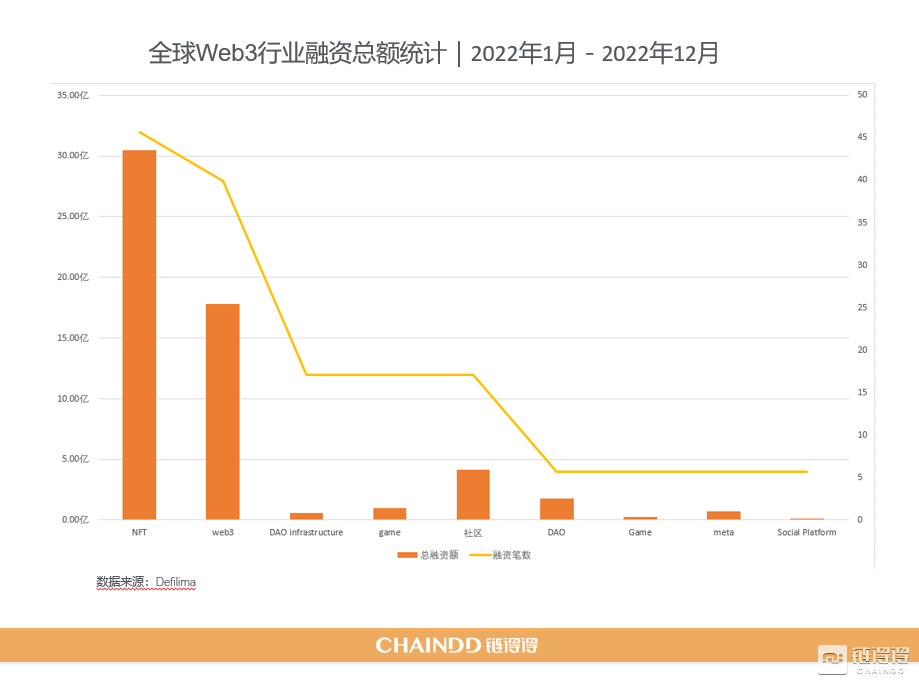
NFTs led all Web3 sectors in total funding raised, with Web3 applications and communities following closely behind.
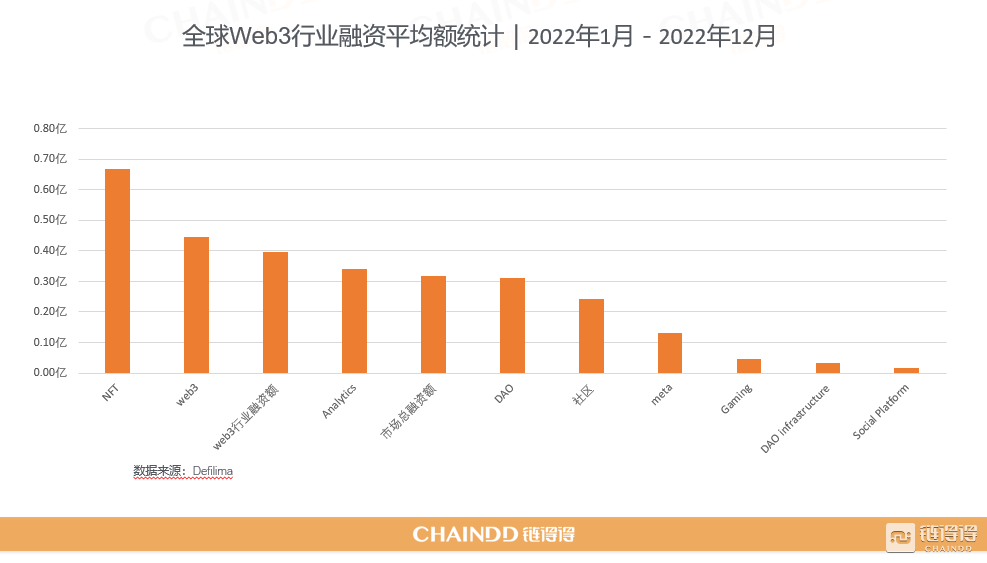
In terms of average deal size, NFTs and Web3 applications secured significantly more capital than other sectors, comfortably exceeding the blockchain industry's overall average. The average funding for Web3 projects also far outpaced the broader market average.
—2—
Web3 Riding the Wave
Over the past year, Web3 emerged as the defining buzzword of 2022. Institutional data shows that since 2017, publicly disclosed funding for Web3 has surpassed $3.6 billion, attracting active participation from top-tier investment firms.
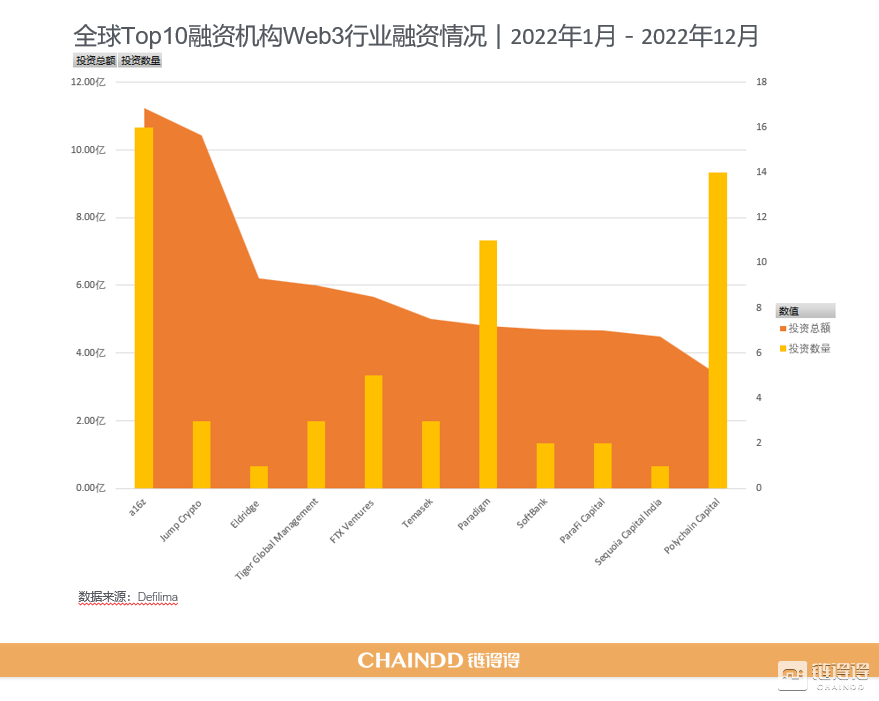
In 2022, a16z led all investors in both total Web3 funding volume and deal count. Jump Crypto participated in fewer deals but invested far more per deal than the market average.
a16z launched a dedicated $3 billion Web3 fund. Other leading firms like Sequoia Capital, Griffin, Bessemer Venture Partners, and Haun Ventures have also committed hundreds of millions each to the space.
Fueled by this capital influx, Web3 developers and startups have multiplied. According to Electric Capital, the number of Web3 developers grew 75% in 2021 alone, with over 34,000 submitting new code—a record high.

Among Web3 companies that raised funds in 2022, 49% were seed-stage ventures. Series B and later rounds accounted for less than one-third of all deals.
It's not just startups diving in—traditional internet giants are also seizing the opportunity. In May 2022, Google formed a dedicated Web3 team to provide backend services for blockchain developers, focusing on infrastructure. In June, a Meta spokesperson announced on Twitter the testing of NFT support for select U.S. creators on Facebook, with NFTs running on Ethereum and Polygon. Support for Solana and Flow NFTs is expected soon. Other tech giants followed: eBay announced plans to allow NFT trading and acquired NFT marketplace KnowsOrigin in June. Shopify also launched a service enabling merchants to create and sell NFT-based products.
Despite this vibrant activity, the Web3 boom masks deeper challenges: a lack of flagship applications, difficulty for new projects to gain traction, and the struggle for Web2.0 companies to transition successfully.
2.1 The Funding Challenge
Li Nan, a Web3 entrepreneur, told ChainDD App that a significant gap exists across the ecosystem: market participants, startups, and investors all have different understandings of Web3. This divergence directly contributes to the current situation where enthusiasm is high but broad commercial adoption remains elusive.
After leaving Alibaba in 2021, Li Nan founded a Web3 project to build a decentralized cross-chain liquidity platform. Built on Tendermint and Cosmos-SDK using a Threshold Signature Scheme (TSS), the platform doesn't wrap or bundle assets but dynamically routes them based on user activity. Essentially, it functions as a decentralized asset management protocol—what Li Nan envisions as "Alipay for crypto."
In early 2022, Li Nan secured $3 million in private funding and grew his team to 11. The larger team brought greater financial pressure, forcing him to travel frequently between Hong Kong, Singapore, and the U.S. to seek more capital. Pandemic restrictions made returning home a lengthy ordeal, so he hasn't been back in nearly a year. Despite his efforts, he found little success: while many VCs expressed strong interest, none ultimately invested.
Li Nan found himself repeatedly meeting with partners from various firms. What frustrated him most was having to explain Web3 fundamentals to traditional investors. He shared with ChainDD App a presentation deck he prepared for such audiences, covering blockchain basics, the Web3 landscape, and case studies of prominent projects.
From these conversations, he sensed genuine investor curiosity about Web3. Yet paradoxically, despite numerous pitch meetings and repeated questions about the sector, no investments materialized. Li Nan remarked wryly, "They treated me like a Web3 consultant."
He is far from alone in this dilemma. While investment firms express interest in Web3, their actual capital deployment remains highly cautious. As the blockchain industry entered a bear market, many VCs adopted strategies to reduce overall investment amounts.
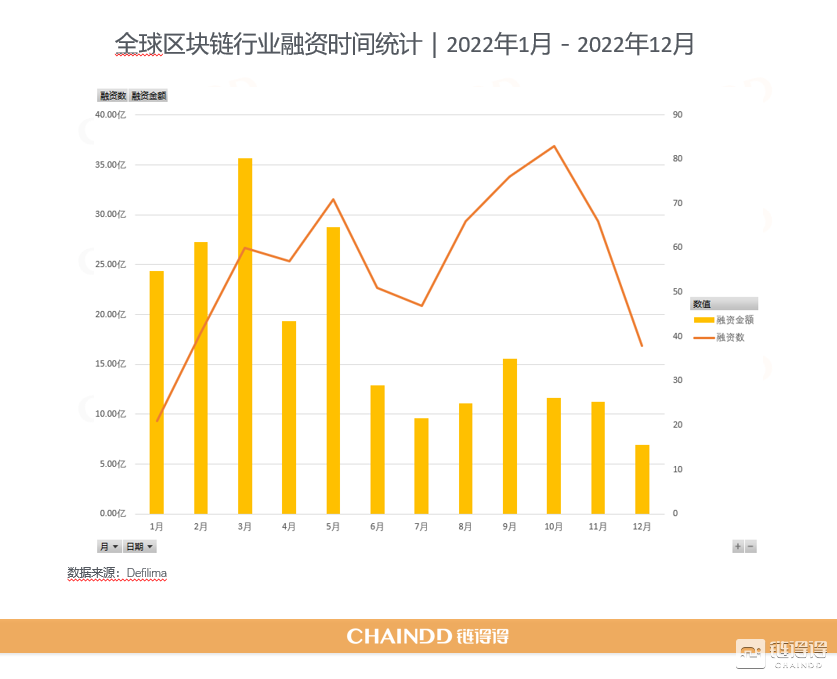
The blockchain industry's average funding amount in 2022 was approximately $31 million. Starting in June, the average deal size began declining sharply, falling to just $18.15 million by December. In contrast, the number of deals increased: the first half averaged 50 deals per month, rising to 63 per month in the second half.
2.2 The Decline of Web2.0 Enterprises
Why do Web3 applications struggle to gain market acceptance? To answer this, we must first examine Web2.0.
First, it's important to clarify that "Web2.0" and "web3" are not technical standards, but terms describing a technological evolution. Web2.0 introduced two-way communication for users, spawning new services and business models like blogs, RSS, wikis, social networks, microblogs, and instant messaging. This era also gave rise to the internet giants that dominated the first fifteen years of this century—companies like Google, Meta, and Amazon.
Driven by the internet's explosive growth, these tech giants sustained remarkable expansion through the first two decades of the century, continuously broadening their reach. They evolved into conglomerates that monopolized vast swathes of underlying technology and user data. However, with the pandemic and broader macroeconomic headwinds, these titans have entered a period of contraction.
In July, reports emerged that Apple plans to slow hiring and cut budgets in some departments next year to brace for a potential economic downturn. The news triggered sharp stock declines for Apple and other U.S. tech firms. Last month, Microsoft announced it would eliminate some roles as part of a "strategic realignment." Oracle is reportedly considering $1 billion in cost cuts, including thousands of layoffs. Twitter slashed a third of its recruiting team and terminated an outsourcing contract for its Silicon Valley headquarters. Alphabet, Amazon, and Snap have all recently announced hiring freezes and other budget controls, while Microsoft, Tesla, and Meta have already begun layoffs.
Li Nan's team has 11 members. Five based in China all have prior experience at major internet companies, or "big tech." Three backend engineers joined after leaving their jobs during the widespread layoffs that hit China's internet industry in early 2021. Li Nan's technical lead, Zhang Yuming, was out of work for three months before joining the team.
For Zhang Yuming, the move to web3 backend development had its pros and cons. On the plus side, his big tech experience gave him hands-on knowledge of building highly available systems, high-concurrency architectures, and big-data processing. Web3 roles also offered significantly higher pay, and many didn't require coming into an office. The downside was clear: while he had dabbled in Solidity, he had almost no practical blockchain development experience. What ultimately convinced him was a line from Li Nan during their remote interview: "The ultimate goal of web3 is to dismantle all internet giants."
After three years at a major internet company, Zhang Yuming held no particular affection for such giants. As a programmer with an undergraduate degree from an ordinary university, his path into big tech wasn't easy. He bounced between several startups during China's post-2015 entrepreneurial boom before finally landing a backend engineering role at a top-tier domestic firm in 2018 through an internal referral. While he made it into a leading tech giant, reality quickly diverged from his expectations. His actual coding output decreased, and his main duties shifted to mentoring junior engineers and conducting interviews—partly because project workloads were relatively light.
A key reason Zhang Yuming left was his refusal to remain a cog in a massive machine that harvested value not only from users, but from him personally. During a Spring Festival visit home, he discovered his parents had bought numerous "IQ-tax" products on a short-video app—energy-saving devices, hydrogen-rich water, and various health supplements. Ironically, the app his department had built and maintained was the very platform facilitating those purchases. After just one week of researching web3, Zhang Yuming decided to join Li Nan's team.
In 2021, web3-related investment and job postings in China surged by over 400%, spanning full-time, part-time, and remote roles. The vast majority of new practitioners came from the internet industry, including many former employees of major tech companies.
2.3 Why Does Web3 Threaten Internet Giants?
Internet-centric technology companies have broadly hit a bottleneck in innovation and growth. Whether measured by global market penetration, business expansion, or technological advancement, the Web2.0 giants that once dominated have long since plateaued.
The global pandemic and remote work temporarily fueled massive growth for the sector and sent related stock valuations soaring. But as the world enters a post-pandemic era—with normal activity resuming, remote work demand falling, liquidity tightening, and cyclical shifts—multiple converging factors have triggered a downturn across the global internet industry.
Against this backdrop, pursuing web3—the widely heralded next evolution of the internet—has naturally become a focal point. Among incumbents, Meta stands out as the most determined and aggressive. Compared to Apple or Amazon, Facebook (Meta's predecessor) was fundamentally built on Web2.0 business models, making its core social platform especially vulnerable to disruption in the web3 wave.
In November 2021, Mark Zuckerberg announced at Facebook's Connect conference that the company would rebrand as "Meta" and commit fully to the metaverse. As one of the world's largest internet companies, Meta's pivot sent shockwaves through the digital ecosystem, prompting a widespread question: Why was Zuckerberg so eager to steer such a massive ship in a completely new direction?
One thing is indisputable: Zuckerberg sensed an existential crisis, with the emergence of new internet paradigms posing the most immediate threat.
Shortly after Ethereum launched in 2014, co-founder Gavin Wood introduced the concept of "Web3." At its core, Web3 aims to return power to users—not as abstract rights, but as verifiable ownership—leveraging blockchain, cryptocurrencies, and NFTs. In simple terms: Web1 was read-only; Web2 added read-and-write; Web3 adds true ownership. Web3 is decentralized: most of the internet is not controlled by centralized entities, but governed collectively by builders and users. It's permissionless: everyone has equal access. It features native payments via cryptocurrency, bypassing outdated banking infrastructure. And it's trustless, operating through incentives and economic primitives rather than intermediaries.
Given these traits, there's no room for "giants" in the Web3 world—or rather, Web3's ultimate goal is to eliminate them. Whether they admit it or not, internet giants rose to dominance by monopolizing the vast majority of online data.
So-called "monopolistic enterprises" typically build "moats": by controlling supply chains and leveraging proprietary patents and technology, they create barriers that stifle competition.
In the internet sector, such monopolies are even easier to establish. Core technologies themselves become moats. And in recent years, as the value of data has become increasingly recognized, data has evolved into a critical component of corporate defenses.
Take Google. Since its founding in 1998, it first monopolized search through superior technology. It then expanded into advertising, cloud services, email, video, and social networks—each gradually achieving market dominance. User data flows seamlessly across Google's services, generating compounding value and forging a global internet empire.
For example, User A searches for a product on Google and watches a related video on YouTube. That behavioral data is stored and used to serve hyper-targeted ads. Over the following days, User A sees tailored ads for that product across different websites. Based on such data, Google builds detailed user profiles deployed across its services. These datasets often include sensitive information like social connections, health records, and location history.
Within Google's ecosystem, both its proprietary technologies and the data generated by users form its formidable moat. Competitors lacking comparable user data find it nearly impossible to replicate Google's offerings. Beyond delivering personalized services, Google monetizes this data at scale. Crucially, in this dynamic, Google and users are profoundly unequal: Google holds absolute control over user data, while users receive none of the value derived from it.
2.4 How Far Is It from Web2.0 to Web3?
This model is standard practice among Web2.0 internet giants. Web3 was born explicitly to break such monopolies, placing it in inherent conflict with them. This tension manifests in the difficulty of transplanting Web2.0 product logic into Web3 applications, creating persistent friction between theory and practice. Consequently, internet giants continue to struggle to launch genuinely functional Web3 products. Meta is a prime example: its stablecoin and wallet initiatives repeatedly hit roadblocks and were eventually abandoned. Beyond sporadic experiments displaying NFTs on Twitter and Instagram, it has yet to launch any meaningful Web3 application.
Other internet giants face similar challenges. Outside of foundational infrastructure, their presence in the Web3 ecosystem remains virtually nonexistent.
It's not just giants encountering these issues; internal disagreements about Web3 versus Web2.0 also persist within startup teams.
Li Nan dreams of turning his project into "Alipay for the Web3 era." But Zhang Yuming considers this vision flawed. Speaking to ChainDD App, Zhang explained that Web3's development reminds him of China's 2015 startup boom—waves of ventures emerging and failing rapidly, populated by gold-rush speculators. "Web3, built on decentralized blockchain technology, can't be realized using Web2.0 governance or product logic," he said. "Both Web2.0 companies and startups must first bridge a cognitive gap to build accepted Web3 projects. The first step is abandoning traditional corporate structures for DAO-based governance."
Li Nan, however, believes Zhang Yuming is overly idealistic. While DAOs offer maximal decentralization, they also introduce severe inefficiencies—a trade-off nearly intolerable for someone like Li Nan, who comes from big tech and is accustomed to rapid iteration and agile development.
In reality, their disagreement has nearly stalled the project's development, pushing the launch of its demo further out of reach. Zhang Yuming plans to leave with several engineers to join other DAO-governed projects. Li Nan's attempts to persuade him to stay have left Zhang conflicted: "No one can say for sure that DAOs are the only right path—this project still has room to grow. With no clear blueprint to follow, we're essentially feeling our way forward. And who knows? The current Web3 momentum could fade at any time."