

As 2020 drew to a close, the public discourse around blockchain in China remained largely positive. Momentum from the "October 24" policy directive, progress on the central bank's digital currency (CBDC), and a steady stream of real-world applications all contributed to growing confidence in the technology's widespread adoption.
Interchain Pulse reviewed the past year's blockchain deployments. While the overall number of applications stayed high, the underlying technology platforms often operated behind the scenes as unsung heroes. We selected 12 representative platforms—including foundational infrastructure, consortium chains, and Blockchain-as-a-Service (BaaS) providers—and compiled their publicly disclosed projects from 2019.
The data reveals a broad decline in disclosed deployments across major platforms in the second half of 2019 compared to the first. This could be partly due to projects not yet being announced. Furthermore, the disclosed projects suggest that domestic tech platforms are converging on three distinct development paths.
Note: "Deployed applications" here refer to those integrated with the real economy, excluding games, gambling, exchanges, or Ponzi schemes built on public chains. For this analysis, projects within the same corporate group were attributed to the platform that disclosed the highest number for that group.
Fewer Public Disclosures from Tech Platforms; Industry Points to Rise in Government Contracts
Drawing from semi-annual 2019 reports and the 2019 China Blockchain Infrastructure Platform Development Report, Interchain Pulse analyzed 12 platforms: Ant Chain, ThunderChain, Qulian, FISCO BCOS, Ping An OneLedger, ZhongAn Chain, Tencent Blockchain, Baidu XuperChain, JD Zhizhen Chain, Huawei Cloud Blockchain Service (BCS), Zhongqian (now merged with Shangshangqian), and Zhongxiang Bit.
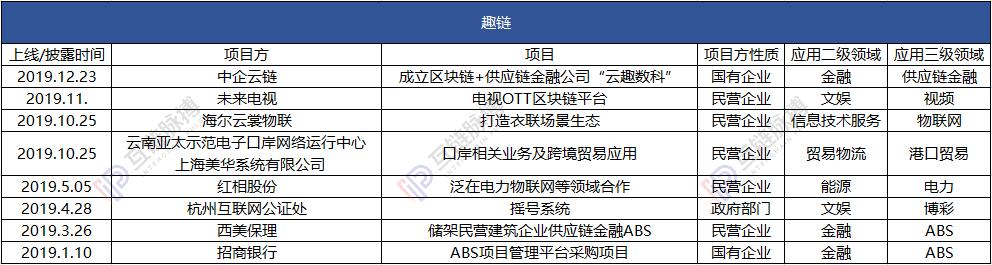
Based on our incomplete statistics, these 12 platforms disclosed 92 projects in 2019. Ant Chain led with 24, primarily from Alibaba Group and Ant Financial. ThunderChain followed with 12, and Tencent Blockchain with 11. Zhongqian disclosed 7 projects before its July 2019 merger with Shangshangqian; the combined entity reported 9 for the full year. Qulian, Ping An OneLedger, JD Zhizhen Chain, FISCO BCOS, Baidu XuperChain, ZhongAn Chain, Huawei Cloud BCS, and Zhongxiang Bit disclosed 8, 7, 6, 5, 4, 3, 2, and 1 project(s), respectively.
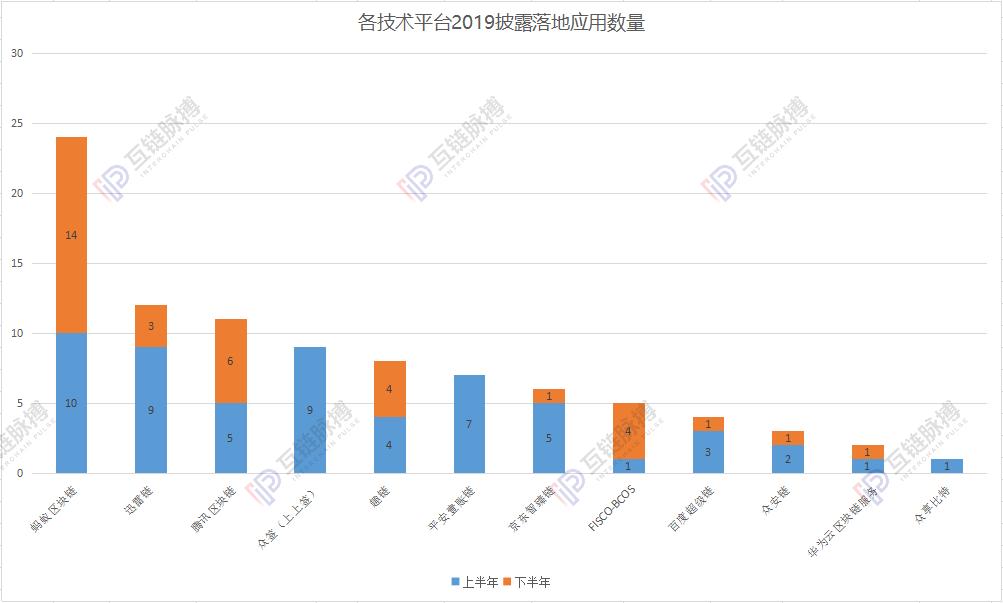
In H2 2019, Ant Chain significantly increased its disclosed deployments to 14, a 40% rise from H1. In contrast, Ping An OneLedger disclosed no new projects. Overall, the 12 platforms disclosed 57 projects in H1 and only 35 in H2, indicating a decline in public announcements.
However, our global full-year 2019 statistics show 408 disclosed deployments in H1 and 437 in H2—a modest increase. Following the "October 24" policy, government procurement interest surged. Several blockchain providers told Interchain Pulse they've seen a spike in government consultations and training. Many government and state-owned enterprise (SOE) projects are already under development or live, though not yet public. The slower growth in disclosed deployments in H2 may reflect the longer, more complex approval processes typical of public-sector collaborations.
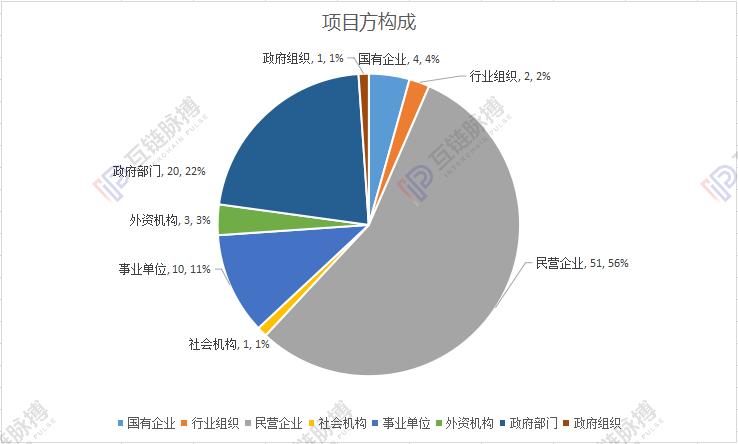
Of the 92 projects disclosed, collaborations with private enterprises were most common (51 projects, 56%). Government departments, public institutions, and SOEs followed with 20, 10, and 3 projects, respectively.
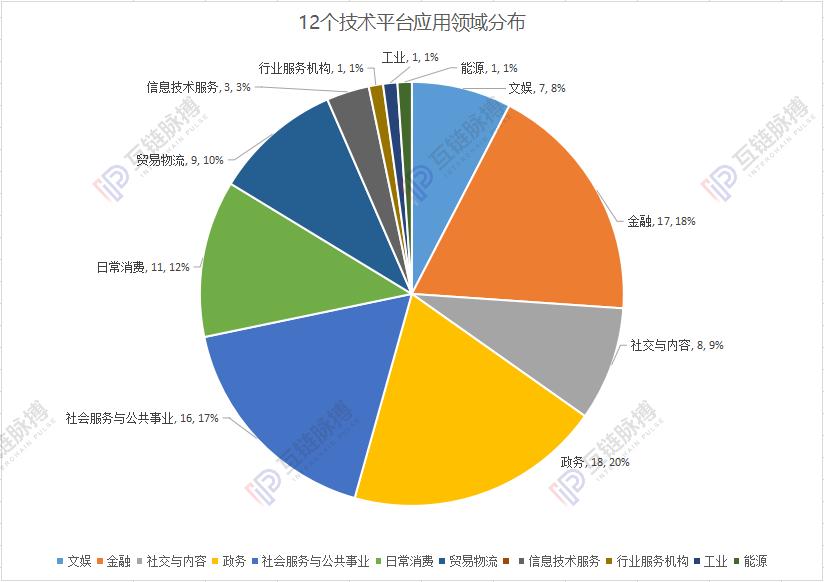
By sector, government services and finance led with 18 and 17 projects, respectively. Social services and public utilities ranked third with 16 deployments, another key focus for leading platforms.
Three Development Paths for Blockchain Technology Platforms
Based on their deployments, current blockchain platforms fall into three broad categories. First, dedicated blockchain firms like ThunderChain, which provide cross-industry solutions to drive sector-wide "blockchain transformation." Second, tech giants like BAT (Baidu, Alibaba, Tencent), whose current blockchain efforts often prioritize public-sector and government applications, serving more as tools for maintaining relations and building social credibility than as primary revenue drivers. Third, platforms like Ping An OneLedger, which evolved from existing industrial ecosystems and maintain a strategic focus tightly aligned with their parent company's core business.
Empowering Multiple Industries: ThunderChain Leads in Deployment Breadth
Among the 12 platforms, ThunderChain's 12 deployments spanned the most sectors—seven in total, including daily consumer goods, IT services, social services & public utilities, finance, social media & content, and culture & entertainment. Ant Chain also touched seven sectors, but with 24 disclosed projects, there was more overlap in its domain choices.
Beyond sector breadth, ThunderChain's deployments showed minimal repetition in specific use cases, covering areas like food & consumption, big data, healthcare, e-commerce, transportation, insurance, publishing & copyright, sports, and gaming.
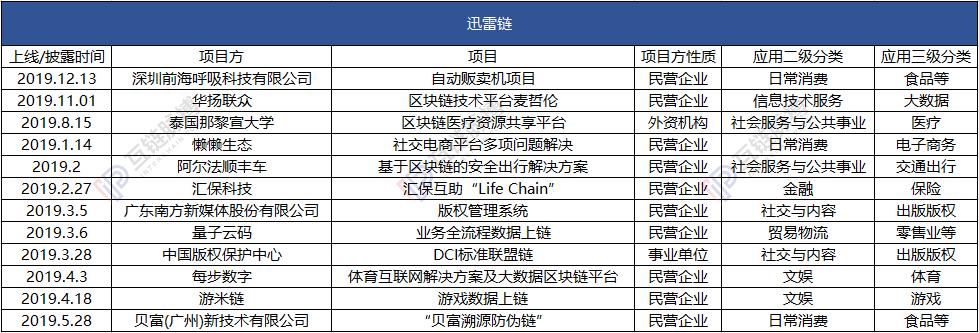
One of ThunderChain's projects highlights Chinese blockchain technology going global: a partnership announced on August 15, 2019, with Thailand's Naresuan University to build a blockchain-based medical resource-sharing platform. The platform uses ThunderChain's technology across the university's network of over 490 medical institutions to enable secure, on-chain storage of patient records.
As traditional enterprises increasingly seek blockchain integration, technology platforms must provide versatile, sector-specific solutions to enable cross-industry transformation. Expanding application scenarios is key to driving broader societal efficiency and quality improvements.
Similar to ThunderChain, FISCO BCOS, ZhongAn Chain, and Zhongqian (now Shangshangqian) are also broadening their application scope. Though FISCO BCOS and ZhongAn Chain disclosed few projects in 2019, their choices indicate a deliberate effort to empower diverse traditional industries. For instance, FISCO BCOS's five projects span automotive manufacturing, finance, copyright, and public utilities. ZhongAn Chain's three cover social services & public utilities, social media & content, and culture & entertainment. Qulian's eight deployments touch finance, culture & entertainment, energy, trade & logistics, and IT services.


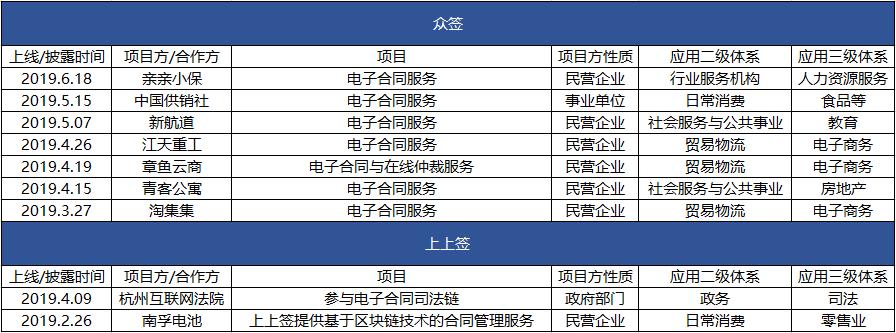
Notably, Zhongqian Blockchain disclosed seven projects in H1 2019, ranking among the top three platforms for that period. Its electronic contract services spanned daily consumer goods, social services & public utilities, trade & logistics, and industry service providers. However, on July 31, 2019, Zhongqian and Shangshangqian announced a strategic merger, with Shangshangqian's CEO Wan Min leading the combined entity. Post-merger, neither disclosed new projects; Shangshangqian had disclosed two in H1 2019.
Focusing on Public Good: The "Government-First" Approach of Ant Group, Tencent, and Baidu
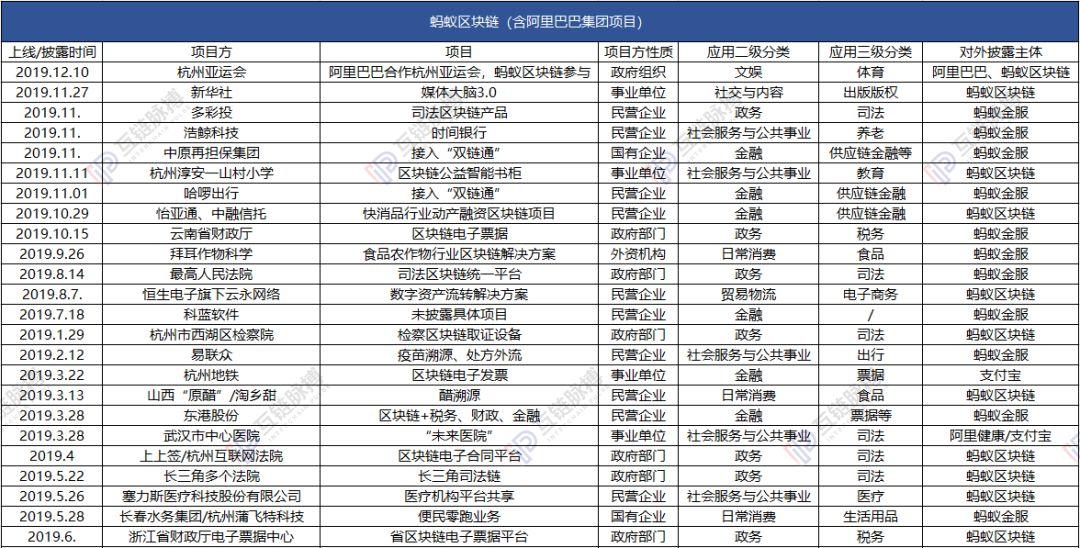
In contrast to other platforms, Ant Blockchain, Tencent Blockchain, and Baidu Blockchain have carved out a distinct niche, with a clear focus on government services and social welfare applications.
In 2019, Ant Blockchain launched seven government-focused projects and five applications in social services and public utilities. Its government work often centered on judicial and tax invoice solutions. For instance, in November 2019, Ant Group partnered with Duocai Tou to develop a judicial blockchain product. Earlier that year, in August, under the guidance of the Supreme People's Court, Ant built a unified judicial blockchain platform. In the social sector, Ant also developed products targeting healthcare and education.
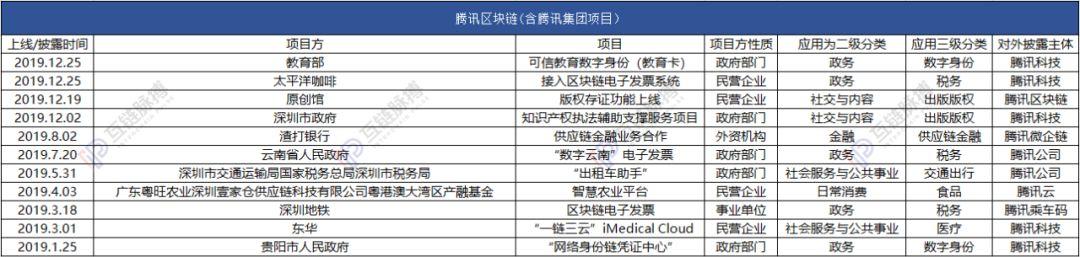
Similarly, among the 11 projects disclosed by Tencent Blockchain, five were for government use and two fell under social services and public utilities. Examples include an education card product with verifiable digital identity launched for the Ministry of Education on December 25, 2019, and an intellectual property law enforcement support system built for the Shenzhen Municipal Government on December 2, 2019.
Of Baidu's four disclosed projects, two served government departments. These included a blockchain-based judicial arbitration system for the Qingdao Arbitration Commission and the "Wangtong Falian" intelligent credit ecosystem launched at the Guangzhou Internet Court. Baidu also collaborated with the China Copyright Protection Center to offer copyright services.

Financially, these public-interest projects are rarely major profit drivers, but they significantly boost a company's social standing. For well-resourced tech giants like Ant Group, Tencent, and Baidu, such initiatives are a current priority. They view blockchain more as a strategic long-term investment than a source of immediate revenue.
Building on Core Business: The Path of JD.com and Ping An
Another category of platforms has grown naturally from a company's existing operations, with their blockchain applications deeply integrated into the parent company's core business.
JD.com Blockchain's applications reflect its e-commerce roots. Of its six applications launched in 2019, four focused on supply chain traceability—for products like tea, black pigs, e-commerce goods, and pharmaceuticals. JD Group and JD Digits were frequently listed as the implementing entities.

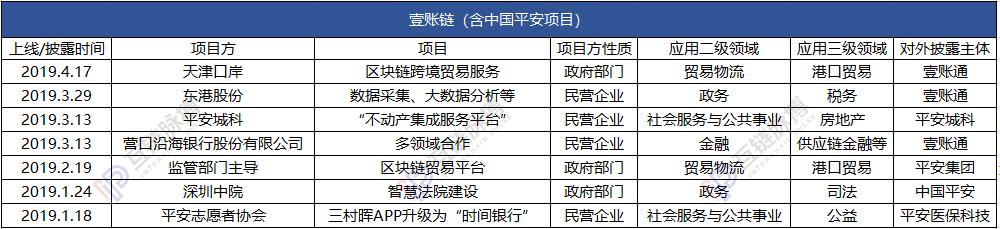
Ping An's OneConnect launched seven projects in the first half of 2019, tying for third place, but announced no new projects in the second half. Following its U.S. IPO on December 13, no new applications for 2020 have been disclosed. Its deployed applications are heavily weighted toward trade finance, with others supporting internal group operations. These include upgrading the "Time Bank" platform for the Ping An Volunteers Association and building a blockchain-integrated "Real Estate Integrated Service Platform" for Ping An City Science & Technology.
Huolian Pulse also tracked disclosed applications from Huawei Blockchain and Zhongxiang Bit. Huawei announced one government and one financial project in 2019. Its Beijing Catalog Blockchain application has seen notable adoption: by January 20, 2020, the system had onboarded 53 municipal departments, according to the Beijing Municipal Bureau of Economy and Information Technology. Plans for 2020 included using the platform to enable efficient data sharing between departments and piloting district-level systems.

Zhongxiang Bit disclosed one project in 2019: a strategic partnership with the China Banking Association to build the "China Trade Finance Cross-Bank Transaction Blockchain Platform." In a previous interview with Huolian Pulse, the company explained its revenue model involves building platform products for clients and sharing revenue based on the data and transaction volume generated. According to disclosed figures, Zhongxiang Bit reported revenue of RMB 17.8757 million and a net profit of RMB 2.873 million for 2019, making it one of the few blockchain firms to publicly claim profitability.

While implementation strategies differ across technology platforms, one thing is clear: these diverse efforts are steadily pushing blockchain applications toward greater maturity in the real world.