

Introduction: The supply chain finance market was rocked by major risk incidents in 2019. As a vital component of supply chains, this sector is in urgent need of an upgrade.
The deep integration of emerging technologies like blockchain, IoT, and big data into logistics, particularly the unique attributes of blockchain, is providing new answers to old problems in supply chain finance. As a result, the supply chain is emerging as one of blockchain's most promising application areas.
2019: Explosions, Policy Signals, and a Perfect Match
Two major scandals hit supply chain finance in 2019. On July 8, Noah Holdings' RMB 3.4 billion private fund imploded due to exposure to Chengxing International. Soon after, Fujian Minxing Pharmaceutical Co., Ltd. was exposed for fabricating accounts receivable to secure financing. Multiple financial institutions, including Zhongyuan Securities and Guolian Trust, were implicated, with total funds involved exceeding RMB 2.2 billion.
Who's to blame for these repeated blow-ups? In truth, such fraud is commonplace even among banks that actively finance micro and small enterprises (MSEs). Classic cases include the Shanghai steel trading scandal, the Qingdao Port incident, the Dalian Machine Tool case, the Guangdong pulp fraud, the Hengyun Pharmaceutical debacle, and the Jinlianshu affair.
For the industry, 2019 also brought two pivotal developments. First, in July, the China Banking and Insurance Regulatory Commission (CBIRC) issued guidelines to promote supply chain finance for the real economy. The document outlined four principles: precision in financial services, authenticity of transactions, accessibility of information, and comprehensive risk management. Notably, it explicitly encouraged institutions to integrate blockchain technology into transaction processes. Second, President Xi Jinping elevated blockchain to a national strategic priority in a major speech, igniting widespread enthusiasm for the technology.
The convergence of these events instantly cemented "Blockchain + Supply Chain" as a perfect match, bringing the vision of "dual-chain integration" into sharper focus, Wang Chao, Deputy General Manager of the Research Center at Sifang Jingchuang (300468.SZ), told ComputePower Intelligence.
Blockchain's distinctive features offer viable solutions to the key challenges holding back supply chain finance, making this domain one of the technology's most promising frontiers.
How Blockchain Can Break Through in Supply Chain Finance
Blockchain technology—with its distributed data storage, peer-to-peer transmission, consensus mechanisms, and cryptographic algorithms—enables rapid confirmation of core enterprises' accounts payable while cutting out intermediaries. Transaction data serves as tamper-proof evidence, preventing fabrication and enabling full traceability. Crucially, the integration of blockchain with supply chain finance enjoys strong policy support. Indeed, blockchain's technical attributes align perfectly with the requirements of supply chain finance, offering concrete solutions to its persistent pain points.
Supply chain finance has opened a window to ease the financing difficulties of SMEs and MSEs. Driven by technological advances and market liberalization, today's landscape is far more dynamic than traditional models, thanks to diverse participants, funding channels, and vastly improved information flow. Yet, stubborn challenges remain.
Industry insiders summarized the key challenges for ComputePower Intelligence:
1. Information asymmetry hinders financing.
2. A poor credit environment.
3. Difficulty ensuring business security.
4. High financing costs.
As blockchain matures, its inherent characteristics are a natural fit for supply chain finance, providing practical answers to these pain points. The convergence of the two also benefits from robust policy backing.
Building on this, Sifang Jingchuang (300468.SZ) launched a comprehensive blockchain-based supply chain finance solution centered on core enterprises. Recognizing different trust anchors upstream and downstream, it offers two approaches: upstream solutions leverage the core enterprise's credit, while downstream solutions rely on verifiable data from pledged assets. The former uses "Blockchain + Tokens" to unify the "four flows" (information, logistics, capital, and commerce), allowing accounts receivable to be flexibly split, transferred, and financed. The latter innovatively integrates IoT hardware—like RFID chips, smart cameras, and IoT-enabled locks—with white-box cryptography, turning them into trusted data sources for the blockchain. This delivers a complete "Blockchain + ARIF" end-to-end solution.
Similarly, Bubi Technology, a company deeply involved in supply chain finance, launched its blockchain-powered product "Yinuo Finance" to address client pain points. Wang Jing, Co-Founder and CTO of Bubi Blockchain, told ComputePower Intelligence that through professional financial services and strong R&D, Bubi demonstrates that "Blockchain + Supply Chain Finance" represents the future of industrial finance.
2020 Outlook: Fierce Competition, Bright Prospects
According to ComputePower Intelligence, over 45 listed companies are currently exploring deep applications of blockchain in supply chain finance (data from Tonghuashun).
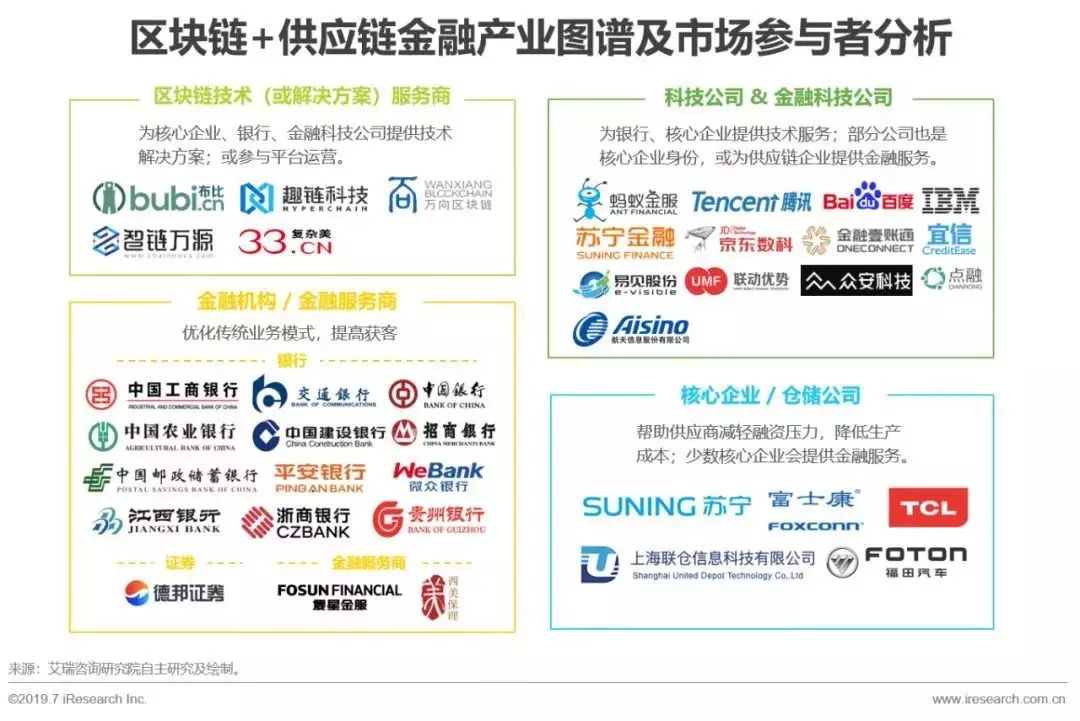
In the next three years, participants in supply chain finance will become increasingly diverse. Beyond traditional core enterprises, their partners, and financial institutions, fintech companies will emerge as critical players. Meanwhile, B2B industrial service platforms developed by multiple stakeholders will best embody industrial integration, Wang Chao told ComputePower Intelligence.
Furthermore, empowered by blockchain, IoT, AI, and other technologies, financing costs for SMEs will drop substantially, lending risks for financial institutions will decline sharply, and corporate operational efficiency will improve significantly—ultimately enabling financial services to truly serve the real economy.
In practice, supply chain finance targets SMEs and MSEs. Although Chinese banks have promoted it for over a decade and achieved scale, it still falls short of meeting their financing needs—fundamentally due to risk control and operational cost concerns. Blockchain's verifiability and immutability allow banks to better manage risk and drastically reduce operational overhead.
Overall, blockchain technology effectively tackles long-standing challenges in bank-enterprise financing: difficulty accessing funds, monitoring risk, and regulatory oversight. Blockchain applications in supply chain finance are steadily moving toward real-world implementation. "Blockchain + Supply Chain Finance" may become the optimal solution for banks to promote these services, offering bright prospects ahead.