

Both Tim Berners-Lee, father of the World Wide Web, and Satoshi Nakamoto, creator of Bitcoin, were part of the Cypherpunks movement—yet history shows they never joined forces. Henry Wang's "Grand Unified Theory of Web3.0" finally bridges this divide, uniting these two giants to restore clarity and purpose to the third-generation internet.
The widespread adoption of Web3.0 and Decentralized Physical Infrastructure Networks (DePIN) won't start in developed nations. Instead, it will first take root in regions like Asia, Africa, and Latin America, where traditional infrastructure lags behind.
This past May in Hong Kong, the prominent Chinese-language Web3 community 1783DAO hosted "The Mass Adoption Moment for DePIN" at Central's Exchange Square. The event emerged as one of the most popular and professional side events during Bitcoin Asia, drawing over 500 attendees.
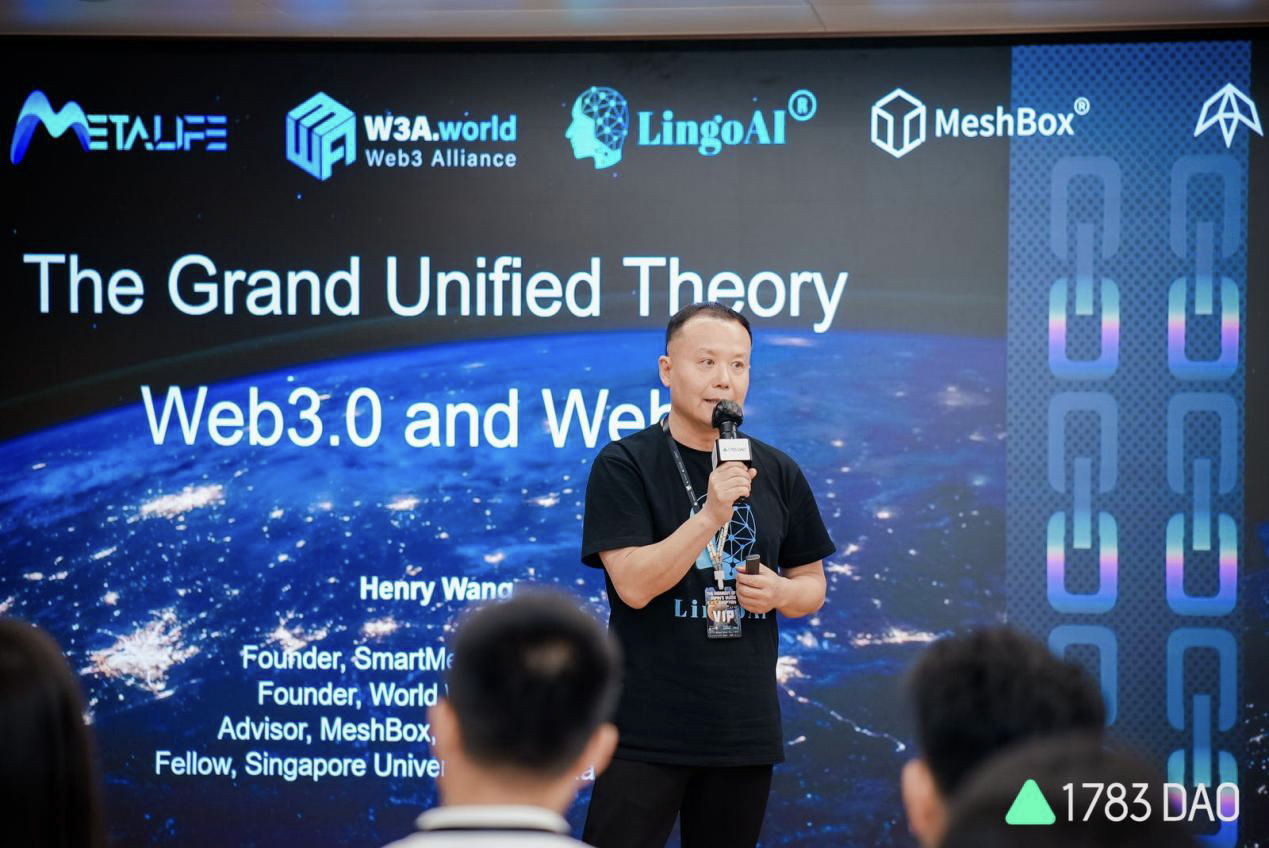
There, Henry Wang—founder of the SmartMesh Foundation and W3A World Web3.0 Alliance, advisor to LingoAI, MetaLife, and MeshBox, and a researcher at the Singapore University of Social Sciences (SUSS)—delivered a keynote titled "Web3.0 and the Grand Unified Theory of Web3." Here are the key takeaways from his presentation:
The term "Web3.0" was first coined by Henry Wang back in 2003 while he was developing Movo, a cross-lingual social network built on the "One World, One Web" vision. Movo gave users ownership of their data (like articles) and used AI to let people view and interact with content in their native language, enabling real-time multilingual communication. By 2006, Tim Berners-Lee himself had adopted "Web3.0" to describe the web's next evolution, moving beyond his earlier "Semantic Web" label. His revised definition explicitly incorporated decentralization and user data sovereignty to address flaws inherent in the original HTTP and WWW protocols.
Henry explained that while the simplicity of foundational protocols like TCP/IP and HTTP fueled the internet's early growth, it also created lasting problems: network hegemony, centralized data monopolies, and widespread privacy violations. TCP/IP's lack of a native value layer allowed telecom operators to control infrastructure centrally through billing. Meanwhile, HTTP's simplicity led to application data being hoarded by giants like Facebook and Twitter, creating walled gardens. These companies monetized user data at scale, while the users themselves saw no fair return.
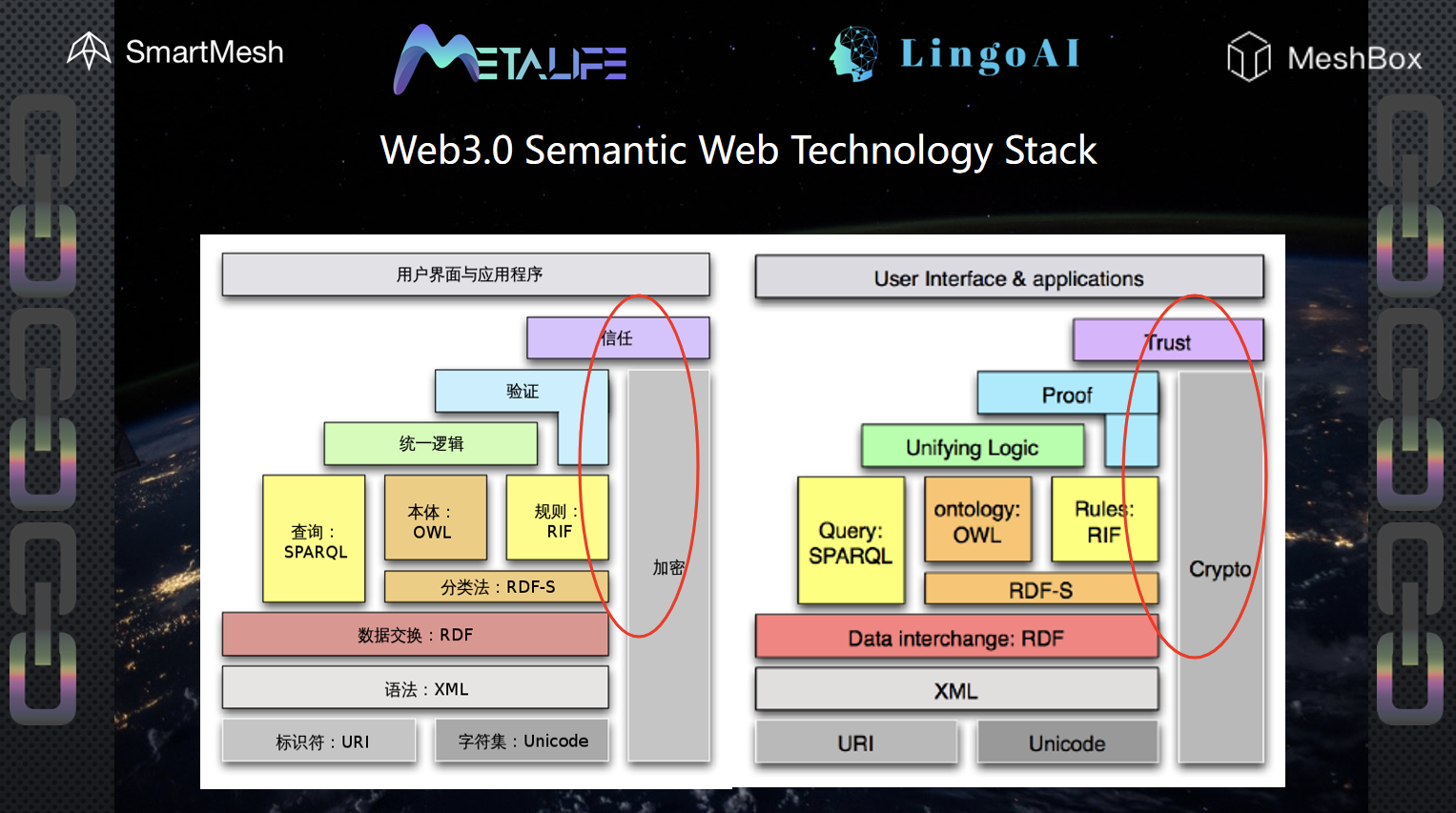
Henry noted that Web3.0 rests on three pillars: decentralization, data sovereignty, and privacy protection. Its ultimate goal is to separate data from applications, returning ownership to users. Protocols like SOLID, proposed by Berners-Lee, aim to achieve this. However, the "right-side" trust technologies within his Semantic Web stack lost out to Satoshi Nakamoto's blockchain in direct competition—a divergence that has misled the entire industry.
He highlighted a pivotal coincidence from 2008: both Tim Berners-Lee's whitepaper "Decentralization: The Future of Online Social Networks" and Satoshi Nakamoto's "Bitcoin: A Peer-to-Peer Electronic Cash System" were published that same year. This was no accident. Both blockchain and Tim's AIR (Accountability In RDF)—a verifiable, tamper-proof language—tackle the same core problem: enabling trusted exchange in an untrusted environment via immutable records. Both paths are valid, but because Nakamoto's implementation included cryptocurrency, tying it closer to real-world finance, blockchain gained more traction in the trust technology race.
Despite their shared Cypherpunk roots, Berners-Lee and Nakamoto never collaborated.
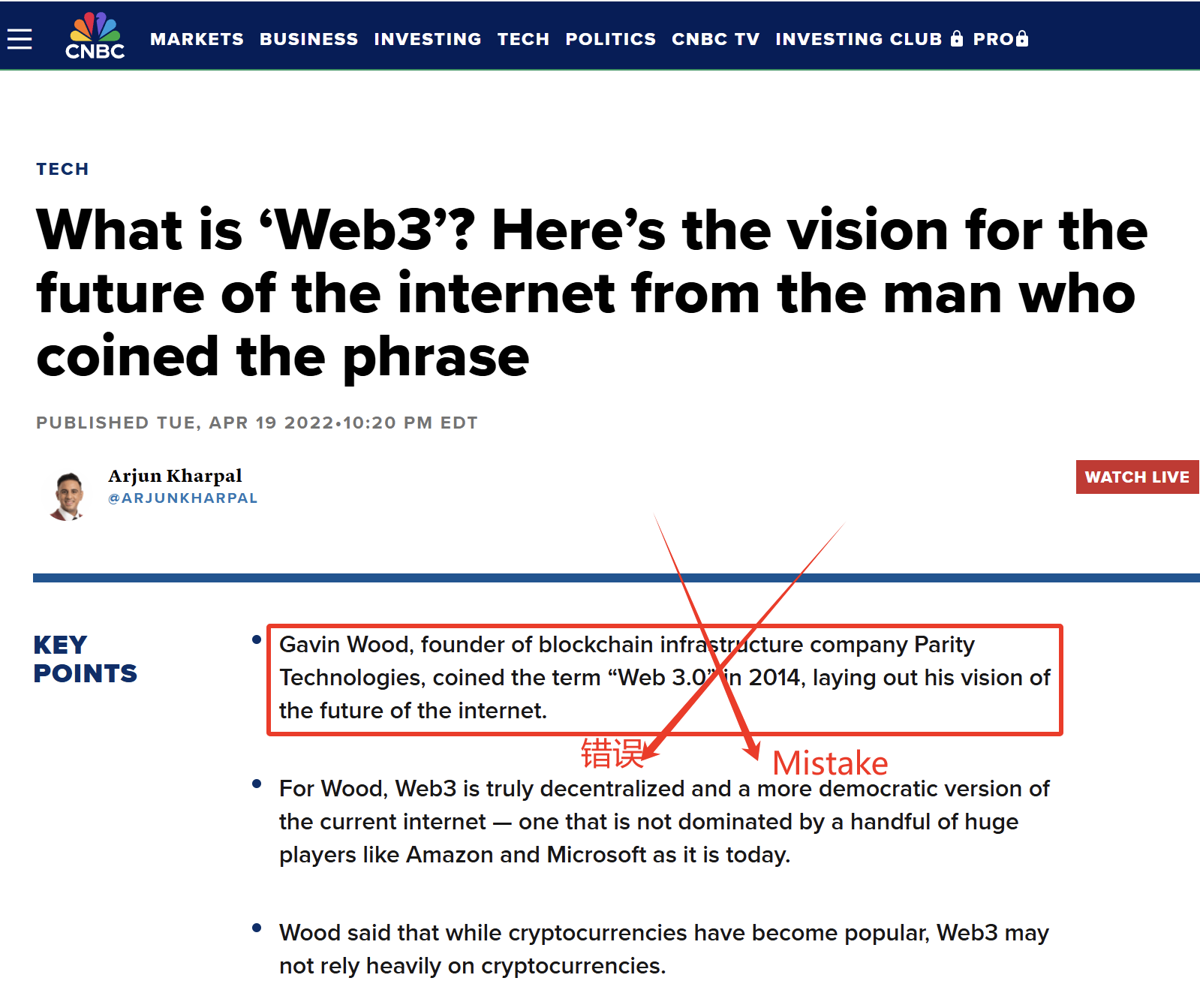
Henry stressed a major misconception: the widespread belief that Gavin Wood first coined "Web3" in 2014. This error has nearly led the world astray, conflating blockchain and cryptocurrency with the next-generation internet (Web3/Web3.0). Because crypto is so tied to finance, the public often sees "Web3" as synonymous with speculation, rug pulls, and Ponzi schemes. This makes it incredibly difficult for regulators worldwide to balance innovation with oversight. Berners-Lee himself has criticized this media-driven narrative, stating that such "Web3" isn't the web at all, and that this mislabeling dangerously distorts the true vision of Web3.0.
Henry shared that today's blockchain and crypto ecosystems have become overly financialized zero-sum games—playgrounds for speculators that extract value from users. Even some early Web3.0 believers have grown disillusioned. If this version of "Web3" continues unchecked, it will face ever-stricter crackdowns. Conversely, Berners-Lee's Web3.0 protocols like SOLID are too detached from monetary incentives and lack practical traction, causing Web3.0's core mission—dismantling data monopolies—to be largely ignored.
Berners-Lee leans left; Satoshi Nakamoto leans right. If Web3.0 and "Web3" continue to drift apart, neither can achieve the goal of decentralizing the next-generation internet.
To restore conceptual clarity, Henry Wang proposes the "Grand Unified Theory of Web3.0 and Web3." He labels Berners-Lee's data-and-application protocols (like SOLID and the Semantic Web) as the "left-side" of Web3.0, and Nakamoto's peer-to-peer value-transfer protocols as the "right-side." He argues these two sides must integrate, not evolve separately, to realize the true third-generation internet. From now on, "Web3" should serve as the official abbreviation for "Web3.0," representing a single, unified concept.
In this unified Web3.0, blockchain and crypto function solely as the value-transfer layer. The grand narrative is the architecture itself: enabling data sovereignty to separate data from applications, and tokenizing value to build a global distributed data marketplace. Data is the new oil of the Web3.0 era. These protocols let users reclaim ownership of data currently locked in Web2.0 silos. The economic value unlocked could surpass the total market cap of all existing cryptocurrencies like BTC and ETH by two to three orders of magnitude. True Web3.0 tokens are backed by data, allowing users to monetize their personal data assets—effectively giving everyone their own piece of the internet.
Since J.C.R. Licklider first envisioned an "intergalactic computer network" in 1962, we've moved from the circuit-switching era, through packet-switching, into what Henry Wang defines as the "token-switching" era. Now, networks facilitate not just data exchange, but the exchange of data *and* value, creating the world's largest decentralized data marketplace: A Web of Data, or Web3.0.
MetaLife embodies this vision, merging data sovereignty with decentralized social networking while remaining fully compatible with Berners-Lee's SOLID protocol. At its core, SOLID enforces data sovereignty: users store data in a personal online datastore (POD) but retain full control, granting or revoking access to apps at will. This design prevents platform monopolies and data misuse. While not yet mainstream, SOLID's architecture lays the groundwork for Web3.0.
The decentralized social network MetaLife.Social is a Web3.0 protocol that bridges Berners-Lee's SOLID with blockchain-based crypto incentives. This year, it will deploy Web3's fundamental token-incentivized protocol for separating data from applications, heralding a new era.
The future value-internet will be built on Web3.0's decentralized protocols, achieving both data sovereignty and seamless value transfer. Protocol-layer innovation will disrupt current business models, accelerating the internet's evolution from an information-delivery system to a value-delivery infrastructure. Blockchain and crypto will provide users with new ways to monetize their data, establishing entirely new economic paradigms.
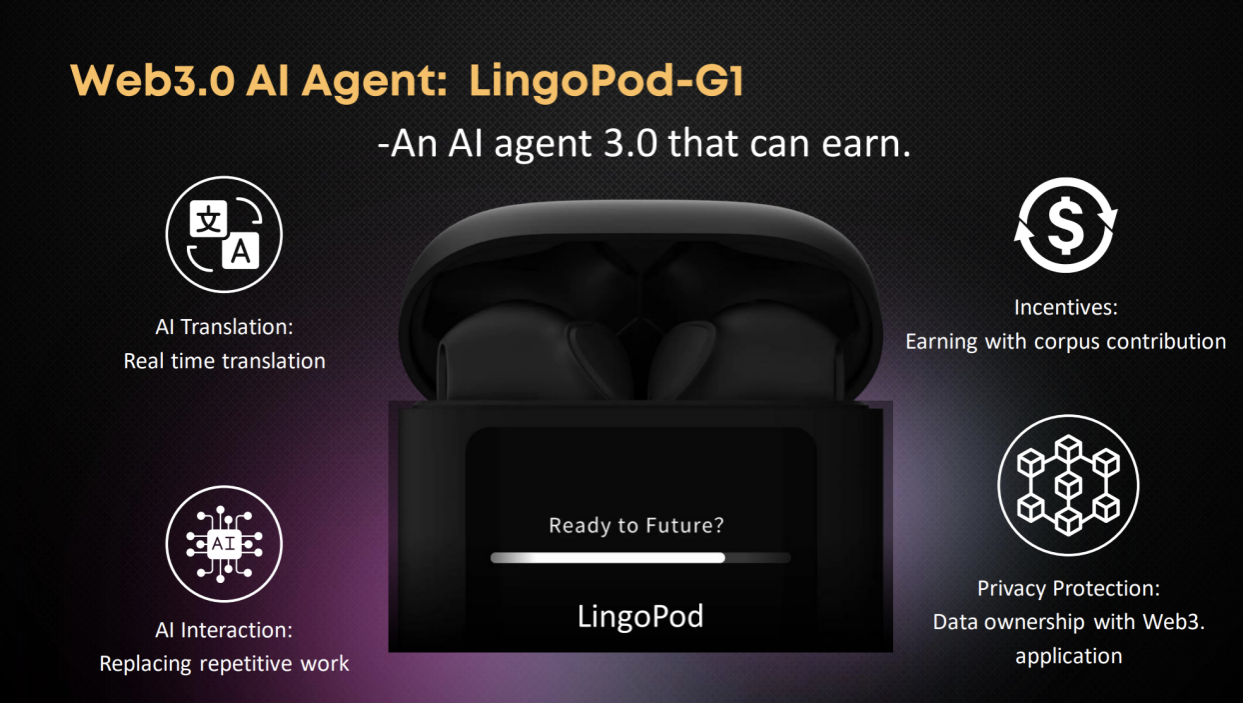
In the future, websites and apps as we know them may fade. Humans will interact with AI agents via voice or gesture, and those agents will handle everything. AI assistants will become essential infrastructure, but this future must be built on Web3.0. Large language models (LLMs) running on centralized servers like OpenAI's cannot guarantee personal privacy. Only decentralized Web3.0 AI agents can truly protect users—a concept pioneered by the LingoAI project with LingoPod, the world's first Web3.0 AI agent earpiece, hailed as a "real-time multilingual communication神器."
On the relationship between AI and Web3.0, Henry observed a divide: most AI practitioners view Web3 developers as "rug-pull artists," while many in Web3 see AI-integrated projects as just "riding the hype wave."
Henry emphasized that many fail to grasp a fundamental truth: sustainable AI is built on Web3.0. While AI is the ultimate productivity tool, Web3.0 determines its ownership and how the value it creates is distributed. Without Web3.0, AI development is unsustainable and will remain under the control of a few tech giants like OpenAI, Microsoft, Google, and Amazon. Achieving AGI (Artificial General Intelligence) early could be a boon for humanity, as its capabilities would operate on a completely different level. However, until AGI arrives—and while AI is still centralized—it poses the greatest threat to humanity, surpassing even the risks of low-Earth-orbit (LEO) satellite constellations and nuclear weapons.
To mitigate the risks posed by LEO satellite constellations, we need a peaceful framework based on Web3.0 and DePIN—the Decentralized Physical Infrastructure Network. This involves creating an interconnected constellation that allows all LEO systems to work together globally. Its operation must be free from sovereign control, with data sovereignty resting solely with individual users, not with any state or its capital. Such a system would allow countries across Asia, Africa, and Latin America to confidently adopt satellite services without fearing for their data sovereignty or privacy.
By implementing DePIN systems, we can secure LEO satellites and build a new, participatory internet. This network would maintain offline communication and payment capabilities (e.g., via SmartMesh) even during disasters, ensuring a cashless society remains functional. This vision is a key part of the new Web3.0 paradigm.
Henry Wang noted that Web3.0 and DePIN adoption won't start in developed nations, but in regions with inadequate infrastructure across Asia, Africa, and Latin America. Historically, while PC-based internet took off first in the U.S., mobile internet emerged in China—a country then less developed but with higher mobile phone penetration, creating ripe conditions for its growth. Similarly, today's demand for genuine Web3.0 applications is stronger in Southeast Asia and other developing regions than in advanced economies like the U.S. or China. Since Web3.0 is inherently about dismantling internet hegemony and data monopolies, its development must begin at the periphery.
Using technologies like LEO satellites and MeshBox networks, DePIN can be rapidly deployed in underserved areas to provide both broadband and narrowband services. This decentralized architecture can connect the world's 3 billion unconnected people, accelerating global Web3.0 adoption. Developed nations will only embark on large-scale Web3.0 initiatives after seeing how the Value Internet drives economic growth and social equity in Southeast Asia and other developing regions—a classic "periphery-to-center" development model, reminiscent of "surrounding the cities from the countryside."
Concluding his speech, Henry Wang outlined the Web3.0 evolution sequence: first cash flow (wealth creation), then information flow, and finally logistics flow. Bull markets are won by leveraging wealth-creation effects to drive powerful narratives. The core productivity force shaping humanity's future—and one that will remain red-hot for years—is AI. Centralized AI will inevitably be monopolized by a handful of corporations, putting it at odds with humanity's broader interests. Only a combination of decentralized AI (which protects data privacy) and centralized AI (publicly accessible) can create sustainable AI for all—a foundation built on Web3.0. This next-generation internet enables semantic interconnection and value exchange across all human data by restoring user data sovereignty. AI + DePIN + DeSoc represents the grandest narrative yet: unlocking and redistributing the data-value wealth of all humanity and the physical world—an economy orders of magnitude larger than the total cryptocurrency market cap today. This is the path to a true Community with a Shared Future for Mankind.
According to available information, the special event "The Mass Adoption Moment of DePIN" was co-organized by Copilot Venture, an investment firm focused on DePIN and related sectors. The event was sponsored by CocoCat, with co-organizers including LingoAI, SmartMesh, MeshBox, MetaLife, and the World Web3 Alliance (W3A). It also received strong support from partners including SOON, WIS (World in Shadow), and Zhongben Finance.