

Source: Zinc Scale | By Chen Dengxin | Edited by Xu Wei
As global financial markets convulsed, Bitcoin was swept up in the turmoil.
On March 12, Bitcoin's price plummeted, crashing below $3,800 in its sharpest single-day decline in nearly six years. Data from CoinGecko shows over 100,000 traders were liquidated that day, with total network liquidations reaching $2.93 billion—roughly 20.5 billion yuan.
Bitcoin staged a minor recovery in the following days but failed to reclaim most of its losses. Then, on March 16, it plunged again, dropping to $4,538 at the time of writing. A bearish mood has settled over the crypto community, with investors large and small expressing widespread dismay.
Yet, a contingent remains unfazed. Some argue that rising mining costs will inevitably push Bitcoin's price higher, believing a rebound is only a matter of time. Others are banking on the May 2020 halving, expecting reduced supply to drive prices up. A third group maintains that Bitcoin's status as the "hard currency" within hacker circles remains unshaken, making panic unnecessary.
To sell or to hold—it's a difficult choice.
Betting the Cost Inversion Won't Last
"Honestly, Bitcoin's sudden shift from bull to bear market caught me completely off guard," sighed Yang Shenghua, a 42-year-old partner at a Bitcoin mining facility in Yunnan, as he watched the price collapse.
Yang was once part of the "Beijing drifters"—those who left first-tier cities like Beijing, Shanghai, and Guangzhou in 2016. "I never bought property in Beijing, so I never felt settled there. My hometown, Chengdu, is just more comfortable."
That year, he co-founded a tech and web development company with friends, building corporate websites and mobile apps. Bitcoin was booming at the time, and a friend traveled to Yunnan to start mining. Persuaded by his friend's enthusiasm, Yang invested 470,000 yuan into the venture.
Though not involved in day-to-day operations, Yang keeps a close eye on Bitcoin's cost floor. "I remember in 2018, the price fell below mining costs, and we shut down for a month or two. Luckily, we didn't give up entirely, or we would have missed the 2019 rally."
He had high hopes for this year. "Bitcoin didn't hit a new all-time high last year. With the halving coming in May 2020, many were optimistic it would easily break $20,000."
Public records show Bitcoin's block reward halves roughly every four years: the first was in May 2012, the second in May 2016, and the third is scheduled for May 2020. This will cut the daily supply of newly minted Bitcoin from 1,800 BTC to 900 BTC.
From a supply-demand perspective, halving reduces supply; for miners, it raises costs.
Yang told Zinc Scale that in January, all partners preliminarily agreed to purchase Bitmain's Antminer S19 Pro units to boost hash rate ahead of the halving. The current mining cost for the S19 Pro is around $3,150 per BTC. Assuming stable electricity and operational costs, the post-halving cost is theoretically expected to double to roughly $6,300 per BTC.
When the "black swan" event hit, the equipment procurement plan was put on hold. The price crash has now created a severe inversion between mining costs and Bitcoin's market price.
"After the halving, a lot of older miners—like the U8s and S9s—will go offline. With supply shrinking and demand holding steady, prices should rise," Yang said, remaining hopeful. "The price might dip below cost temporarily, but that shouldn't last long."
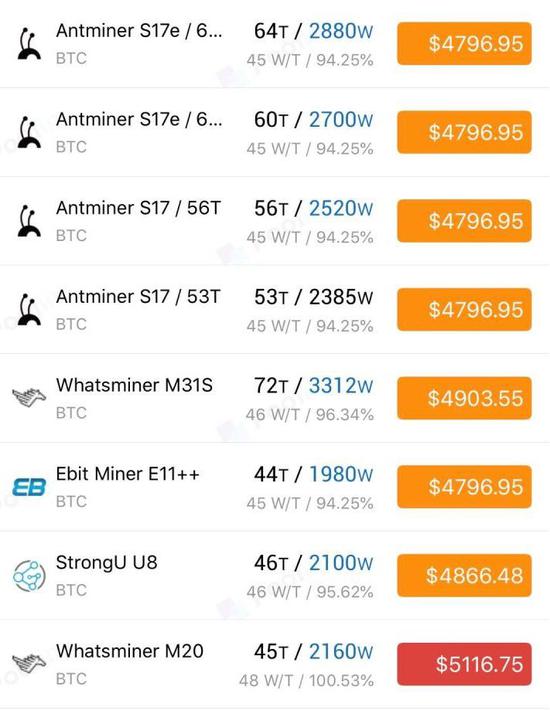
Shutdown price of some miners is close to Bitcoin's current price
Yang hasn't forgotten the 2018 cost inversion, but he refuses to believe that nightmare will repeat itself.
On this point, Chen Qi, founder of cloud platform service provider AiCloudata, was blunt: "Not everyone can resist the impulsiveness and allure of the crypto space. In this smoke-filled battlefield, those who fall may not be the speculators, but the entrepreneurs who gaze toward the future yet lose their heads chasing short-term gains."
Buying the Dip, Betting on the Bull Run
Beyond miners, other steadfast Bitcoin bulls are also pinning their hopes on the upcoming halving.
Stock investor Deng Yi, who also trades Bitcoin, told Zinc Scale: "Some say 'halving = asset halving'—that's nonsense. It's pure confirmation bias: bullish when prices rise, bearish when they fall."
He pointed to the historical pattern: after the first halving, Bitcoin's price rose from $5 to around $1,000 within 18 months; after the second, it surged from $450 to nearly $20,000 in the same timeframe.

Bitcoin halving date is May 15, 2020
"Historically, the price has always risen after a halving—it's inevitable. Many top analysts on Snowball share this view," said Deng, who recently bought Bitcoin near $5,100. "Technically, Bitcoin is in a bear market now. But its bull-bear transitions happen fast. You can buy with confidence during downturns, but you have to be cautious during rallies."
Of course, not all investors agree.
Blockchain developer Wu Fengling noted that Bitcoin's circulating supply has already exceeded 18.27 million BTC, with less than 3 million left to be mined—a process stretching to 2140. "Bitcoin has entered a 'stock market' phase. With only 900 new BTC minted daily, how much impact can that really have? Seasoned crypto veterans sense that Bitcoin's pricing power is gradually shifting from miners to the broader market—specifically, to large holders, or 'whales.' So, the logic that halving inevitably triggers a massive surge is flawed."
As global financial turbulence began, Wu sold three-quarters of his Bitcoin holdings. "When conditions worsen, riskier assets are the first to be dumped. Bitcoin is a risk asset, not a safe haven. That idea is pure marketing hype."
When asked why he didn't sell everything, Wu explained to Zinc Scale: "Within hacker circles, Bitcoin is still the hard currency. As long as that use case exists, Bitcoin retains liquidity value—and who knows, the next bull run might be just around the corner. So I'm not afraid of being stuck holding; I'm afraid of missing out."
Renowned investor "Gu She Qu" shares a similar mindset: "My Bitcoin investment is insurance against being left behind if cryptocurrencies take off—watching a whole generation pull ahead on the wealth ladder. That would be unacceptable."
Though their reasons for holding vary, they ultimately stand on the same side.
Mining Hardware Giants Seek New Paths
Mining hardware companies are in a similar boat—their valuation in capital markets is closely tied to the price of Bitcoin.
According to Qixinbao data, Bitmain is the world's leading supplier of Bitcoin mining hardware, famous for its Antminer series and for operating mining pools like BTC.com and AntPool. The company is pursuing a U.S. IPO, though no concrete progress has been made public. Canaan Creative ranks as the second-largest global supplier, primarily known for its Avalon miners.
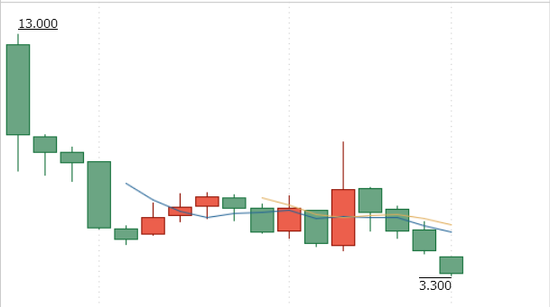
Canaan Creative's stock has trended downward since its IPO.
Bitcoin's sluggish price has clouded Bitmain's IPO outlook. While Canaan Creative did manage to list in the U.S., its stock performance has been weak. As of March 16, 2020, its share price was $3.37—a 74.08% drop from its peak.
The core issues are deeply connected to Bitcoin's own challenges.
First, global regulatory pressure on cryptocurrencies, including Bitcoin, is increasing, squeezing their operational room and limiting the growth potential for hardware makers. Second, Bitcoin's price swings cause wild fluctuations in these companies' financial results.
This is why both Bitmain and Canaan Creative are urgently exploring new strategies.
Developing AI chips has emerged as a common goal, but their approaches differ. A veteran internet industry observer told Zinc Metrics: "Bitmain's AI chips are geared more toward security surveillance and smart campus solutions, while Canaan is targeting the smart home market."
For example, Bitmain's Director of Product Strategy, Weiwei Tang, has said publicly: "AI computing is built on deep learning, which requires immense computational power for neural network processing. Without substantial computing resources, these AI applications aren't feasible—and the security industry presents a major opportunity for AI."
In fact, Bitmain has stated that "up to 40% of the company's revenue could come from its AI business within five years." Similarly, Canaan noted in its IPO filing: "Our future revenue growth will largely depend on successfully entering new markets beyond Bitcoin mining, especially the market for AI chip applications."
However, the AI chip business is not expected to be a major revenue driver anytime soon. In the first half of 2019, Bitcoin mining machines and related parts made up 99.4% of Canaan's total sales—highlighting just how difficult diversification is for these companies.
Regardless of where Bitcoin's price goes from here, there will always be those who hold out hope, dreaming of one day striking it rich in the crypto ecosystem.
But they should remember that the line between the "lucky few" and the "unlucky many" is often razor-thin.
(The names Yang Shenghua, Deng Yi, and Wu Fengling are pseudonyms, as requested by the interviewees.)