

Authors: Chris Dixon and Eddy Lazzarin, Partners at a16z
Odaily Planet Daily Translator | Azuma
Veteran crypto observers often describe our industry as moving in cycles, swinging between "bull markets" and "crypto winters." So far, we've seen three major cycles, with peaks in 2011, 2013, and 2017.
While these cycles might seem chaotic on the surface, they follow a consistent internal logic, typically unfolding in this order:
Bitcoin and other crypto asset prices start to climb.
Public interest surges, driving more activity and conversation on social media.
New talent enters the field, bringing fresh ideas and technical innovation.
An influx of new projects and startups emerges.
These new ventures launch products, inspiring further innovation and setting the stage for the next cycle.
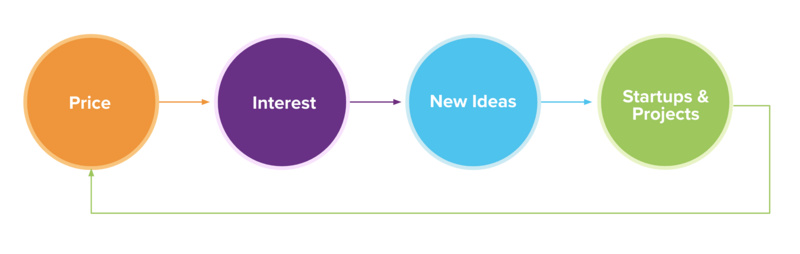
This perspective is backed by data and anecdotal evidence. A common refrain we hear from crypto founders—in hundreds of conversations—goes something like this: "I first heard about crypto in 2011 (or 2013, or 2017) when prices were skyrocketing and everyone was talking about it. At first, I saw it as a way to make money. But then I started reading whitepapers and blogs, learned about the technology's potential, and got hooked."
Recently, we conducted an internal research project at a16z to see if the data supported this narrative. With help from our crypto data scientist, Eddy Lazzarin, we analyzed nearly a decade of data—including cryptocurrency subreddit comments, GitHub commits, and PitchBook funding data. The results are captured in the chart below.
Cycle One: 2009–2012
The first crypto cycle peaked in 2011. Before that, even the most passionate Bitcoin supporters largely viewed it as an intriguing experiment with little practical use. During this period, entrepreneurs began to see that cryptocurrencies could form the basis of real businesses. Many of today's leading exchanges, mining hardware makers, and wallet providers were founded at this time.
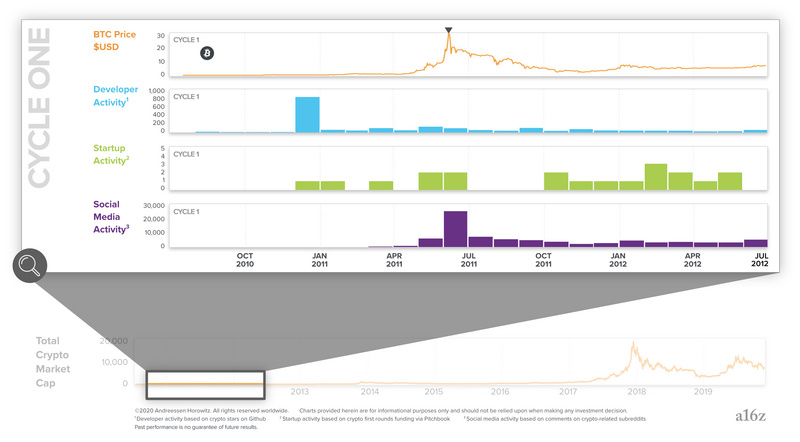
Odaily Planet Daily Note: The chart above tracks five key metrics from top to bottom: BTC price (top orange line), developer activity (blue), startup activity (green, showing the number of crypto company funding rounds), social media activity (purple), and total crypto market cap (bottom orange line).
A key takeaway is that after prices began to fall, development activity, new startup formation, and social media discussion continued. As we'll see, this pattern held true for the subsequent cycles as well.
Cycle Two: 2012–2016
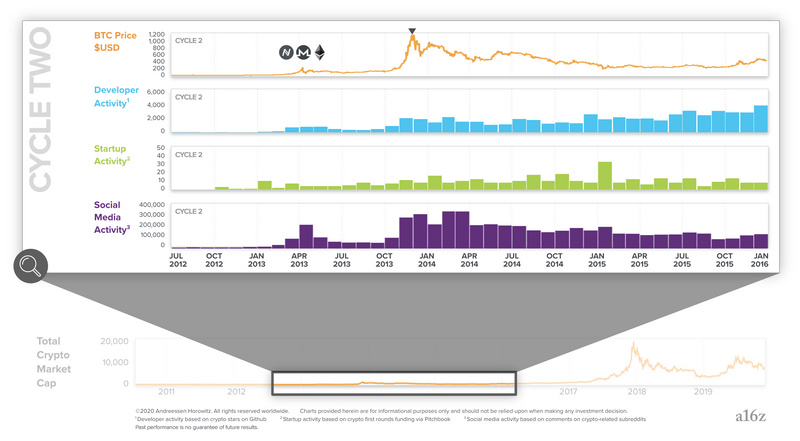
The second cycle peaked in late 2013, marking the first time Bitcoin entered the mainstream consciousness for many outside the tech world. During this period, the ecosystem saw an influx of developers and projects, roughly ten times greater than before. This was also when many foundational projects officially launched or secured funding—most notably Ethereum, whose arrival set the stage for the 2017 boom. A defining feature of crypto cycles is how each one plants the seeds for the next.
Cycle Three: 2016–2019
The third cycle reached its peak in 2017, as cryptocurrency's broader potential began capturing widespread attention. Once again, developer activity and new startups grew by about an order of magnitude. During this phase, crypto truly evolved from a niche interest into a legitimate emerging industry.
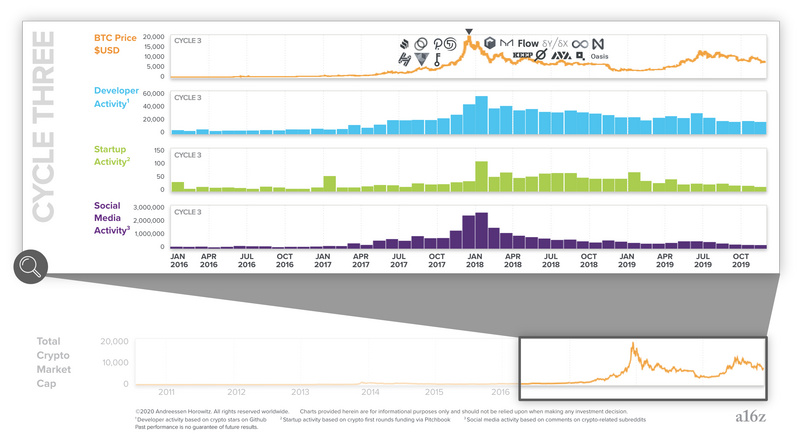
When plotted together (see below), all key metrics reveal volatile but consistently upward long-term growth across the three cycles. The compound annual growth rates (CAGRs) for these metrics are: BTC price (196.4%), developer activity (74.4%), startup activity (53.9%), and social media engagement (207.5%).
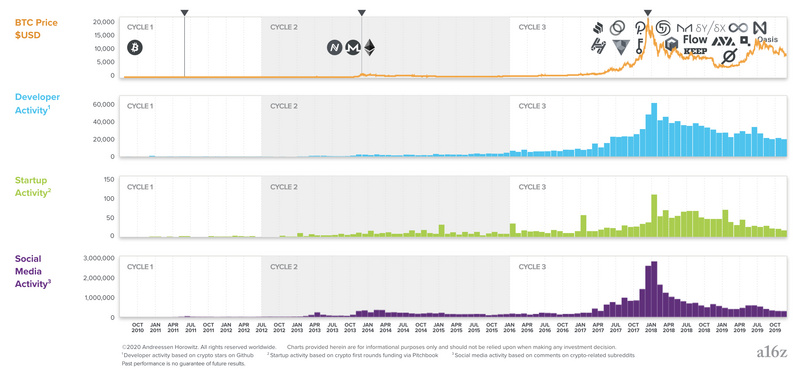
In the chart above, the logos represent high-quality, emblematic projects from each cycle. The third cycle alone spawned dozens of exciting new ventures across payments, finance, gaming, infrastructure, and web applications. Many of these projects are poised to launch soon and could very well catalyze the fourth crypto cycle.
Over the past decade, a wealth of novel ideas, technologies, and projects have emerged, forming the core drivers of innovation in crypto. In the years ahead, engineers and entrepreneurs will continue to push the technology forward. We look forward to seeing what they build.