

This article is from Chainalysis, originally authored by Philip Gradwell. Translated by Moni for Odaily Planet Daily.
The week of March 9–15 saw unprecedented volatility in the cryptocurrency market, accompanied by a massive influx of Bitcoin (BTC) into exchanges. Chainalysis recently analyzed BTC transaction flows during this extraordinary period. The findings reveal that while retail investor activity surged on both the buy and sell sides, well-capitalized professional traders and investors continue to dominate the Bitcoin market—though investment trends within the crypto space are quietly shifting.
Beginning March 9, the number of individuals looking to sell BTC on cryptocurrency exchanges surged to unprecedented levels, peaking on March 12 and 13. On those two days alone, exchanges received approximately 475,000 BTC more than their average daily inflow—a ninefold increase. Since then, BTC inflows have gradually declined and currently sit at roughly double the historical average.
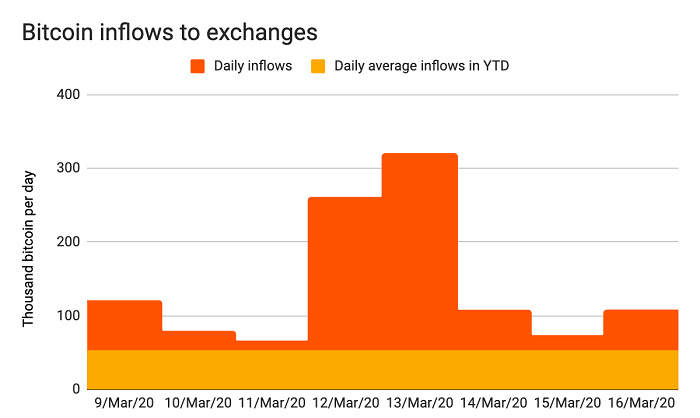
From January 1, 2020, through March 8, cryptocurrency exchanges received an average of 52,000 BTC per day. However, over the eight-day period from March 9 to March 16, exchanges collectively received 1.1 million BTC—712,000 BTC above the average. Of this excess, only 40,000–240,000 BTC remains actively traded on exchanges today. This means just 6–34% of the "extra" BTC inflows have yet to be sold (or were sold and quickly repurchased by new traders). In other words, most of the BTC that flowed into exchanges has already been sold, suggesting the oversupply pressure may be easing.
Selling Pressure May Be Easing
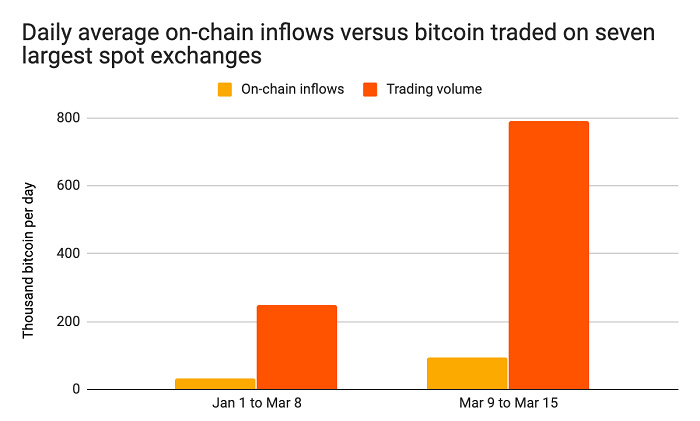
As large volumes of BTC moved onto exchanges for trading, overall exchange activity surged. However, BTC trading remains highly concentrated: nearly two-thirds of the BTC entering the market was traded on just seven spot cryptocurrency exchanges. According to data from digital asset data provider Kaiko, these seven exchanges processed an average of 249,000 BTC per day across all trading pairs before March 9. After March 9, their daily average jumped dramatically to 790,000 BTC.
The rise in trading volume closely mirrors the surge in BTC inflows, indicating that recent trading was primarily driven by newly deposited BTC—not by older, long-held BTC already sitting on exchanges. If more "legacy" BTC had been traded recently, we would expect the ratio of trading volume to on-chain BTC receipts to be even higher.
Furthermore, although the market has absorbed the "excess" BTC being sold, this volume represents only a small fraction of the total BTC in circulation—suggesting most holders prefer to hold rather than sell.
The 721,000 BTC representing the "excess" inflow accounts for only 5% of the estimated 14.52 million BTC in available circulation (available BTC = "18.27 million mined BTC" – "3.75 million lost BTC"). Additionally, cryptocurrency exchanges currently hold an estimated 4 million BTC (with a lower bound of 2 million BTC and an upper bound of 5.5 million BTC). As noted, while some of this BTC has been traded recently, the trading volume appears relatively modest—and exchange balances have actually increased. Still, under an extreme (and practically impossible) assumption—that all 4 million BTC held by exchanges were sold—over 9.8 million BTC would remain unsold, representing roughly 67% of all available BTC.
Who Was Selling BTC During the Turmoil?
Who sold the most BTC during the sharp price declines? We conducted a deeper analysis to find out. Preliminary findings indicate that, despite a significant uptick in retail trading activity, professional traders were the primary drivers behind the massive BTC inflows into exchanges. Since March 9, the volume of BTC moving in and out of exchanges via small transfers (0.1–10 BTC) has nearly doubled—pointing to substantial retail participation on both the buy and sell sides.

However, as in most typical trading scenarios, the majority of BTC flowing into exchanges came from large transfers. Specifically, among BTC sent and received on exchanges in recent days, transactions sized between 10–100 BTC and 100–1,000 BTC accounted for approximately 70% of total volume—a proportion similar to, though slightly higher than, usual levels. About 10% of BTC transactions exceeded 1,000 BTC.
These findings confirm that well-capitalized professional traders and investors continue to dominate the cryptocurrency market. Yet, with large numbers of retail participants joining both sides, investment trends in crypto are undergoing a shift.
Given the extreme uncertainty introduced by the COVID-19 pandemic, predicting Bitcoin's next move remains highly challenging. However, it's clear that a sharp rise in BTC inflows to exchanges serves as a key indicator of heightened volatility. Investors should monitor BTC movements into exchanges. For now, professional traders remain the primary drivers of Bitcoin market activity, given their dominance in large-value transactions.
Summary
1. Although the cryptocurrency market experienced massive volatility last week (March 9–12), it also witnessed the largest BTC inflow in history. From March 9, exchanges collectively received 1.1 million BTC over eight days. March 13 alone saw 319,000 BTC flow into exchanges, setting a new single-day record. From the start of 2020 through March 9, the average daily BTC inflow into exchanges was only 52,000 BTC.
2. Between March 12 and 13, the amount of BTC sent to exchanges was double the daily average. This selling pressure drove the price of BTC down by roughly 37%.
3. That pressure has since subsided. At least two-thirds—and likely more—of the BTC that flowed into exchanges has been withdrawn. Current daily inflows are now only about twice the historical average, allowing the BTC price to stabilize.
4. Most BTC trading activity comes from professional traders and investors. Since March 9, the volume of BTC moving on and off exchanges in small transfers (0.1 to 10 BTC) has nearly doubled, pointing to significant retail trading on both sides of the market. However, 70% of the total value moving in and out of exchanges involves transactions in the 10 to 1,000 BTC range.
5. The vast majority of available BTC remains unspent, suggesting most holders are opting to hold rather than sell. Over the past eight days, the total BTC sent to exchanges exceeded the average daily volume by 712,000 BTC. Yet this "excess" represents just 5% of the total available BTC supply. (Planet O-Daily note: Available BTC supply = total mined BTC minus all lost BTC.)