

Key Topics
1. What is the impact of the Shanghai Upgrade on ETH and its ecosystem?
2. What is the short-term impact of the Shanghai Upgrade on the broader crypto market, and what participation opportunities does it present for retail investors?
3. Will there be selling pressure in the market following the Shanghai Upgrade?
4. The recent market recovery has triggered rapid rotation across multiple sectors—do you have any preferred sectors or projects?
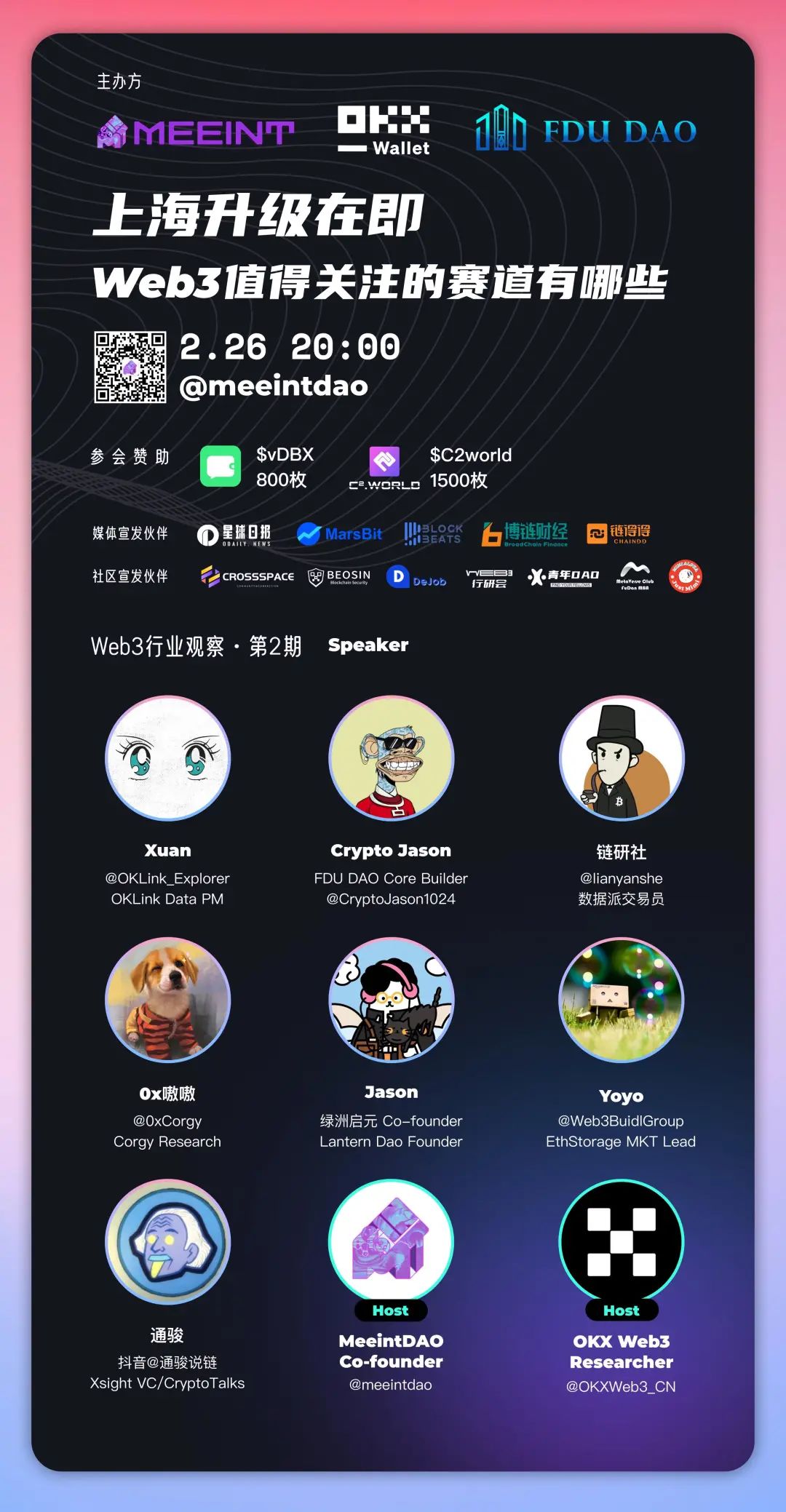
Guests
Xuan OKLink Data PM, @OKLink_Explorer
Crypto Jason FDU DAO core builder, @CryptoJason1024
0xAoao Corgy Research, @0xCorgy
Chain Research Society Data & Trading Analyst, @lianyanshe
Jason Co-founder of Oasis Qiyuan / Founder of Lantern DAO, @shixiang2
Yoyo Marketing Lead at EthStorage, @Web3BuidlGroup
Tong Jun Xsight VC/CryptoTalks, Douyin: Tong Jun Speaks on Blockchain, @tongjun88
Key Highlights
1. What is the impact of the Shanghai Upgrade on ETH and its ecosystem?
0x AoaO: Let me first explain what the Shanghai Upgrade entails. Each Ethereum upgrade—including the Shanghai Upgrade—consists of proposals from the community or the Ethereum Foundation being integrated and successfully deployed. Such coordinated efforts are collectively referred to as an “Ethereum upgrade.”
This upgrade consists of three components. First, minor improvements—such as modest scalability enhancements or reductions in gas fee costs. Second, developer-focused upgrades to the Ethereum Virtual Machine (EVM), introducing new development standards. Third, enabling withdrawals from the Beacon Chain, allowing users to withdraw ETH staked through Ethereum-based staking protocols.
Xuan: A particularly important proposal is EIP-4895, which introduces a new “withdraw” instruction on the Beacon Chain, enabling users to withdraw their staked ETH and staking rewards at zero gas cost. This change could significantly reshape the broader ecosystem.
In the long term, ETH staking participation will inevitably rise across contract-based sectors where high gas fees have been a bottleneck. From an investment perspective, the “front-running and compounding” strategy will gain increasing recognition and adoption among conservative investors. From an asset allocation standpoint, liquid staking pools also serve as high-quality hedging assets. Overall, I believe the Shanghai Upgrade will play a pivotal role in shaping Ethereum’s broader strategic landscape—and will likely trigger significant changes in ETH’s price trajectory.
Tong Jun: The most notable aspect is Beacon Chain withdrawals—a clear liquidity-enhancing measure. Any development that improves liquidity is bullish; conversely, anything that impairs liquidity is bearish.
Yoyo: The Shanghai upgrade is relatively modest in scope, primarily aimed at enabling withdrawals of staked ETH as soon as possible. Without timely withdrawal functionality, the appeal of ETH staking would significantly diminish, hindering new user adoption.
However, from my personal perspective, many more ambitious and technically challenging features—including parts of EIP-4844—have been postponed to Q3 or later. The EIPs included in this upgrade will nonetheless lay groundwork for future technical developments, enhancing the richness and diversity of smart contract capabilities.
Chain Research Society: Let me cite an on-chain data point: On the 25th, Sun Brother staked 55,000 ETH with Lido—a clear signal that Ethereum’s staking upgrade is underway. Post-upgrade, ETH stakers will be able to withdraw funds freely, a critical feature for large holders. Thus, Sun Brother deposited his ETH into Lido ahead of the Shanghai upgrade to earn yield.
Another data point: Ethereum’s current mainnet staking ratio stands at approximately 20%, whereas some other public blockchains achieve staking ratios as high as 70%. Following the Shanghai upgrade, large holders are expected to become more willing to allocate capital—indicating substantial room for further growth.
Jason: This upgrade is expected to unlock 16.5 million ETH, causing some short-term price volatility. In the long term, however, it will reduce users’ gas fees, benefiting ecosystem development—especially for applications requiring frequent, high-volume gas-consuming transactions.
Crypto Jason: This upgrade enables previously staked funds to be withdrawn. Post-unlock, downward price pressure may occur—but it won’t be severe, for two key reasons: First, validator exits are capped at a maximum of 1,350 per day under a queue-based, linear withdrawal mechanism. Second, in the event of large-scale exits, the staking APR will rise accordingly, dynamically pushing prices back up. Therefore, I remain confident in ETH’s price trajectory over the medium to long term.
2. What are the Shanghai Upgrade’s short-term impacts on the crypto market, and what participation opportunities does it present for retail investors?
0x AoaO: I’d like to highlight two sectors—both of which are currently drawing the most attention. The first is the staking sector, including LDO and all staking tokens issued by exchanges. The second is Layer 2 networks—a topic generating intense discussion recently—including OP and Arbitrum, both of which have seen explosive price gains, as well as the widely known ZK-based solutions. This Shanghai upgrade may only serve as an appetizer for Layer 2 adoption; the real breakout will likely come with the next upgrade, Capella. It’s during the Capella upgrade that EIP-4844—the “proto-danksharding” proposal—will be fully implemented on Ethereum’s consensus layer.
Xuan: Let me briefly address price and data aspects. As ETH staking withdrawals begin, there may be short-term selling pressure in the market, potentially triggering irrational price movements. For retail investors like us, it’s critical to hedge positions and actively manage risk exposure. Since short-term opportunities typically hinge on “expectation gaps,” and given that the Shanghai upgrade has been anticipated for a long time, short-term price action should be analyzed using real-time market data.
Tong Jun: There’s broad consensus on this question—I’ll just add a few points. Arbitrum, among Layer 2 solutions, has not issued a native token. However, Binance recently listed two Arbitrum ecosystem projects that did launch tokens—worth keeping an eye on. Similarly, other high-profile projects within the Arbitrum ecosystem—not yet listed on Binance—also merit attention.
Yoyo: In my view, Arbi(trum) has indeed gained significant traction recently among retail investors—but this surge may partly reflect premature hype. Once the current wave of attention subsides, focus could shift elsewhere. Additionally, following the Shanghai Upgrade—which introduced ETH staking services to ordinary users—staking pools appear to be a relatively sound option.
Chain Research Society: Short-term impacts have already emerged—for instance, the Layer-2 LSD sector has surged notably. Regarding post-upgrade dynamics, I previously calculated that the first month after completion of Ethereum’s staking upgrade will see ~30,000 ETH in sell pressure, averaging ~20,000 ETH per subsequent month. Over time, this sell pressure is expected to gradually diminish. Moreover, much of this supply may re-enter staking on Ethereum. Thus, for retail investors, the most opportune moment may be purchasing ETH during the first month post-upgrade—and then benefiting from price recovery and ecosystem growth as staked ETH volumes rise. This strategy offers the most stable path to capturing upside.
Jason: My view aligns closely with the previous speaker’s. As I mentioned earlier, approximately 16.5 million ETH will be unlocked over the coming period—but releases are capped monthly. Therefore, as noted by the prior speaker, retail users should monitor market volatility during this window and seek profit opportunities within those fluctuations.
Crypto Jason: Regarding this upgrade, in addition to the widely discussed EIP-4895, there are also EIP-3855 and EIP-3860—both of which are equally critical. First, EIP-4895 primarily introduces a more flexible staking mechanism for validators. EIP-3855 aims to improve transaction throughput on the Ethereum network, while EIP-3860 reduces transaction fees. As for fee reduction, I have firsthand experience: as an NFT enthusiast, I vividly recall January last year, when gas fees went absolutely wild—I personally witnessed fees exceeding $300, not to mention even more extreme cases like those involving “Monkey” NFTs. Therefore, I believe EIP-3855 and EIP-3860 will significantly enhance the user experience for DeFi and NFT applications on Ethereum.
Additionally, several staking-related tokens have recently drawn attention—including RPL, IDO, and SSV, which continues gaining momentum these days. That said, I don’t think those who haven’t yet entered should feel overly anxious; opportunities may still arise following market pullbacks.
3. Will there be selling pressure post-Shanghai Upgrade?
0x Aoaoo: Selling pressure is the least concerning factor for everyone. First, both retail and institutional investors hold strong consensus on Ethereum—otherwise, so many tokens wouldn’t be staked on Ethereum. This time, Ethereum has restricted the quantity and speed of staked token unlocks, significantly alleviating this selling pressure. Second, numerous tokens have recently undergone airdrops and large-scale unlocks—for example, the OP airdrop, Sandbox’s massive unlock, and earlier, the large-scale $APE unlock on the day Yuga Labs launched its new game Sewer Pass. Notably, renowned singer “Ma Ji Da Ge” (Brother Ma Ji) profited substantially from this move (as Yuga Labs’ top supporter, Brother Ma Ji staked a large amount of APE tokens to earn yield; later, as staking yields declined, he gradually reduced his APE position. According to statistics, Brother Ma Ji generated approximately $4.4 million in total APE-related profits within 70 days, achieving an ROI of roughly 58%). These cases all validate the saying: “Unlocks drive price up.” Even institutions or large holders won’t dump all their holdings immediately upon unlocking if they aim to trade at their target prices. Instead, they’ll release tokens gradually—or adopt strategies maximizing their returns. Third, a significant portion of tokens held on staking platforms remain liquid, including LDO, SSV, and Rocket Pool. For instance, sETH has consistently traded near $0.90, reflecting market recognition and consensus on Ethereum. Of course, certain exchanges and specialized staking tokens—with lower liquidity—have seen their exchange rates against ETH exceed 1.0, further confirming that selling pressure isn’t severe and the market has already absorbed it.
Xuan: I believe short-term selling pressure will emerge, but long-term pressure won’t materialize. Here’s why: First, users wishing to exit can do so immediately without waiting for Shanghai Upgrade unlocks. For instance, most of my staked ETH uses liquid staking pools like Lido or SSV’s liquist, enabling me to swap stETH for ETH via DEXs—no need to wait for Shanghai. Second, current data shows ETH is in a deflationary state; post-Merge, daily net issuance may even turn negative, indicating sustained long-term deflation. Third, ETH’s staking yield dynamically adjusts based on staked supply: lower staked ETH leads to higher yields. At ~4 million staked ETH, annualized yield hovers around 7.8%; at ~8 million staked ETH, it drops to ~5.5%. Thus, any short-term selling pressure would boost yields, attracting new stakers. Moreover, unlocks occur linearly over time. In summary, the Shanghai Upgrade is a minor short-term headwind but a major long-term tailwind. OKLink may publish a research report later—stay tuned.
Tong Jun: The upgrade is a deterministic, non-random mathematical event. Early, steadfast supporters are unlikely to sell ETH, and the market has already reacted—confirming stable fundamentals. However, market liquidity will increase, and volatility will rise; participants must adapt accordingly.
Yoyo: In my view, the Shanghai Upgrade is unlikely to trigger significant sell pressure; if any sell pressure does emerge, its impact on the market will be limited. As widely noted, early stakers are long-term supporters of Ethereum, and staked ETH will be unlocked gradually. Moreover, the Shanghai Upgrade is a long-term positive catalyst for Ethereum. However, sell pressure and ETH’s price volatility are two distinct matters—black swan events cannot be ruled out, and such events could negatively impact the broader Web3 industry.
Chain Research Society: In my view, the Shanghai Upgrade will still generate some sell pressure, but its impact will be concentrated primarily in the first two weeks, with diminishing effects thereafter.
During Ethereum’s previous bear market cycle, its price plunged by as much as 95%. Why did it fall so severely? Because in 2017, nearly all ICO fundraising projects raised capital exclusively in ETH. When those projects ran out of funds during the subsequent bear market, they were forced to liquidate their ETH holdings to meet payroll obligations—creating extremely intense sell pressure on ETH.

https://twitter.com/lianyanshe/status/1612281175455961092
https://twitter.com/lianyanshe/status/1601054877752643584
However, this ETH upgrade and staking event will generate less selling pressure; thus, the price won’t be suppressed significantly in the short term. Nevertheless, it may exert downward pressure on ETH’s post-upgrade price. Once the selling pressure is absorbed, the situation will turn bullish, and trading volume and price appreciation in the staking rate market will proceed more smoothly.
Jason: This upgrade will generate short-term selling pressure and impact the market. In the long run, however, it is bullish. I agree with LianYanShe’s view.
Crypto Jason: I agree with the view that short-term selling pressure is likely, while long-term prospects remain positive. From an individual investor’s perspective, whether it’s selling pressure or positive catalysts, market volatility itself is good news—what’s truly concerning is declining trading volume. Individual investors should manage risk according to their own strategies, implement proper risk hedging, and adjust positions based on market developments.
4. The recent market recovery has triggered rapid sector rotation. Are there any specific sectors or projects you’re bullish on?
0x AoaO: Large institutions, competing for limited capital in a stagnant market, are driving rapid sector rotation to identify breakout opportunities. These rotations do not reflect genuine fundamentals but rather premature hype. By the time retail investors spot such events and attempt to enter, it’s often already too late. In my view, L2 solutions built atop major platforms may become the next hot trend—exchanges and other infrastructure providers may increasingly deploy onto specific Layer-2 networks. Investors should closely monitor this space.
Xuan: I’ll primarily share insights from a development perspective on the LSD and L2 sectors. Ethereum remains in a deflationary phase, and its staking rate still has significant room for growth. Among Ethereum-based projects, I’m particularly bullish on Lido, SSV, and FXS. As for L2 networks that haven’t issued tokens yet, everyone should continue monitoring them closely.
Tong Jun: Overall macro conditions aren’t favorable, so we remain cautious. I recommend keeping an eye on Polygon (MATIC), which is scheduled to undergo its cKEVM upgrade in March, as well as developments related to the SDK EVM. Recently, my focus has been on infrastructure projects.
Yoyo: Personally, I’m optimistic about the storage sector—it’s foundational and essential for Web3, and remains in its early stages. Here, I recommend the Eason Storage project.
Chain Research Society: I am personally more bullish on the ZK and LSD sectors. ZK is linked to the Shanghai Upgrade, and several major projects have yet to launch—this represents a significant tailwind in my view. Additionally, I am also optimistic about the on-chain derivatives sector. While U.S. and Hong Kong regulations currently restrict on-chain derivatives, user demand for such products remains strong; thus, this sector warrants close attention.
Jason: Given that FET’s data was previously stored on centralized servers, I am focusing short-term on the decentralized storage sector. Long-term, I will concentrate on GameFi, aiming to integrate GameFi with the metaverse—and exploring how Web2 games can be transformed into Web3 versions.
Crypto Jason: I am particularly bullish on the staking sector and Arbitrum within the L2 space—though one should exercise caution when selecting specific projects built on Arbitrum.