

Fintech primarily refers to a category of technologies that apply cutting-edge scientific and technological achievements—such as artificial intelligence, blockchain, big data, cloud computing, and the Internet of Things—to transform or innovate financial products, business models, operational processes, and thereby enhance the quality and efficiency of financial development. China’s fintech sector is currently experiencing vigorous growth, supported by continuous policy initiatives, and the industry is poised for accelerated expansion.
1. 2020 May Become the Global Central Bank Digital Currency (CBDC) Inaugural Year
In the field of digital currencies, countries worldwide are intensifying their efforts. On January 21, according to the Bank of Japan’s official website, it joined forces with the European Central Bank (ECB), the Bank of England, and others to form a Central Bank Digital Currency (CBDC) working group, jointly assessing the feasibility of CBDCs. The group also includes the Bank of Canada, the Swiss National Bank, the Swedish Riksbank, and the Bank for International Settlements (BIS).
Numerous countries have already made substantive progress in CBDC research and development—or publicly expressed intentions to issue one. ECB President Christine Lagarde stated at a press conference in December 2019 that a dedicated CBDC committee had been established, and efforts to study digital currency phenomena would be accelerated, with conclusions expected by mid-2020.
According to analysis by Anxin Securities, a global review reveals that central banks worldwide are accelerating their CBDC initiatives to respond to Libra’s planned 2020 rollout—marking the onset of a global CBDC race. Thus, 2020 may become the inaugural year for global central bank digital currencies.
2. The People’s Bank of China Has Largely Completed the Top-Level Design for Its Legal Digital Currency
Under strong policy support, innovative technologies—including AI, big data, and cloud computing—have already seen widespread adoption across China’s financial industry, with financial institutions continuously increasing investment in frontier technologies. Meanwhile, China has consistently rolled out supportive policies and conducted multi-year explorations into central bank digital currencies.
According to Caijing magazine, a pilot project for the PBOC’s legal digital currency—jointly led by the People’s Bank of China and involving the four major state-owned commercial banks (ICBC, Agricultural Bank of China, Bank of China, and China Construction Bank), as well as the three major telecom operators (China Mobile, China Telecom, and China Unicom)—is expected to launch in cities such as Shenzhen and Suzhou. Unlike previous pilots, this round will extend beyond the PBOC’s internal systems into real-world service scenarios—including transportation, education, and healthcare—and directly reach end consumers (C-end users), enabling frequent practical usage.
On January 10, the PBOC’s WeChat public account published an article titled “Reviewing the PBOC’s Fintech Initiatives in 2019,” stating that, under the principles of a two-tier operational framework, M0 substitution, and controllable anonymity, the PBOC has largely completed top-level design, standard formulation, functional development, and joint debugging/testing for its legal digital currency. It has also conducted rigorous research on digital currencies and closely tracked international developments in this field.
The table below, compiled by China Merchants Securities, outlines the PBOC’s progress in developing its digital currency:
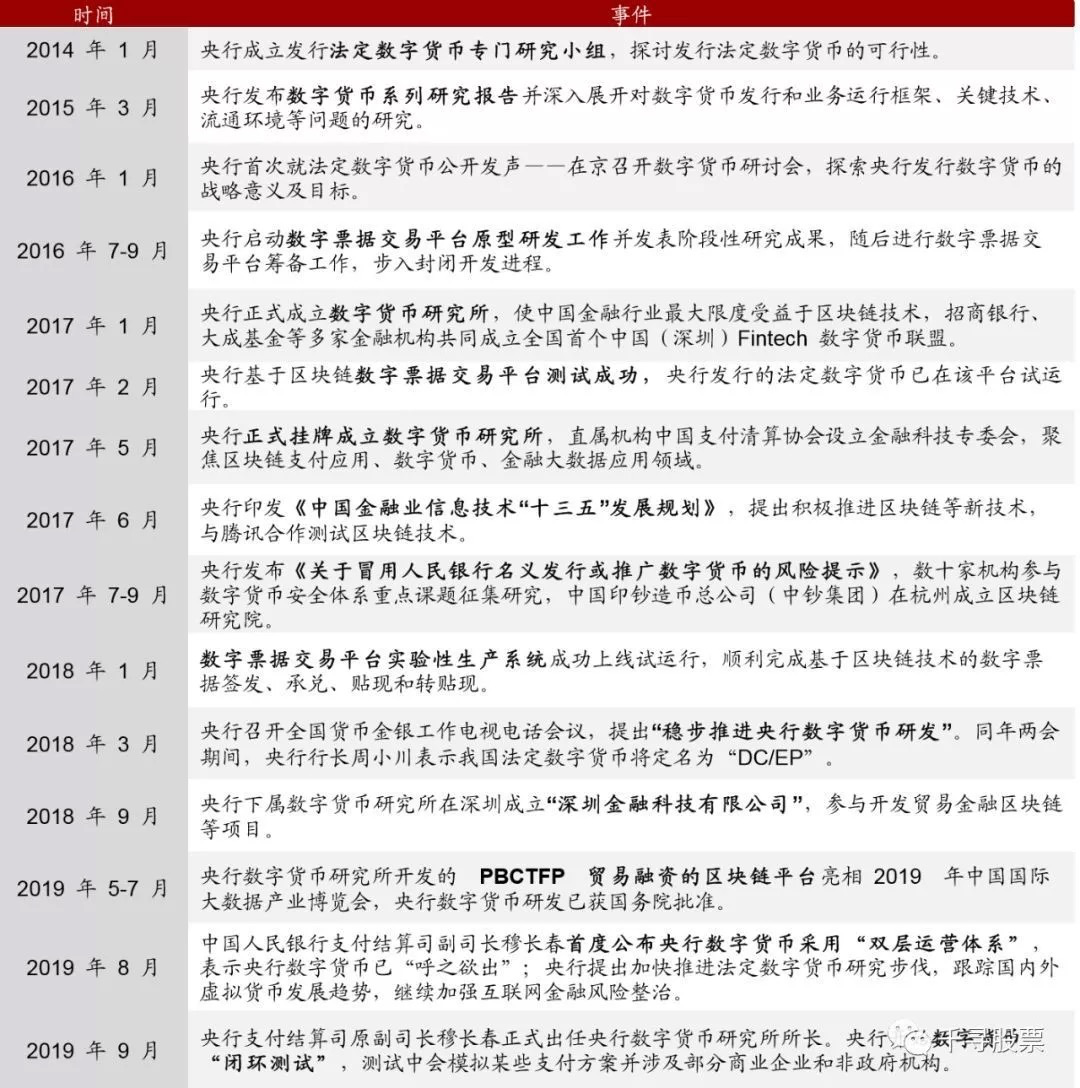
After five years of R&D exploration, the PBOC’s legal digital currency—Digital Currency/Electronic Payment (DC/EP)—has advanced rapidly since 2019 and is expected to enter pilot testing this year.
3. What Are the Benefits of the PBOC’s Digital Currency?
CITIC Securities identified the following three key advantages:
(1) First, it reduces costs associated with printing, issuing, and storing physical banknotes and coins. Replacing physical cash enables the central bank to close the monetary policy loop—previously unattainable due to anonymity—by enhancing forecasting, statistical analysis, and management capabilities, thus improving both efficiency and accuracy. Additionally, the central bank’s large-value clearing system could be replaced by automated clearing mechanisms, eliminating intermediate settlement steps and enabling direct payment-to-clearing transitions—thereby lowering transaction costs and boosting efficiency. Second, domestically, cash (M0) as a share of M2 has declined from 11% in 1998 to just 4% today, with offline payments increasingly dominated by card networks and third-party platforms like WeChat Pay and Alipay. If a high-credit-grade DC/EP is launched, it could reshape competitive dynamics in the payments industry and strengthen the PBOC’s and commercial banks’ control over monetary issuance.
(2) It safeguards individual privacy and fulfills demands for anonymous payments. Unlike electronic payments—which rely on traditional bank accounts (“account-tight coupling”)—the PBOC’s digital currency employs “account-loose coupling,” enabling value transfer independent of conventional bank accounts and significantly reducing transactional reliance on accounts, thereby achieving controllable anonymity. Moreover, widespread CBDC adoption and the phasing out of paper currency will help combat tax evasion, money laundering, and other illicit activities.
(3) It improves the efficiency of monitoring monetary circulation and enriches monetary policy tools. Interest-bearing CBDC design, coupled with the gradual withdrawal of physical cash, will contribute to macroeconomic stability. Issuing a legal central bank digital currency makes real-time collection of data on money creation, accounting, and circulation feasible. After anonymization, these data can be deeply analyzed using big-data techniques, providing valuable insights for monetary issuance decisions and the formulation and implementation of monetary policy—enhancing the effectiveness of instruments such as reserve requirement ratios and interest rates. These policy tools influence commercial banks’ liability and asset structures, as well as financial asset prices, guiding adjustments in economic decision-making by banks, enterprises, and households—thus ensuring effective monetary policy transmission.
4. Central Bank Digital Currencies Will Be a Key Investment Theme in 2020
Guosheng Securities’ outlook for 2020 includes the following points:
(1) As more institutions and capital enter the cryptocurrency space, we expect the stablecoin market size to continue expanding in 2020.
(2) With further development of infrastructure—such as public blockchains—and the deployment of diverse on-chain applications and financial services, long-term competition among stablecoins may increasingly center on use-case differentiation.
(3) Achieving secure, trusted, and regulatory-compliant operations remains the foremost challenge for stablecoin development.
(4) Once governments begin adopting or issuing CBDCs, competition from outside the crypto ecosystem will inevitably reshape the existing stablecoin landscape. From an industry perspective, stablecoins have clearly emerged as bridges connecting the digital world with the real economy. With CBDCs entering the arena, the industry is set for a major reshuffling.