

Introduction
Stock markets are often driven by short-term, random noise. But at major turning points and over the long term, does the market reflect collective wisdom—or simply the madness of the crowd?
To explore this question, few periods are more revealing than the stock market's performance during World War II. While the war itself was a medium-term event in the grand sweep of history, it was packed with dramatic, world-altering moments that were extensively documented—offering a perfect case study.
In the coming weeks, Junmao Capital will share insights from the financial history book Wealth, War, and Wisdom by the late American investment legend Barton Biggs.
History is the witness that testifies to the passing of time; it illuminates reality, vitalizes memory, and provides guidance in daily life.
— Marcus Tullius Cicero
Before we begin, consider this:
If you were living in the United States during WWII, with the dark clouds of war gathering, at which of these pivotal moments would you have had the courage to aggressively buy stocks?
(1) The German Blitzkrieg; (2) The Dunkirk Evacuation; (3) The Attack on Pearl Harbor; (4) The Battle of Midway; (5) The Battle of Stalingrad; (6) D-Day (The Normandy Landings); (7) The Allied Capture of Berlin.
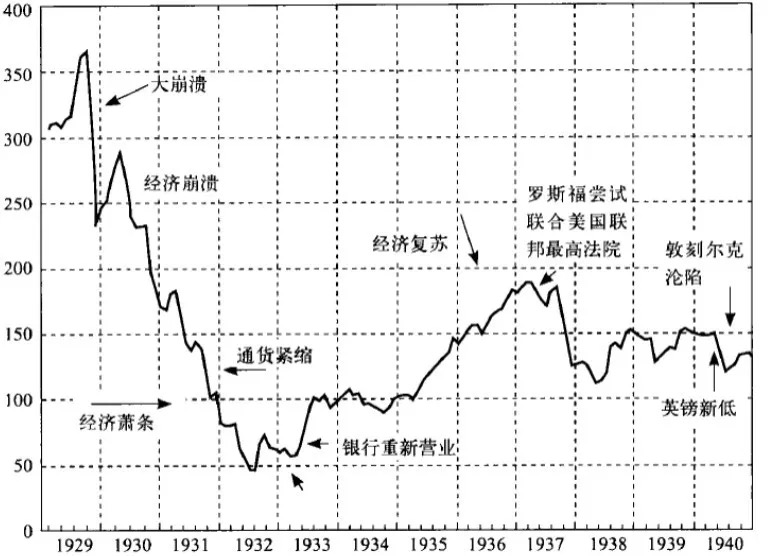
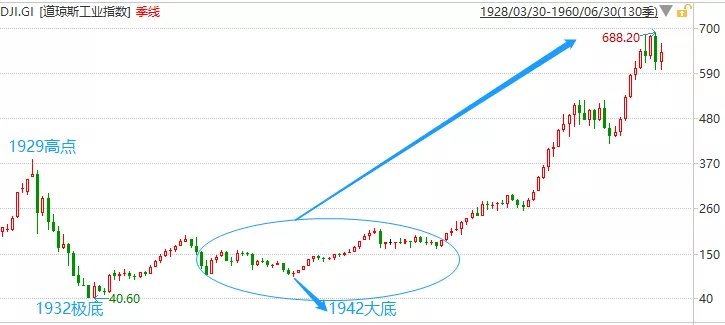
U.S. Stocks Before WWII (1929–1939). The Dow Jones Industrial Average (DJIA) peaked at 380 in 1929 before the infamous crash and the onset of the Great Depression. By 1932, it had plunged 89% to a low of 40. President Roosevelt took office in 1933 and launched the New Deal, spurring an economic recovery. The 1932 low marked the absolute bottom of that bear market—a level never seen again. By January 1937, the total market capitalization of the NYSE had surged from a trough of $19.7 billion to $62.5 billion. To put that in perspective, the entire U.S. stock market in 1932 was worth about the same as a mid-sized company today. After 1937, the economy slid back into recession, leaving half of Wall Street's office buildings vacant and trading activity muted.
Figure 1: Dow Jones Industrial Average, 1929–1940
Source: Dow Jones & Company
On September 1, 1939, Hitler invaded Poland, and Britain declared war on Germany. U.S. stocks rallied for three straight days, gaining 7% on volume that hit a two-year high—investors bet that defense contracts would boost the economy. This optimism was short-lived, however, as growing fears over the war's trajectory quickly snuffed out the rally.
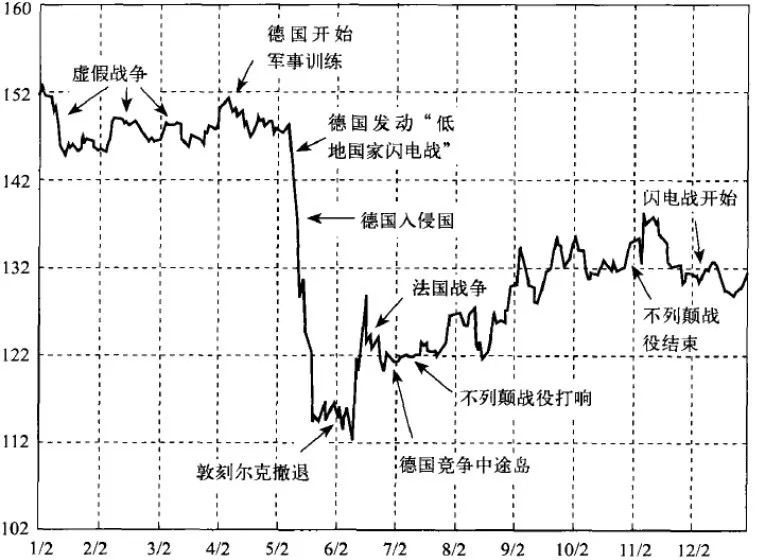
By 1940, war news was dictating market moves. While military orders did provide economic stimulus, the Wehrmacht's rapid conquests across Europe spooked investors. They feared a prolonged conflict, disrupted global trade, and a return to depression. Japan's aggression in Asia added to the anxiety, making the world's future seem hostile and deeply uncertain. By early June, the DJIA had fallen 25%—from 150 down to 114.
Interestingly, U.S. equities had already bottomed out in May, defying the grim news from France. After the British completed the Dunkirk evacuation, the Dow Jones Industrial Average (DJIA) staged a sharp rebound, climbing 40% from its lows. Yet, on the ground, American newspapers painted a bleak picture of Britain's plight. Many were convinced a German invasion of Britain was imminent and that nothing could stop the German advance. The German military was well-trained and battle-hardened, while both British and American forces struggled with outdated equipment and insufficient training. Following the fall of Paris, U.S. equities weakened again but managed to hold above their previous lows.
Figure 2: Dow Jones Industrial Average in 1940
Source: Dow Jones & Company
Some U.S. media outlets even admired Hitler's extraordinary charisma, hailing him as the last great emperor after Alexander the Great, Julius Caesar, and Napoleon. Yet amid this despair, U.S. equities began a modest summer rebound. Even during the Blitz on London, the market seemed to believe the Royal Air Force could repel the air raids and prevent a German cross-Channel invasion. Indeed, the rebound continued even after the Blitz ended.
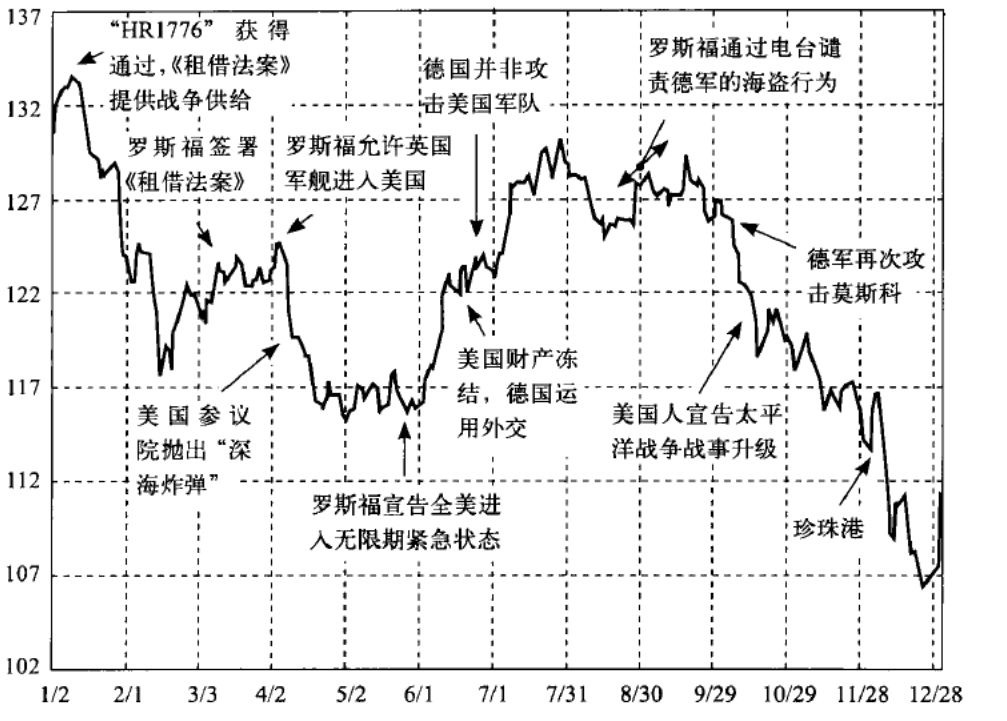
By the end of 1940, war-related news grew even worse, Britain's economy sustained severe damage, and U.S. equities slipped back into sluggishness. Even though the U.S. economy continued growing—unemployment dropped by 10% and wages rose by 16%—stocks kept declining. This was because commodity futures markets were benefiting from wartime raw material price spikes; prices surged 25% in September alone. In 1940, U.S. GDP and corporate earnings remained slightly below their 1929 levels, yet stock prices stood at only one-third of their 1929 value. For the full year, the DJIA declined 12%.
The weakness in U.S. equities at the end of 1940 seemed to foreshadow an even worse year ahead in 1941. Indeed, it proved to be an extremely perilous and dark period. Consider the dire circumstances facing the Allied powers at the time:
(1) Germany occupied nearly all of Europe;
(2) Italy, Hungary, and Romania had joined the Axis Powers;
(3) Finland, attacked by the Soviet Union, launched a counteroffensive and pledged cooperation with any nation seeking to attack the USSR;
(4) After Greece’s surrender, German forces advanced into the Soviet Union, reaching the outskirts of Moscow;
(5) Rommel decisively defeated British forces in Africa, while German U-boats blockaded Britain, leaving the country in ruins;
(6) Following Japan’s surprise attack on Pearl Harbor, Japanese forces achieved continuous victories across the Pacific, triggering widespread panic in the United States.
That year, even more celebrities in New York and London found themselves drawn to Hitler's charisma, privately praising his military and political prowess. However, the majority remained clear-eyed, wary of his brutality.
Figure 3: Dow Jones Industrial Average in 1941
Source: Dow Jones & Company
By 1941, the Allied war effort and the stock market were both in a slump, though the battle lines were clearly drawn. Contemporary newspapers revealed deep concern among America's social elite and commentators that the Allies couldn't hold back the Axis advance. Doubts about ultimate victory and uncertainty over the war's duration were widespread.
U.S. equities remained depressed into early 1942. After the sharp 1941 decline, prices kept falling as war news worsened. German U-boats operated with impunity off the U.S. East Coast, inflicting heavy losses. Churchill feared Britain would become an isolated island. In the Pacific, Singapore fell; Japanese forces swept through Burma, Indonesia, and finally the Philippines—forcing General MacArthur to flee. Japan seemed unstoppable, conquering Southeast Asia by land and sea and threatening Australia. The U.S. was mired in a grueling conflict, with media lambasting the weak performance of American forces, triggering a steep market decline. Even aggressive political propaganda failed to turn the tide.
In hindsight, some call this period one of "groundless panic," given the surge in military production, expanding fiscal deficits, and robust corporate profits. But the market's fears were justified: the U.S. Treasury proposed raising the corporate tax rate to 60% to claw back excess profits, making earnings and dividend forecasts nearly impossible. An 85% personal income tax on earnings over $50,000 was also floated. Combined with battlefield losses, these proposals shattered investor confidence. Early in the war, the U.S. War Department often spun defeats as victories; when the public later discovered these "good news" reports were fabricated or misleading, trust in both the military and the media evaporated—a reaction felt acutely by investors. At the time, any rational forecaster would have been bearish.
On April 30, 1942, the Dow Jones Industrial Average hit 92 points—a 31% drop from its January 1941 peak of 132. The only consolation was the unwavering resolve of Britain and America to fight on, yet despair was pervasive and faith in the future was fading. Nevertheless, U.S. stocks were profoundly undervalued. In April 1942, 30% of NYSE-listed stocks traded at price-to-earnings (P/E) ratios below 4x, many at steep discounts, with over two-thirds priced between $4 and $6. Among 600 representative stocks, the median P/E was 5.3x, and only 10% traded above a 10x P/E ratio.

In May 1942—just before the U.S. turned the tide in the Pacific—U.S. equities quietly found a bottom amid pervasive gloom and extreme bearishness, then began a sustained rally. Bad news kept pouring in globally, yet market participants sensed a shift in the U.S.-Japan conflict. In early May, the Battle of the Coral Sea ended in a tactical draw (not a U.S. victory), but it marked the first time Japan failed to achieve its strategic goal—securing a base to invade Australia—and the first time U.S. forces successfully resisted a better-prepared Japanese military.
In fact, Q2 1942 marked the true bottom for U.S. equities—the definitive end of the bear market that began in 1929—and the start of a new, long-term bull market that lasted nearly two decades. Post-war prosperity would later drive stocks to unprecedented heights. Yet at that moment, only the market seemed to intuitively grasp that the long Great Depression was over and a new era had begun.
Markets have repeatedly shown that bear market bottoms form at the point of maximum pessimism. From there, markets don't need good news to rise—they simply need the news to stop getting worse than what's already priced in.
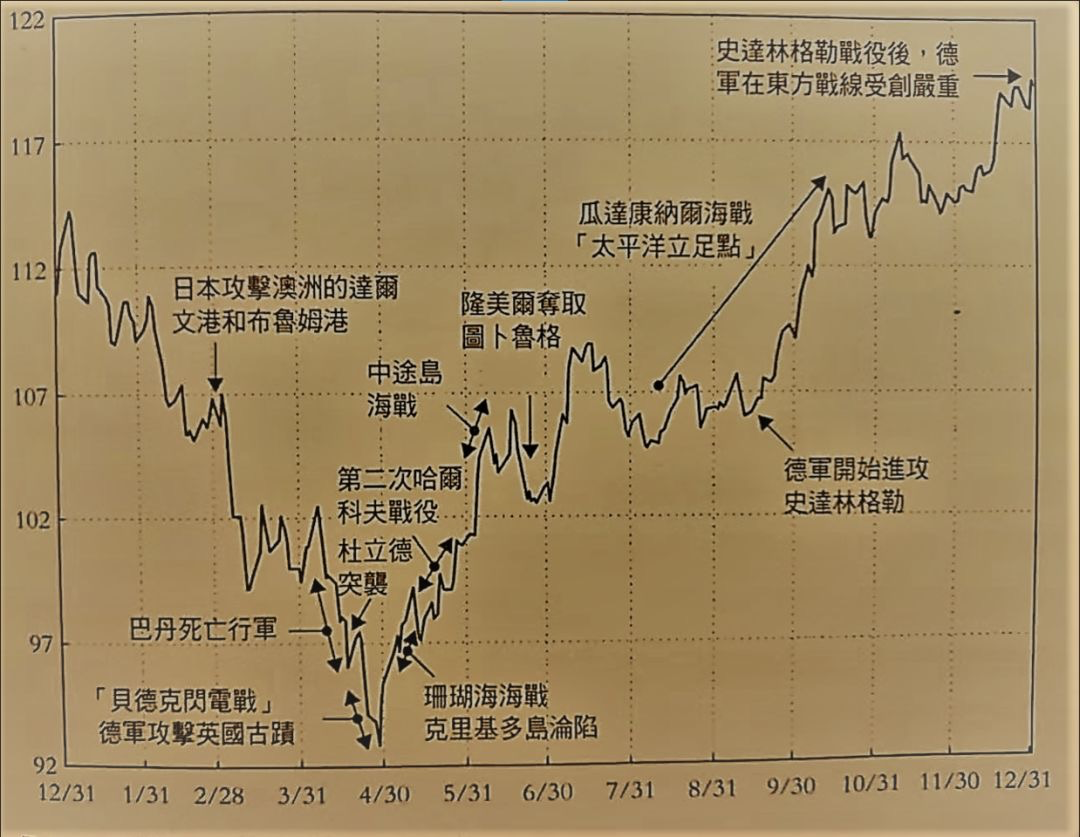
Figure 4: Dow Jones Industrial Average in 1942
Source: Dow Jones Company
In early June 1942, the Battle of Midway dealt a devastating blow to the Imperial Japanese Navy, crippling its ability to launch further offensives and forcing it onto the defensive. Learning from past mistakes, the U.S. government's initial communiqué did not declare Midway a victory. Experts and the media also failed to grasp its significance at the time. Public attention was fixed on a string of defeats and surrenders, completely overlooking the strategic importance of both the Coral Sea and Midway battles.
However, the U.S. stock market intuitively recognized the pivotal importance of the Battle of Midway long before the experts did. From that point, the war shifted to a protracted war of attrition—a type of conflict Japan, lacking the industrial might of the United States, could never win. Japan's fortunes turned from ascent to decline. By then, America was already rapidly building modern warships and aircraft carriers. As early as January 1941, Japanese Navy Commander-in-Chief Isoroku Yamamoto had confided to the Prime Minister: "In the first six months to a year of war, I will run wild. I will show you an uninterrupted succession of victories. But I must also tell you that if the war is prolonged for two or three years, I have no confidence in our ultimate victory."
Winston Churchill also understood the battle's strategic weight: "This memorable American victory was of cardinal importance. It redressed the balance of the Pacific. Japan's moment of peril was gone forever." Ironically, Churchill himself had been misled by a U.S. stock market rebound in late 1937, borrowing heavily to invest his life savings. When the market crashed in March 1938, he was wiped out and left £18,000 in debt—a fortune at the time. He eventually repaid it, and earned a substantial income, through his skills in oratory and writing. A decade later, his WWII memoirs earned royalties equivalent to $40 million today—the highest single-book earnings for any author in history, a record that still stands.
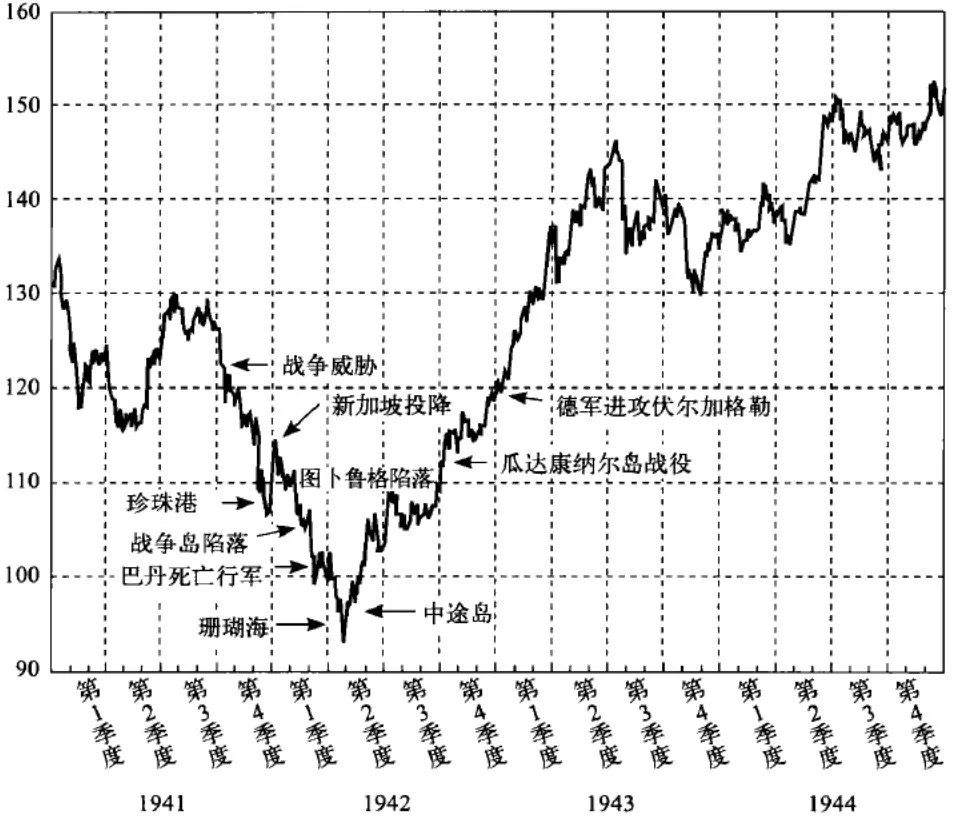
After hitting its low in 1942, the U.S. stock market embarked on a sustained bull run that lasted four years. 1945 was a particularly strong year for U.S. equities, coinciding with the Allies' rapid advance across Europe; large-cap stocks rose 36%. Small-cap stocks were even more remarkable: they surged 45% in 1942, 88% in 1943, 54% in 1944, and 74% in 1945. Once the gloom lifted, the stock market erupted like a pent-up geyser, releasing years of suppressed energy.
Figure 5: Dow Jones Industrial Average, 1941–1944
Source: Dow Jones Company
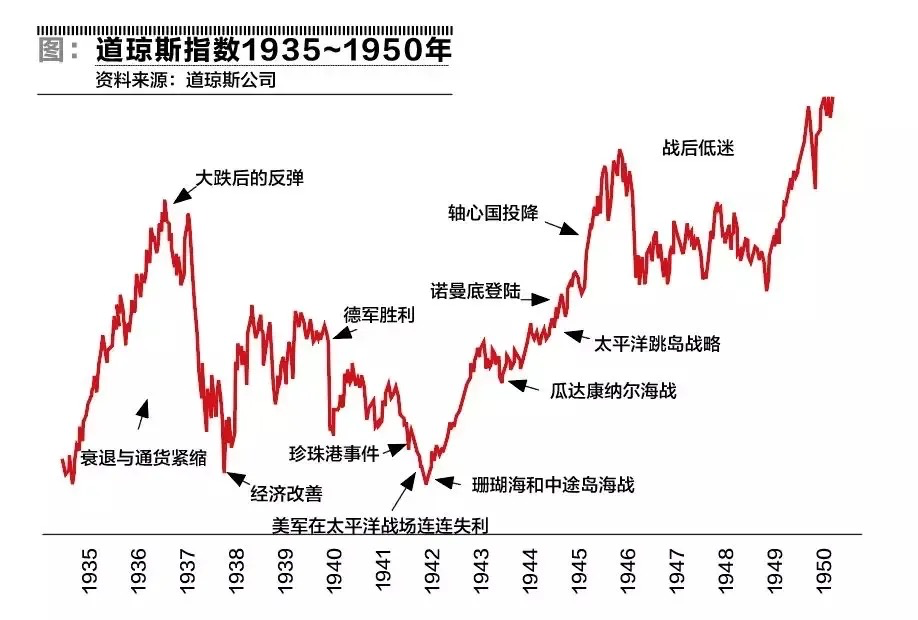
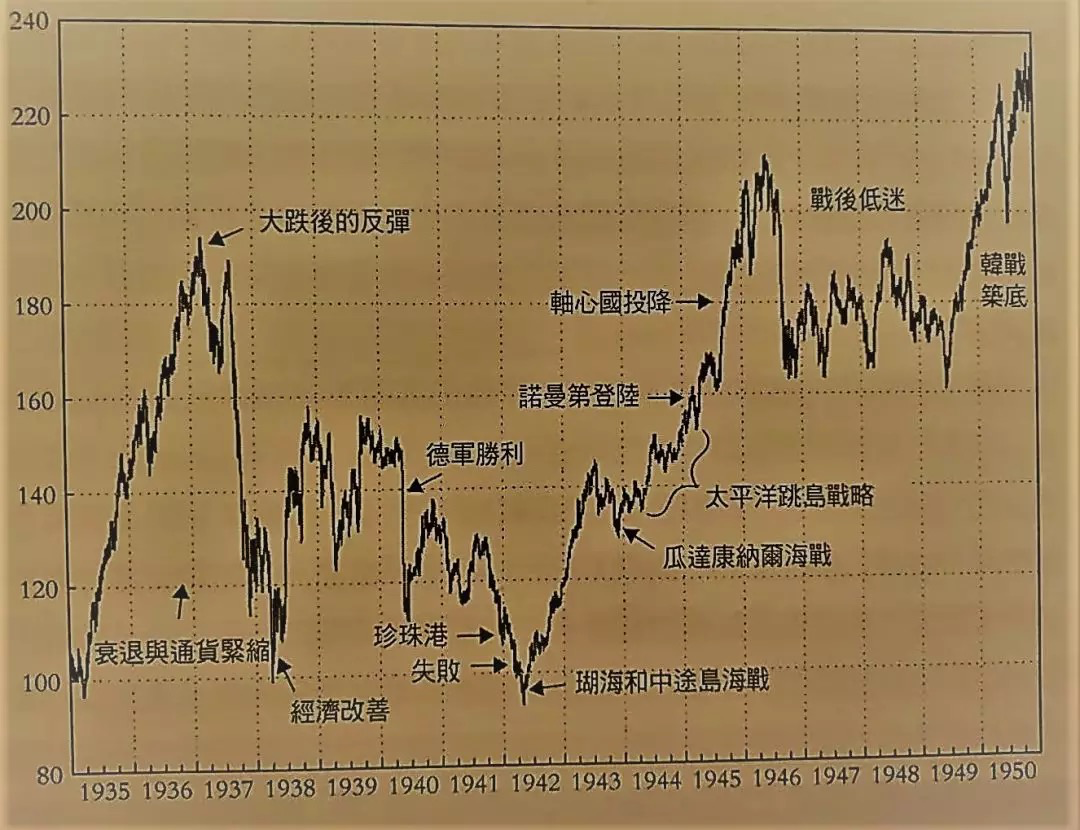
Of course, this 20-year bull market didn't appear overnight—it demanded unwavering confidence and patience from investors. In 1946, U.S. stocks began experiencing sharp swings: the Dow Jones Industrial Average plunged 10% in February, then rallied 14% over the next two months to a new high by late May—only to enter a period of sideways movement before a sharp 20% monthly drop. After that, U.S. equities sank into a severe postwar slump, trading in a volatile, range-bound pattern for three years. The main culprits were the dawn of the Cold War, a sluggish European recovery, and a difficult economic adjustment in the U.S. Inflation hit 18% in 1946 and 9% in 1947, before suddenly flipping to deflation of 1.8% in 1949—plunging both stock and bond markets into a depression. It wasn't until mid-1949, as postwar uncertainties faded, that the markets found their footing again.
Figure 6: Dow Jones Industrial Average, 1935–1950
Source: Dow Jones & Company
Looking back at the volatility of U.S. stocks during World War II offers a valuable perspective. With hindsight, the major turning points are clear. But in the thick of it, shrouded in the fog of war, recognizing a reversal was nearly impossible. The stock market, however, proved to be a wise and far-sighted oracle, repeatedly anticipating these critical shifts.
Today, most investors understand the need for contrarian thinking and try to guard against collective panic or euphoria. Yet these emotions are often fleeting. Market wisdom and price movements arise from the aggregate of countless independent judgments. The investing public frequently shows remarkable intuition about long-term trends. Over the long run, the overall stock market is fundamentally rational. We must be careful not to mistake the irrationality of a few for the irrationality of the whole.
Figure 7: Dow Jones Industrial Average (1928–1960)
Source: Wind
If you wait for the robins, spring will be over.
— Warren Buffett