

Summary: Bitcoin’s price performs poorly in the short term following a Golden Cross, but delivers stronger returns over the long term.
Author: Greg Cipolaro, Global Head of Research at NYDIG Translated by: WEEX Blog
Key Takeaways:
Bitcoin has triggered a rare technical trading indicator—but is it always bullish?
A mystery emerges as Ordinals begin impacting the blockchain
Bitcoin Forms a Golden Cross—But It’s Likely a Long-Term Signal
Last Monday (Tuesday, Singapore time), Bitcoin formed a rare technical analysis signal—the Golden Cross—prompting cheers among traders. A Golden Cross occurs when a short-term moving average crosses above a longer-term moving average—in this case, the 50-day moving average (DMA) crossing above the 200-day DMA. Traders typically interpret this signal as bullish, potentially signaling the start of a new upward price trend.
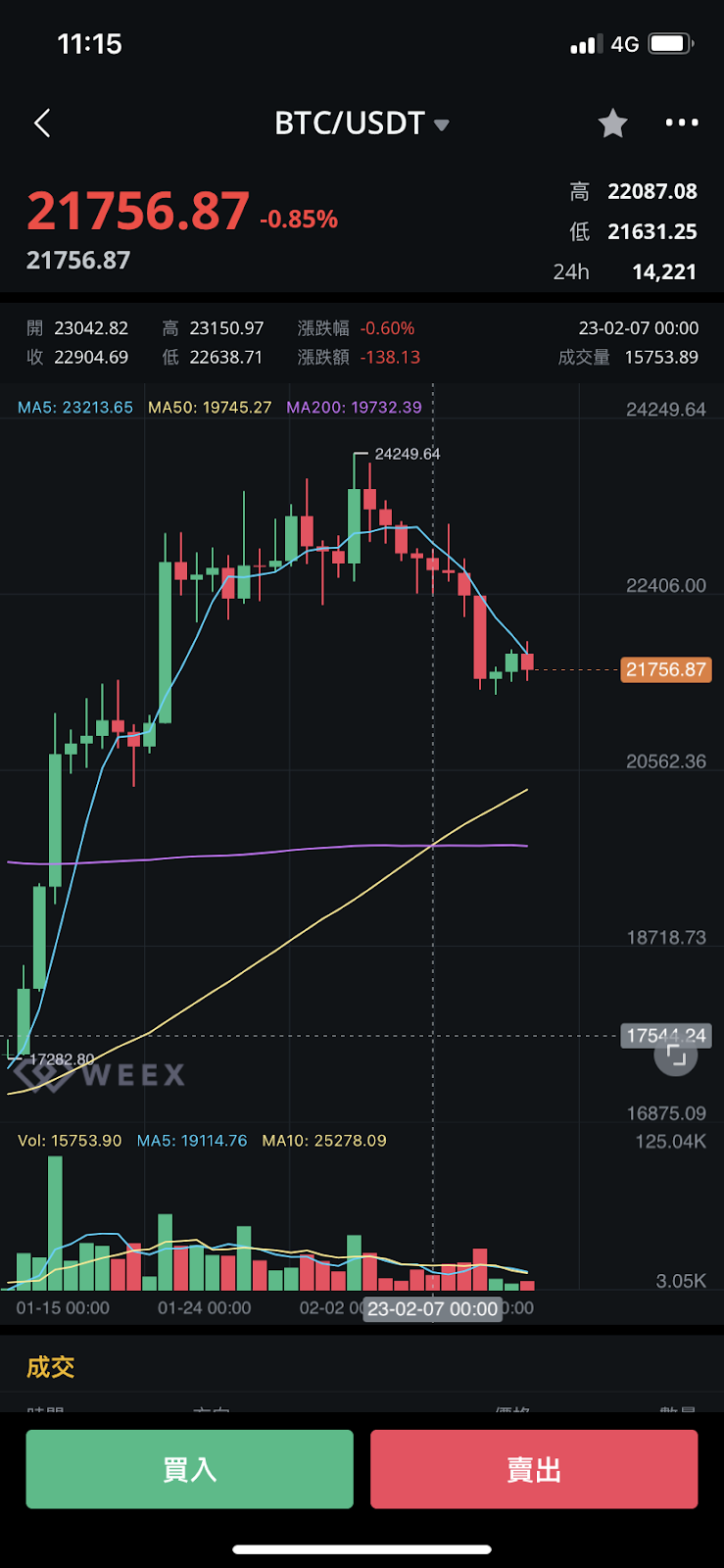
According to WEEX data, BTC/USDT daily candles declined modestly for five consecutive days ending Tuesday, February 7 (Singapore time), followed by three more down days—totaling eight consecutive losing days from February 3 to February 10. Aside from a 4.24% drop on February 10, declines during the first nine days were relatively muted, with an aggregate decline of 9.16% across eight days. Despite this short-term correction, the 50-day MA crossed above the 200-day MA on February 7—forming a Golden Cross.
Historical analysis of prior Golden Crosses in Bitcoin suggests that while they often foreshadow positive future price action, this is not universally true.
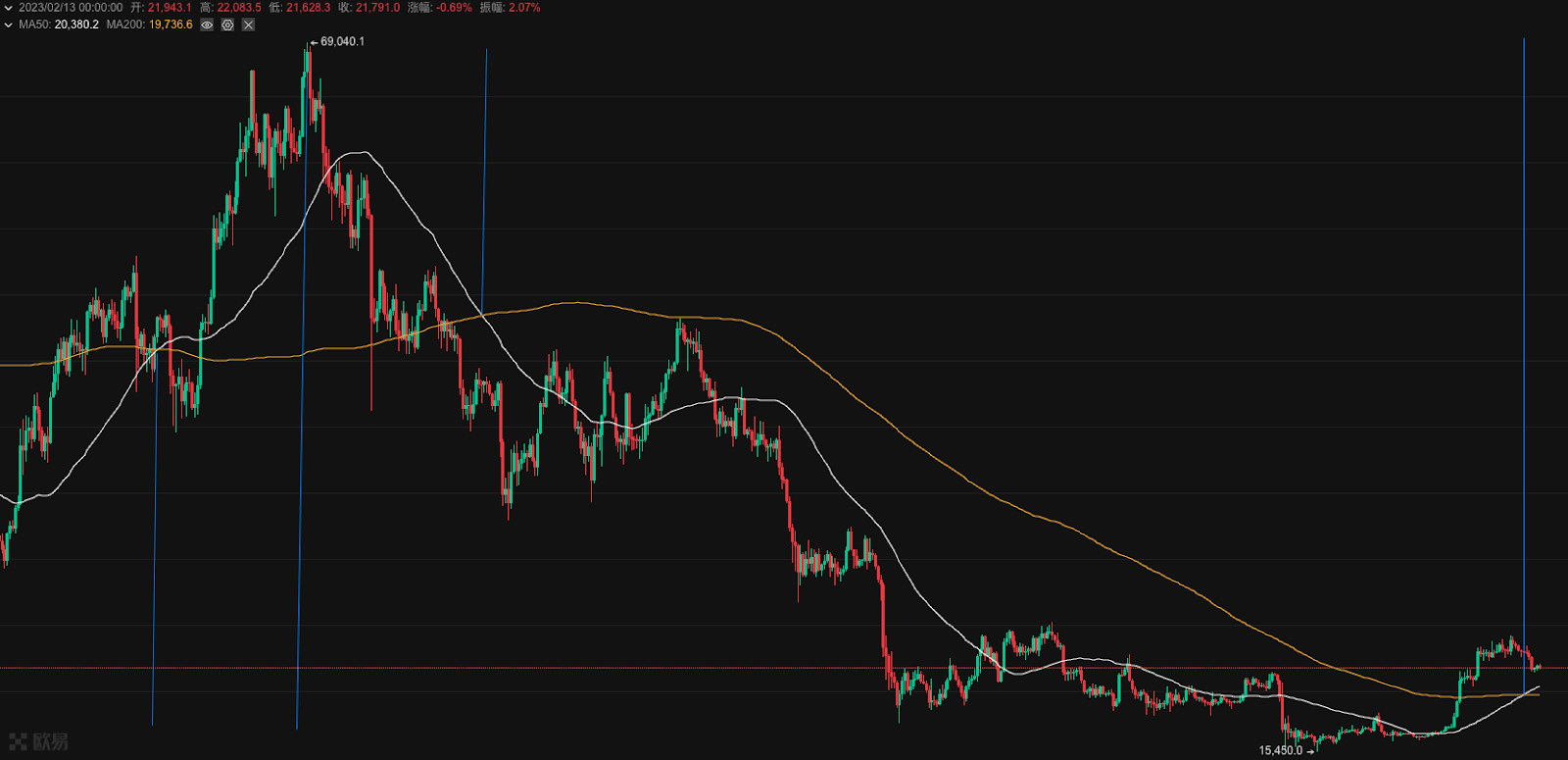
Per WEEX data, the last Golden Cross on the BTC/USDT daily chart occurred on September 15, 2021. Following a brief two-week correction (peak drawdown of -15%), price began rising steadily from $41,698 on September 30 and surged to its all-time high of $69,000 on November 10—a gain of over 65% in just 40 days.
Subsequently, after a sharp decline, a Death Cross formed on January 14, 2022, marking the definitive onset of a bear market. BTC fell 65% throughout 2022 before forming another Golden Cross last week.
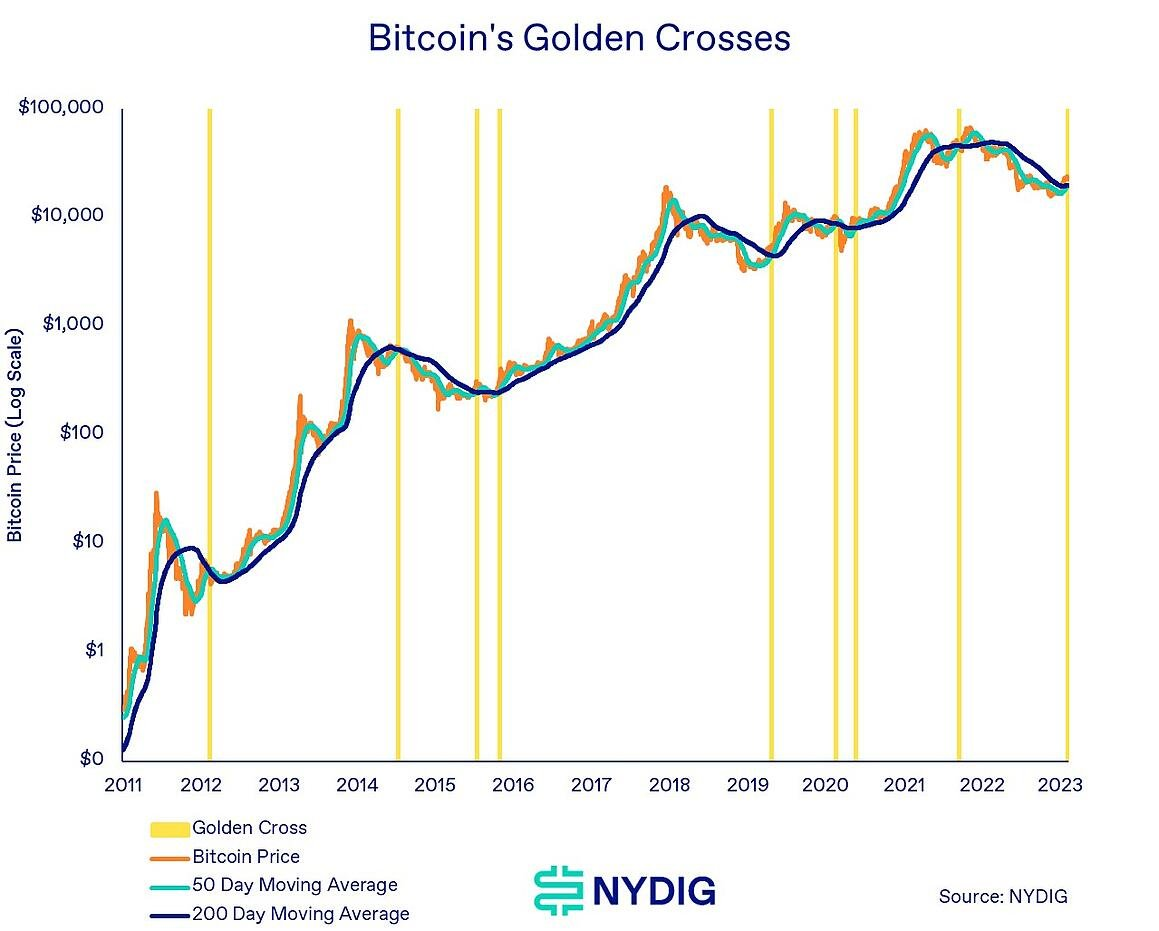
Historically, Bitcoin has formed eight Golden Crosses since 2011. Our analysis shows that while the Golden Cross can indeed serve as a positive indicator, its predictive power appears limited to investment horizons exceeding 90 days.
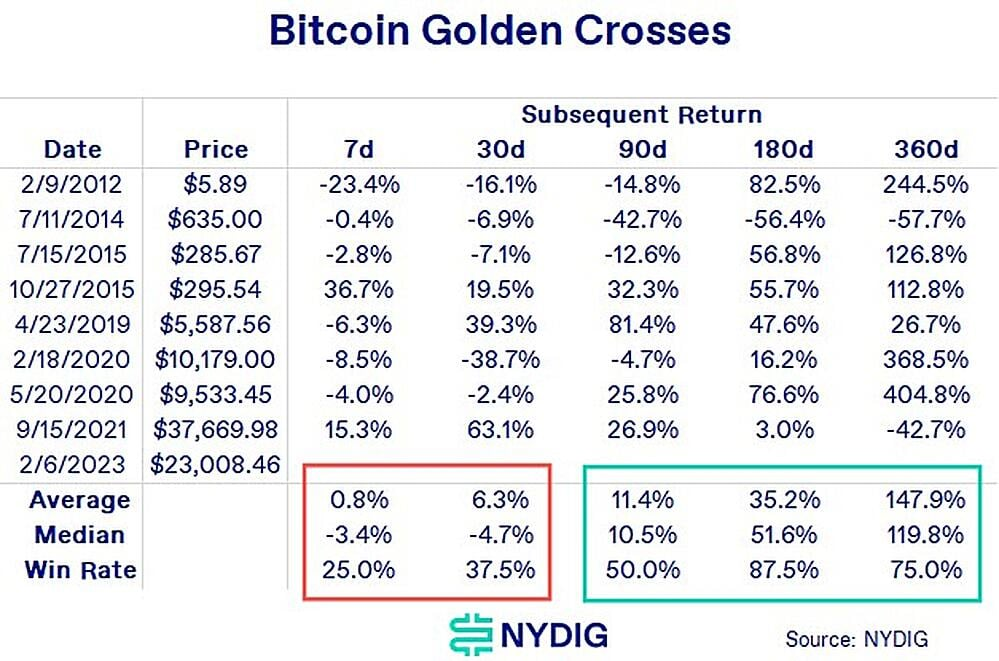
Performance following a Golden Cross is far more nuanced over shorter investment horizons—specifically, 7-day and 30-day periods. In contrast, over longer timeframes—90 days, 180 days, and 360 days—Bitcoin demonstrates robust median returns (we prefer median over mean, as means can be skewed by outliers) and consistently positive price performance (win rate).
For shorter holding periods—7 days and 30 days—median returns are negative, and win rates fall well below 50%. This indicates that Bitcoin’s price tends to underperform immediately after a Golden Cross, yet delivers superior returns over extended time horizons.
Ordinals Is Impacting Blockchains, But Some Outcomes Remain Unclear
Ordinals is a project enabling users to inscribe data onto satoshis—the smallest unit of BTC—effectively turning them into NFT-like assets. It has become a highly discussed topic within the Bitcoin community. Though still in its infancy, Ordinals officially launched on mainnet on January 20, and its impact has already drawn attention and sparked debate.
Last week, we published an article on Ordinals from philosophical, technical, and legal perspectives. Now, with increasing usage and more time elapsed, we have some data to analyze. It remains too early to predict whether Ordinals will achieve long-term adoption—and thus exert a lasting impact on Bitcoin—but early signs suggest it is already affecting the Bitcoin blockchain while raising several unresolved questions.
The first impact of Ordinals is growth in Bitcoin’s mempool. The mempool is a virtual waiting room where users broadcast transactions pending inclusion in a block by miners. As shown in the chart below, the volume of unconfirmed transactions has surged recently—indicating that Ordinals-related activity is consuming significant space, potentially forcing other transactions to wait longer or pay higher fees.

The second impact following Ordinals’ emergence is an increase in average block size. Historically, Bitcoin blocks had an official maximum capacity of 1 MB; however, after the 2017 SegWit upgrade, blocks could grow larger (up to ~4 MB) when data was classified as “witness” data—typically transaction signatures.
Ordinals exploits this by embedding data into the witness section of transactions, resulting in blocks containing Ordinals inscriptions being significantly larger than those composed solely of financial transactions.
Prior to Ordinals’ launch, the largest block ever produced on the Bitcoin network was 2.4 MB. However, after Ordinals launched on February 1, Luxor mined a substantially larger block—block height 774,628—with a size of 3.96 MB (nearly reaching the 4 MB limit), including 3.94 MB of Ordinals inscription data featuring the Taproot Wizard image. As illustrated below, the Bitcoin network’s average block size has increased markedly—especially over the past week.

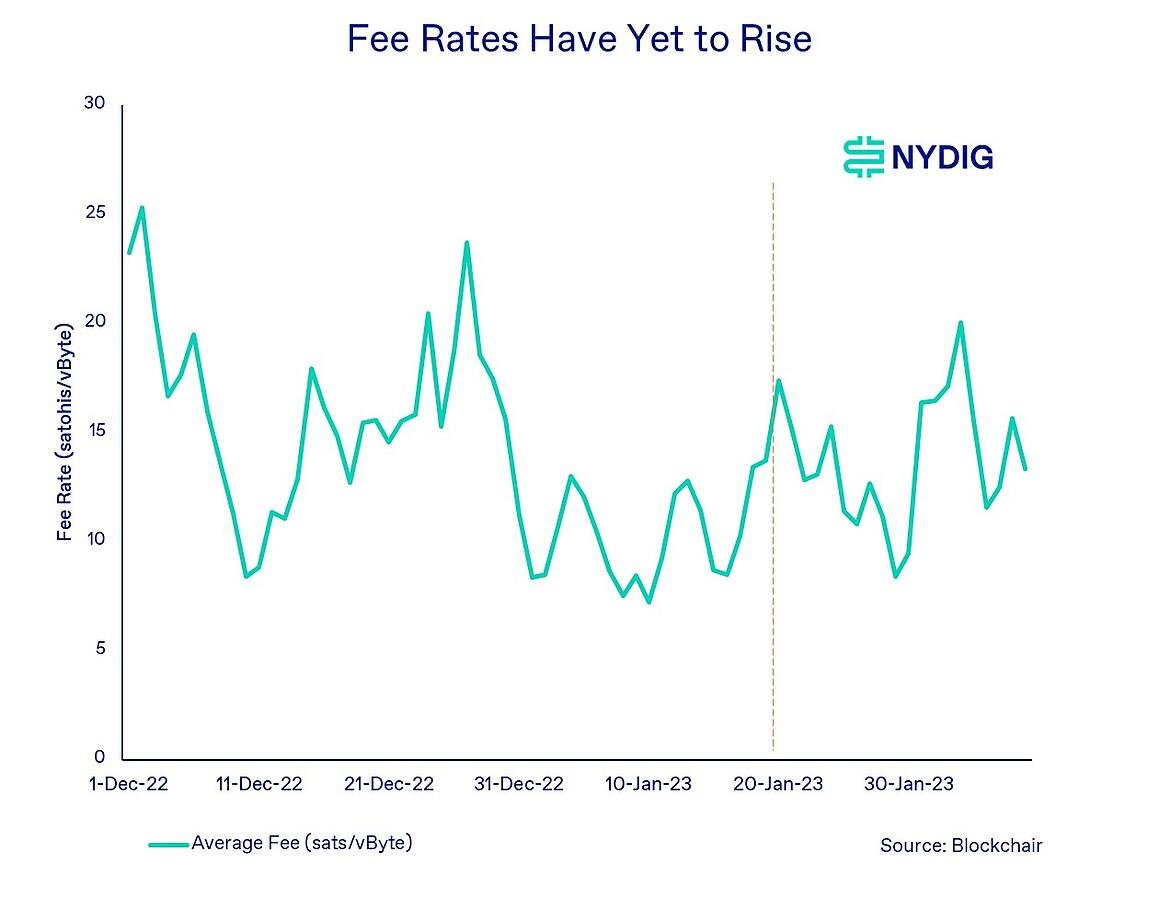
As more transaction data accumulates in the mempool awaiting confirmation in blocks, and increasingly large blocks are generated, we would typically expect transaction fees to rise—as users compete to pay higher fees for priority inclusion in increasingly congested blocks.
However, as shown in the chart below, this trend is not evident: the average transaction fee per vByte—measured in satoshis (one hundred millionth of a BTC)—has not risen. Fees per vByte represent the most accurate metric, as vBytes reflect the actual throughput constraint of the network.
Examining the details of the Taproot Wizard transaction reveals that—according to on-chain records—it carried no associated fee.
How can a transaction occupying nearly an entire block be included without any fee? The answer lies in direct coordination with miners.
Transactions exceeding ~100 kvBytes are considered non-standard: although they may be valid, nodes will not propagate them across the network if submitted to the mempool, and thus they won’t be mined. However, such transactions may still be included in blocks if directly coordinated with miners.
In the case of Taproot Wizard, Luxor may receive transactions directly from senders and pay off-chain to include them in its block template. When Luxor mines its next block, the wizard’s transaction appears on-chain formally (and publicly) with zero fees—hence the “zero fee” and “zero fee rate.”
This could have significant implications for miners. First, miners may earn additional gas fee revenue from Ordinals transactions that are not directly observable on-chain. Second, the emergence of non-standard transactions bifurcates the fee market into two segments: one visible to users via the mempool and blockchain, and another opaque segment conducted directly between users and miners.
Such a market structure could yield unintended consequences—for example, increased fee volatility or greater complexity for users in determining appropriate gas fees. On the other hand, it could foster a more robust fee market, which Bitcoin will increasingly require as block rewards diminish and transaction fees become ever more critical for securing network security.
Transactions like Taproot Wizard remain extremely rare at present, so this remains a fringe case. If Ordinals projects grow in popularity, these market structures and technical dynamics may become more urgent topics of discussion.
Market Update

Last week, asset prices declined across the board as investors assessed the impact of future interest rate hikes and overall economic health. After strong performance earlier in the year, Bitcoin fell 7.9% last week. Although regulatory news dominated headlines last week, we attribute most of the decline to short-term overbought conditions (see the Golden Cross section) and risk-averse sentiment across financial markets.
Equity markets also declined, with the S&P 500 falling 2.3% and the Nasdaq Composite down 3.4%.
Commodities posted mixed results last week: gold fell 2.6%, while oil rose 2.9%.
Bonds declined across the board: investment-grade corporate bonds fell 2.9%, high-yield corporate bonds dropped 2.4%, and long-term U.S. Treasuries declined 3.5%. Real yields and inflation expectations rose last week.
Key News Recap
Technology >>
Bitcoin Lightning Network capacity reaches new all-time high of nearly 5,400 BTC
Investment >>
Binance suspends USD bank transfer services
Peer-to-peer Bitcoin trading platform LocalBitcoins to shut down after ten years of operation
Deposit tokens and CBDCs will become widely used monetary forms within the digital asset ecosystem
Regulation & Taxation >>
Former Coinbase product manager Ishan Wahi pleads guilty in insider trading case
Coinbase accuses SEC of overreach in NFT insider trading case
SEC’s Examination Division lists crypto assets and other emerging technologies as top priorities for 2023
U.S. SEC Issues Investment Warning to Self-Directed IRAs That May Have Exposure to Cryptocurrencies
Kraken Agrees to Shut Down Staking Services and Pay $30 Million Settlement to the SEC
Companies >>
WEEX Launches “Slippage Guaranteed Compensation” Campaign
DCG and Genesis Creditors Reach a Principled Agreement to Convert $1.1 Billion in Bonds into Convertible Preferred Shares
E-commerce Giant eBay Recruits for Web3 Roles at Its Acquired NFT Marketplace KnownOrigin
Miners Hut 8 and US Bitcoin to Merge into a New Company
UK-Based Neobank Revolut Launches Cryptocurrency Staking Services
Major Events This Month
Feb 13 – WEEX “Trade with Us, Gifts for You” Valentine’s Day Campaign
Feb 14 – January CPI Data Release
Feb 24 – CME Futures and Options Expirations