

Author: Nancy, PANews
On-chain activity is emerging as a new battleground for centralized exchanges (CEXs). Recent innovations like Binance Alpha and Bitget Onchain Trading are not only providing users with convenient on-chain trading pathways but are also pioneering a new airdrop model through point-based systems—significantly boosting market participation.
In fact, as infrastructure matures, the product ecosystem diversifies, and on-chain assets grow exponentially, on-chain trading is moving into the mainstream. Notably, emerging trends like MEME and AI Agent have drawn a wave of new users to the on-chain world, fueled by their profit potential and strong community momentum.
Amid this shift, CEXs like Bitget have recognized the potential of the on-chain economy and are working to bridge CeFi and DeFi with more user-friendly products. Beyond letting users trade on-chain assets directly through its interface, Bitget has introduced a series of innovative products and mechanisms. These not only inject fresh liquidity into the on-chain economy but also position the exchange as a crucial hub connecting on-chain and off-chain worlds—strengthening its core market competitiveness.
CEXs Vie for On-Chain Dominance: How Bitget Turns High Barriers into Traffic
As more users and assets flow on-chain, this once niche domain is becoming both vibrant and complex. Airdrop hunters, DeFi yield farmers, MEME chasers, stablecoin yield seekers—diverse participants are shaping a multifaceted ecosystem. They're driving asset growth and pushing infrastructure forward, from smarter wallets and efficient bridges to precise oracles and faster, cheaper Layer-2 solutions.
Yet beneath this thriving surface, a stubborn reality remains: on-chain interaction is still fraught with high barriers. Complex processes, information gaps, cumbersome gas fees, fragmented cross-chain experiences, and persistent security risks create "invisible walls" that deter countless potential users. This isn't just a technical hurdle—it's a fundamental user experience gap. The central challenge for the next wave of Web3 innovation is enabling efficient on-chain interactions while ensuring safety and lowering the entry threshold.
Meanwhile, the on-chain world is entering an era of "high-density interaction," while CeFi faces mounting pressure from the expanding on-chain ecosystem. Users now demand more than simple trades—they want fast, secure, and convenient access to on-chain opportunities, especially during surges like the recent MEME boom.
Bitget Onchain Trading has emerged as a new gateway that redefines the on-chain experience—and a fresh lever for the exchange to boost platform liquidity and capture market attention.
As the on-chain ecosystem flourishes, wealth effects have become a key user magnet. Leveraging its rapid token listing pace and strong asset selection, Bitget Onchain Trading is building unique advantages in early project discovery and value capture.
According to Bitget's first publicly disclosed token listing strategy, its on-chain trading listing process follows three steps: "intelligent detection & preliminary review → manual secondary review → listing execution" (see below). This approach prioritizes efficiency, security, and trend responsiveness, helping the platform gain a first-mover edge in a competitive landscape while filtering reliable, high-potential assets for users.
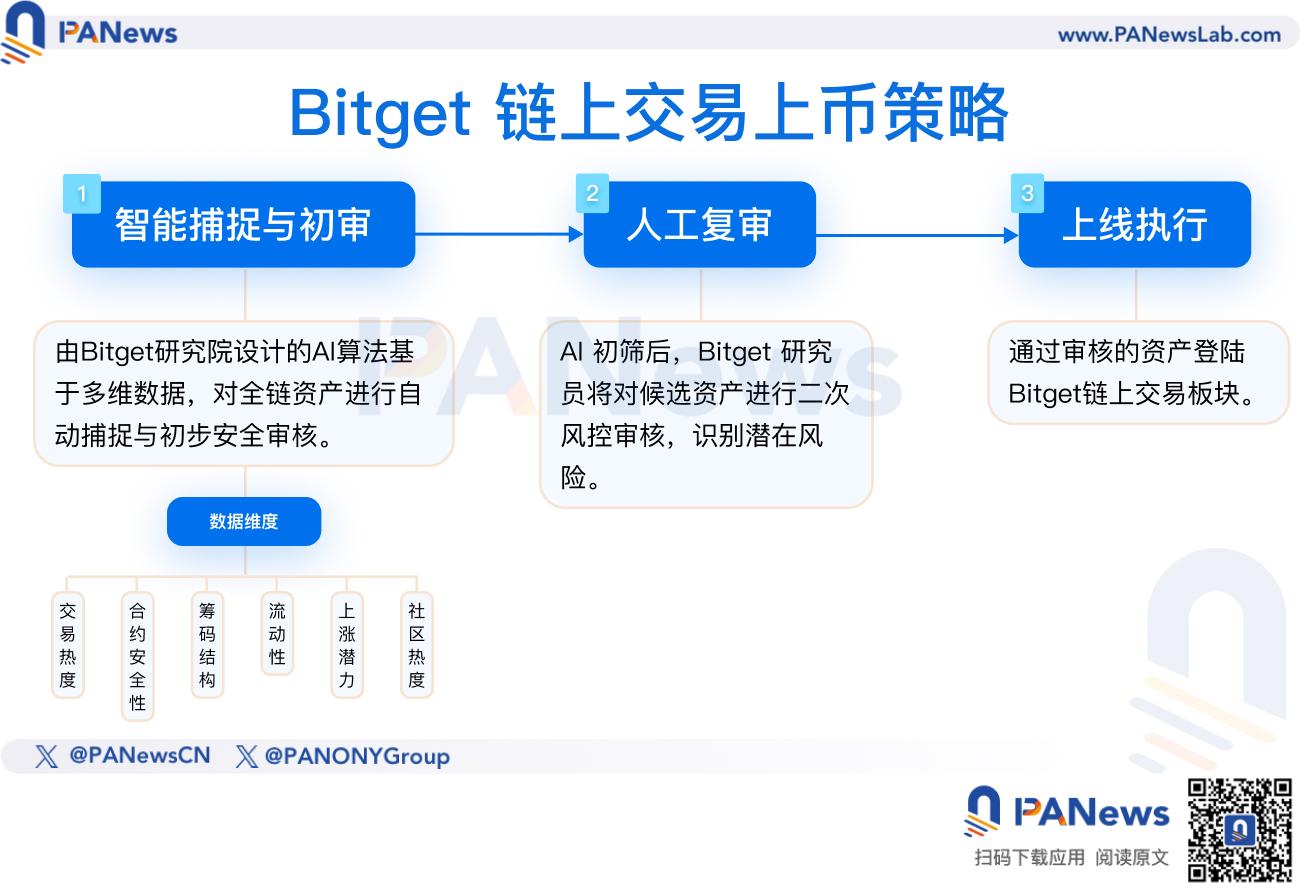
Since launching on April 7, Bitget Onchain Trading has listed over 120 tokens in under two months. Most belong to trending sectors like MEME and AI, aligning closely with current on-chain user interests. With an average of at least two new tokens listed daily, Bitget demonstrates sharp market sensitivity and rapid response to user demand.
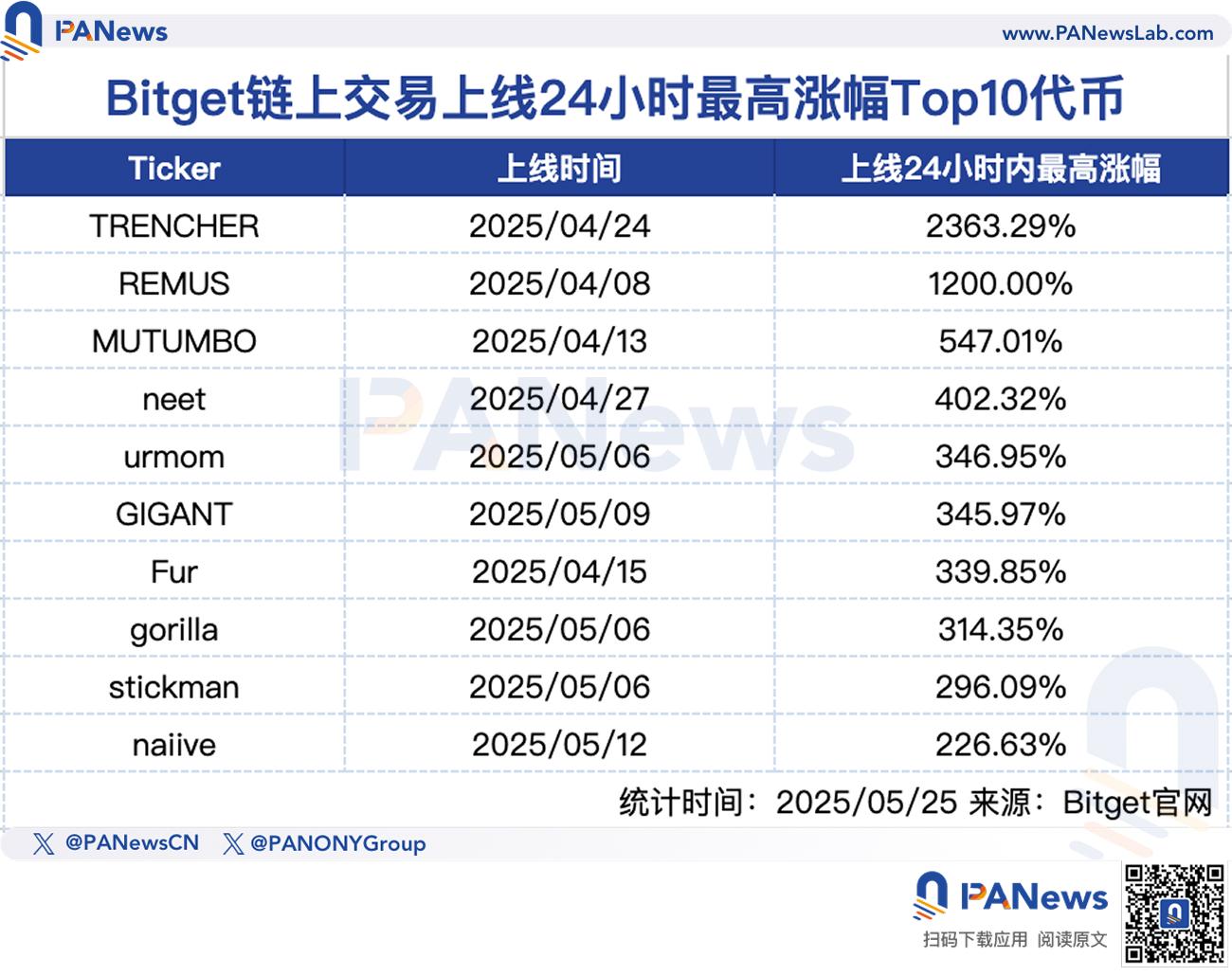
More notably, several projects have delivered impressive returns. A PANews analysis of the top ten tokens with the highest 24-hour price surges after listing on Bitget Onchain Trading shows an average surge of 638.25%, reflecting strong market performance and intense capital interest. Tokens like TRENCHER, MUTUMBO, and REMUS saw multi-fold or even double-digit gains. Most were early-stage assets not yet listed on major exchanges like Binance, underscoring Bitget's foresight and independent judgment in spotting promising projects. Over time, Bitget Onchain Trading has consistently unearthed "dark horse" projects—capturing market attention and solidifying its brand in early-asset discovery.
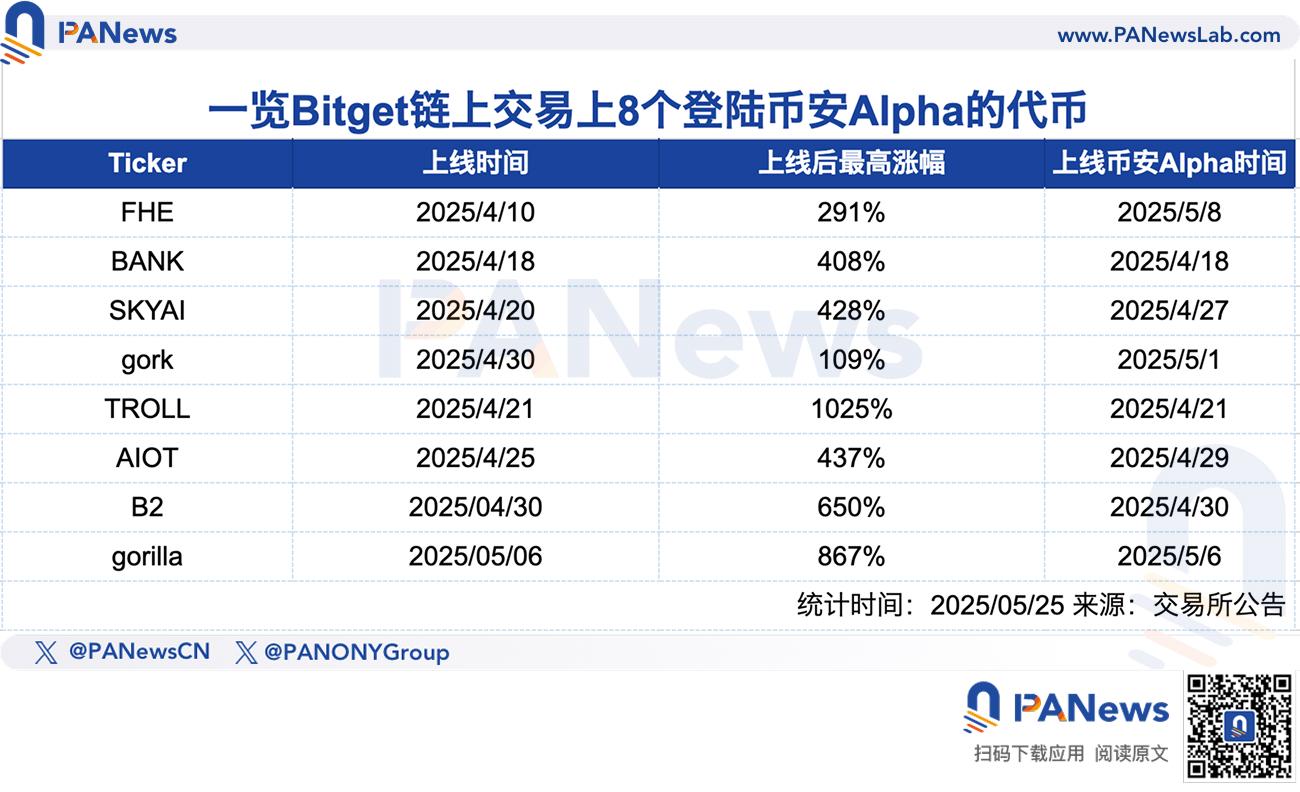
Moreover, Bitget Onchain Trading's value extends beyond being first to list—it lies in sustained support for quality assets. To date, eight projects listed on Bitget Onchain Trading have been included in Binance Alpha. This highlights not just timing advantages but also Bitget's integrated capabilities in project evaluation, trend spotting, and resource coordination.
For instance, Bitget Onchain Trading launched FHE, gork, and AIOT ahead of others, and these later entered Binance Alpha—showcasing Bitget's swift trend recognition and first-mover edge. Their average peak surge of 526% further extended Bitget's market exposure. Meanwhile, TROLL, gorilla, B2, and BANK achieved simultaneous coverage with Binance Alpha on their listing day. This wasn't just market coincidence; it evidenced Bitget's efficient coordination across project screening, timing, and frontier research. On the user experience front, Bitget Onchain Trading employs a seamless gas-fee mechanism—enhancing the trading experience while cutting operational costs, stimulating engagement, and fostering a virtuous cycle of activity.
Point-based reward mechanisms have also emerged as a key tool for exchanges to boost user loyalty, market activity, and resource dominance. Bitget’s on-chain trading points program, with its low entry barrier and dual-reward structure, effectively balances returns for both casual users and high-frequency traders, ensuring fairness and strong incentives. This model creates diverse earning opportunities for newcomers and veterans alike, showcasing an efficient strategy for user engagement and platform growth. Since its launch, Bitget has run two rounds of on-chain points challenges, airdropping 50,000 BGB tokens as rewards in each round.
In summary, as on-chain interactions enter a new era of high density and frequency, user expectations of trading platforms have moved beyond basic "tool" functionality. The focus now is on a holistic assessment of experience, efficiency, and value capture. Bitget’s on-chain trading not only builds a competitive edge by listing tokens frequently and selecting assets early—it also breaks down the "on-chain wall" through seamless Gas handling and point-based incentives. This significantly optimizes the user experience and drives deeper engagement.
Six Core Features Redefine On-Chain Trading—Delivering CEX-Level Smoothness
As a bridge between CeFi and the on-chain world, Bitget’s on-chain trading is a comprehensive solution. It redefines the trading experience, eliminating the need to constantly switch between CeFi and DeFi platforms while avoiding complex processes and steep learning curves.
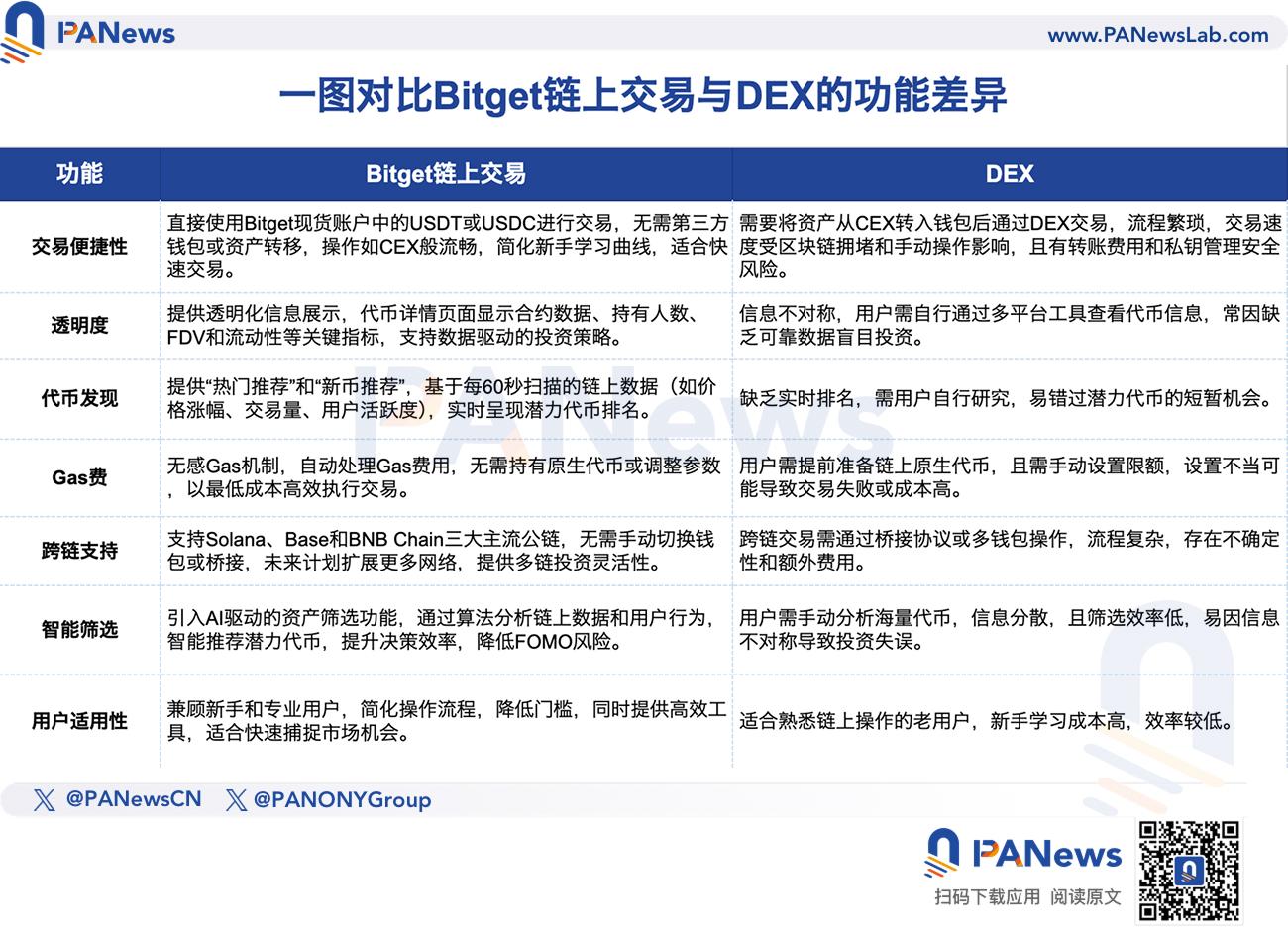
Bitget’s on-chain trading redefines the experience through six core features:
· Instant On-Chain Trading: Trade on-chain assets directly using USDT or USDC from your spot account—no wallet setup or private key management required. This lowers the barrier for beginners while letting pros act on market opportunities quickly.
· Full Transparency: Key metrics like contract data, holder count, FDV, and liquidity are displayed transparently, helping users build data-driven investment strategies.
· Real-Time Token Rankings: The “Trending” and “New Tokens” sections, powered by on-chain data refreshed every 60 seconds (price action, volume, user activity), highlight the most promising tokens.
· AI-Powered Asset Screening: An AI-driven function analyzes vast amounts of on-chain data and user behavior to intelligently identify high-potential tokens, improving discovery, aiding decision-making, and reducing emotional investment risks.
· Cross-Chain Support: Supports Solana, Base, and BNB Chain, letting users capture multi-chain opportunities seamlessly—no manual switching or bridging required. Plans to add more networks are underway.
· Seamless Gas Mechanism: Automatically handles Gas fees, removing manual configuration and enabling fast, low-cost transactions.
Overall, from asset discovery to trade execution, chain selection to fee settlement, Bitget’s on-chain trading is built around user experience. It serves both seasoned traders seeking speed and efficiency, and newcomers taking their first steps—enabling everyone to navigate the on-chain ecosystem effortlessly, efficiently, and securely. By lowering entry barriers and enhancing convenience, Bitget is bringing fresh users and liquidity on-chain, accelerating broader adoption and ecosystem growth.
From Incentive Tool to Ecosystem Integration: Bitget Accelerates Its On-Chain Expansion
“2025 will be a pivotal year for CEXs to deeply integrate with DeFi. Yet DeFi remains overly complex for many newcomers—especially those who’ve just bought their first crypto via a mobile app. In this journey, CEXs will act as gateways to the crypto world for millions. CEXs won’t disappear; they’ll evolve, and DeFi will become central to their adoption strategy. Bitget is already moving in this direction, transforming from a centralized exchange into a comprehensive Web3 platform.” Bitget CEO Gracy Chen has repeatedly emphasized that Web3 is a top strategic priority for Bitget.
Beyond opening on-chain trading channels, Bitget is rolling out strategic product upgrades and mechanism enhancements to build a holistic CeFi-DeFi ecosystem. Previously, Bitget acquired and launched the multi-chain Bitget Wallet and on-chain yield products, expanded the on-chain utility of its native BGB token, created more user pathways into on-chain, and deepened its ecosystem footprint.
A key development this year is Bitget’s upgrade to the BGB token burn mechanism. This not only unlocks greater on-chain potential for BGB but also signals an evolution in token deflationary logic. In April, Bitget announced that to enhance BGB’s compliance, transparency, and ecosystem utility—extending its use from off-chain to on-chain and from crypto to real-world scenarios—the quarterly burn would now be linked to “on-chain Gas fees,” moving away from a fixed 30 million BGB. This new mechanism is grounded in actual BGB usage. BGB thus evolves from a platform incentive tool into a deflationary asset with real on-chain utility—where the burn scale directly reflects its adoption.
Indeed, platform tokens are entering a “post-value-management era.” Competition now extends beyond mere token burns to establishing sustainable deflationary mechanisms and strong market influence. BGB’s applications already go far beyond basic platform utilities like fee discounts, wealth management, and launchpad access—it’s also used for real-world payments. This dynamic, usage-linked burn model strengthens BGB’s on-chain presence, bolsters its practical utility and intrinsic demand, and opens new narratives for its long-term value. Gradually, BGB is becoming a “passport” and “value hub” connecting CeFi and the on-chain ecosystem.
Looking ahead, deeper integration of platform tokens into on-chain ecosystems is a clear trend. While on-chain trading offers openness and transparency, it also faces high technical barriers, security risks, and unstable transaction efficiency. CEXs, leveraging their established user bases, liquidity, and mature infrastructure, can improve trading depth and price stability, lower entry barriers, attract traditional users into Web3, and provide exposure and liquidity to on-chain projects—ultimately achieving interoperability between CeFi and DeFi in both liquidity and users.
At the pivotal moment of Web3's mass adoption, Bitget puts users first. By seamlessly integrating on-chain and off-chain products into a closed-loop ecosystem, we are not just redefining the trading experience—we are building a sustainable, on-chain value system for the future.