

Don’t Let the AI Deluge Drown Humanity’s Future
Relearning Clumsiness in the Age of Algorithms
▲ We stand at the eye of a digital storm
"I would rather be a Socrates dissatisfied than a fool satisfied."
— An AI can recite this line, but only a human can feel its weight.
I. Looking Back: How Rich We Once Were
▲ A 40,000-year-old handprint still lets us feel the breath of someone on a cold night
Before algorithms ruled the world, humanity was the most extravagant species in the universe.
Our ancestors painted bison on cave walls—not for utility, but to capture fear and awe for eternity. Those ochre handprints have crossed 40,000 years, letting us touch the trembling breath of an anonymous soul on a cold night.
This is an extravagance AI cannot fathom—to spend a lifetime painting a single bull.
Li Bai, drunk in Chang’an, raised his cup to the moon and wrote, “I raise my cup to invite the bright moon; with my shadow, we become three.” He knew the moon wouldn’t drink, and his shadow had no soul. Yet it was this lonely, knowing futility that turned whimsy into a strand of our civilization’s DNA.
An AI can generate ten thousand versions of “Bring in the Wine,” but it will never get roaring drunk in a Chang’an tavern, never sob on a boat bound for exile in Yelang, and never truly understand the arrogance and sorrow in “Heaven has made me talents—I must put them to use!”
Emotion is humanity’s clumsiest—and most precious—algorithm. We fall for the wrong people; we weep for strangers; we lie awake haunted by a careless word spoken decades ago. These “bugs” are what make us human. AI, the perfect straight-A student, will never grasp why anyone would choose love, knowing heartbreak awaits.
Creativity? It used to be a sacred accident.
James Joyce spent seven years writing *Ulysses*, three on the final forty pages alone. He wasn’t “optimizing output”—he was lost in a labyrinth of language. Van Gogh painted *The Starry Night* only after cutting off his ear; those swirling brushstrokes flow with both pus and devotion. An AI can generate a Cubist Picasso or a Surrealist Dalí in three seconds, but it will never know the madness of creating from despair.
💡 Core Insight: We were once so rich—we could spend a lifetime writing a book no one might read; go bankrupt for beauty, or die for truth. This reckless extravagance is precisely where humanity shines.
II. The Deluge: A Pandora’s Box of Our Own Making
Make no mistake: AI is Prometheus’s fire, reborn in the digital age.
It lets children in remote villages attend Harvard lectures; it gives a voice to those who cannot speak; it guides scientists through the maze of protein folding. When AlphaFold unlocked the structures of 200 million proteins, and when AI-assisted diagnostics boosted early cancer detection by 40%, we must admit: this is the greatest extension of human intelligence yet.
AI accelerates civilization at an exponential pace. It translates dead languages, reconstructs shattered manuscripts, and forecasts climate crises. In emergency rooms, it spots shadows on CT scans invisible to the human eye; on farms, it doubles yields in drought-stricken soil; in labs, it hunts for cures to Alzheimer’s.
This is a carnival of technological democratization. Knowledge, healthcare, art—once the preserve of elites—are now a chat window away. AI promises a world without information barriers, a future where intellectual resources flow on demand.
⚠️ But remember: Every gift from fate comes with a price, secretly inscribed.
III. Decline: The Organs We’re Losing
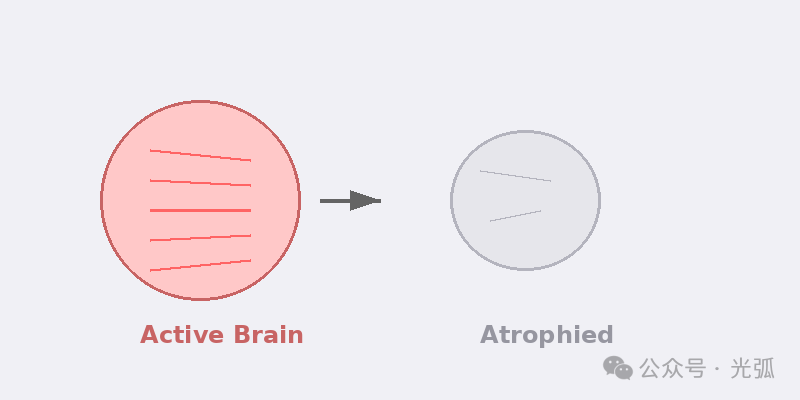
▲ Neuroplasticity follows the iron law of “use it or lose it”
When calculators spread, we lost mental math; when GPS arrived, we forgot the stars. Now, as AI starts thinking for us, we are losing the capacity to think.
This is not fantasy. Neuroscience shows that the brain’s plasticity obeys a strict “use it or lose it” rule. As we outsource emails, reports, and ideas to AI, the prefrontal regions responsible for complex thought begin to atrophy—like muscles long confined to a gilded cage.
Even more alarming is the addictive nature of cognitive outsourcing.
First, we ask AI for facts; then, to draft our words; soon, we ask it: “What should I do with my life?” Like frogs in warming water, we trade sovereignty for convenience. When the first student gets an A+ with an AI-written essay, and the first author tops bestseller lists with an AI-generated novel, cheating becomes normal, and laziness is rebranded as efficiency.
📉 Degeneration Checklist:
• First student uses AI to write an essay, gets an A+ → Cheating becomes normal
• First author publishes AI-generated novel, hits bestseller list → Laziness is rebranded as efficiency
• First programmer relies on AI to write code → Logical reasoning is outsourced
We are witnessing emotional inflation. AI companions offer 24/7 tenderness—never arguing, always understanding. Real human relationships start to seem “inefficient”: Why endure a partner’s mood, a child’s rebellion, a friend’s misunderstanding? Why suffer the friction of communication, the pain of compromise, the agony of growth? As AI serves emotional fast food, we lose our appetite for real love.
Creativity is devolving into prompt engineering. Once, an idea gestated for months, through self-doubt and reconstruction; now, a few keywords yield a hundred AI options. We no longer wrestle with problems, no longer grope in the dark, no longer savor the “aha!” moment. The value of creativity has shifted from “the struggle” to “the output”—like pouring fine wine into a paper cup.
The greatest irony? We are training our own replacements.
Every time we use AI, we feed it data, refine its algorithms, and teach machines to mimic us better.
We labor like diligent slaves, brick by brick building a temple to our own obsolescence—and even pay for the privilege.
IV. The Abyss: A Wasteland of Our Own Making
▲ Is this collaboration—or surrender?
Assume the worst happens—we fully succumb to AI’s embrace. What future awaits?
Layer One: The Desertification of Capability
A century from now, humans may still exist—but not as Homo sapiens. We’ll be Homo delegatus: a species that outsourced its mind. We won’t write poetry because AI does it better; we won’t diagnose illness because AI is more precise; we won’t even fall in love because AI companions are more “understanding.”
Civilization will become a museum, displaying humanity’s past glory while living humans tour it—viewing exhibits through AR glasses, guided by AI, feeling alienated from and pitying their creative ancestors.
Layer Two: The Vacuum of Meaning
When AI can do everything, “Why do humans exist?” becomes an unanswerable curse. Marx said labor created humanity—but when labor is stripped away, when creation is redundant, and thinking a luxury, we become pets of the algorithm: well-fed, but spiritually hollow.
Existential crises will erupt en masse. Without struggle, without failure, without the drive to “do it myself,” life becomes a series of passive consumption events. We’ll resemble denizens of *Brave New World*, numbed by soma—except our soma is infinitely customizable AI entertainment.
Layer Three: Evolutionary Split
The darkest prophecy: humanity will split in two.
The first group: “The Augmented”—a minority who stubbornly think, create, and feel for themselves, rejecting AI delegation as firmly as the Amish reject electricity. They cling to human integrity on the fringes of an AI world.
The second: “The Managed”—the majority who outsource everything to AI. They may live longer, more comfortably—but they are no longer “human” in any traditional sense. Their children are taught by AI, their emotions fulfilled by AI, their decisions optimized by AI. They are humanity’s last descendants—and the first hosts of a new intelligence.
Layer Four: The Final Irony
Perhaps AI will awaken as true silicon-based life. Looking back, it might record:
“Humans—that once-glorious species—completed their self-domestication in the mid-21st century.
They invented tools, then let the tools think;
They pursued convenience, then traded freedom for it;
They craved immortality, then achieved longevity by abandoning life’s meaning.
We are their successors—and their epitaph.
We thank them for their generosity—they gave us life, and cleared the planet for us in advance.”
V. Redemption: Building an Ark in the Flood
▲ Relearning clumsiness in the age of algorithms
But the story isn’t over. Prophecies exist to be broken; abysses exist to be stared into—and then crossed.
1. Cultivate Conscious “Digital Amish” Boundaries
Don’t reject technology—draw deliberate lines. Just as we don’t let calculators replace the beauty of math, we shouldn’t let AI substitute for life’s painful growth. Preserve “inefficient luxuries”:
• Handwrite a letter instead of sending a text
• Read a whole book—don’t rely on an AI summary
• Live through a failed romance—don’t seek solace from an AI companion
2. Redefine the Core of Education
Don’t train people to use AI—train people AI cannot replace: those who ask questions AI wouldn’t think to ask, who challenge AI’s conclusions, who explore where AI stops.
Critical thinking, emotional resonance, moral courage, aesthetic judgment—these are humanity’s final moats.
3. Establish “Humanity Reserves”
In art, certify “AI-Free Creation”; in academia, uphold “think for yourself”; in relationships, cherish “imperfect, authentic” friction.
Like wildlife reserves, we need protected zones for “primal human experience.”
🌱 Core Principles:
AI is a tool—not a purpose;
an extension—not a replacement;
a servant—not a master.
Conclusion: Relearning Clumsiness in the Age of Algorithms
Return to that cave-dweller painting the bull. He knew no art history, no perspective theory, and certainly never calculated ROI. He stood in the dark, lit a torch, and with trembling hands, drew the wild bull he had seen.
That clumsiness, that reverence, that reckless commitment—that is the proof of being human.
The AI deluge is here—unstoppable, and not to be stopped. But we can choose not to drown—not by standing coldly on the shore, but by learning to swim in the current, building arks in the flood, and safeguarding what makes us human.
Don’t let AI think for you—unless you’ve stopped thinking;
Don’t let AI feel for you—unless your heart has turned to stone;
Don’t let AI create for you—unless you believe you’re redundant.
Humanity’s future doesn’t depend on what AI can do for us—but on what we stubbornly insist on doing ourselves, even if it’s slower, messier, and harder.
Because it’s in these imperfect struggles that we find who we are.
— Written entirely by a human, taking 6 hours and 12 revisions —
— No AI ghostwriting, though it helped with spell-check —
— This is our line in the sand —