

Lead:
Amid a series of black swan events, Bitcoin has staged a remarkable price surge.
First, OKEx suspended withdrawals; then Forbes reported on Binance's alleged efforts to evade U.S. regulators. Before the market could recover from the panic, rumors swirled that senior Huobi executives had gone missing. Overnight, the domestic crypto market was on edge, with anxious investors triggering a "withdrawal rush" that saw a record 30,000 BTC flow out of exchanges this year.
Yet, Bitcoin's price action remained unfazed. This week, it repeatedly broke and held above $15,000. Several analysts have even turned bullish, eyeing a potential run toward $20,000.
According to Huobi Global data, around 8:00 a.m. Beijing time on November 6, Bitcoin began a sustained volatile climb. By approximately 9:00 a.m., it broke above $15,900, peaking at $15,985—nearing the $16,000 threshold and reaching its highest level since January 2018. As of now, Bitcoin is trading around $15,660, up roughly 4% from yesterday.
Traditional Overseas Institutions Enter the Crypto Market
Multiple factors are driving Bitcoin's rally, with the most significant being the rapid entry of traditional institutional players from overseas.
Major institutions—including Grayscale, PayPal (NASDAQ: PYPL), Square (NYSE: SQ), and MicroStrategy (NASDAQ: MSTR)—have been aggressively accumulating Bitcoin since the second half of this year.
Huobi Group founder Li Lin publicly noted, "The institutionalization of Bitcoin holders is accelerating." He believes the industry's center of gravity has clearly shifted: since 2017, Bitcoin's influence in Asia has waned, while Grayscale now holds more Bitcoin than Huobi's cold wallet. In the digital asset world, the U.S. market share continues to grow.
In August, MicroStrategy—the world's largest publicly-traded business intelligence company—adopted Bitcoin as its primary treasury reserve asset. Crypto researcher Kevin Rooke revealed that over the past three years (Q1 2017 – Q2 2020), MicroStrategy's gains from Bitcoin investments surpassed those from its core business.
Similarly, U.S. mobile payments giant Square has generated substantial investment income from its Bitcoin holdings.
On October 6, Square announced the purchase of approximately 4,709 BTC (worth $50 million). Bitcoin rose 2.6% within two hours of the news. During the pandemic, Square's Bitcoin-related revenue hit $875 million—a 600% year-on-year increase.
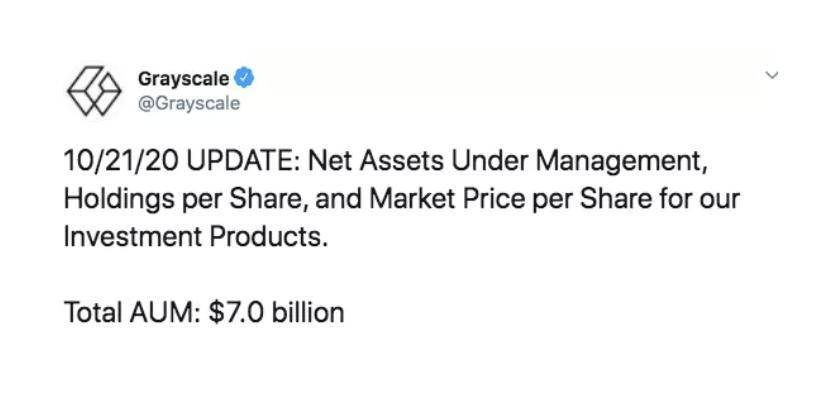
On October 21, Grayscale Investments reported its total crypto assets under management (AUM) surpassed $7 billion. Its Bitcoin Trust held $5.798 billion in BTC, while its Ethereum Trust held $897 million in ETH. The flagship Grayscale Bitcoin Trust saw $719.3 million in inflows during Q3, with its Bitcoin AUM growing 147% year-to-date.
On October 22, global digital payments platform PayPal entered the crypto market, allowing users to buy, hold, and sell cryptocurrencies via its website and app. The company stated that starting in early 2021, PayPal customers could use cryptocurrencies to shop at its network of 26 million merchants.
Kang Lüzhī, Senior Analyst at Huobi Research Institute, analyzed the immediate catalyst: "Bitcoin surged from $15,000 to nearly $16,000 overnight. A pronounced FOMO (fear of missing out) sentiment swept the market. Both retail investors buying on secondary markets and institutions steadily increasing exposure via Grayscale's compliant trusts created continuous buying pressure, directly driving this rapid ascent."
Additionally, Huobi Research Institute believes the U.S. presidential election is an indirect factor. Although official results are pending, a Biden victory appears likely. To revive the economy, Biden has proposed massive fiscal stimulus, fueling persistent inflation expectations and pushing the U.S. dollar to a two-year low. Meanwhile, the global pandemic resurgence has heightened risk-aversion demand, further supporting Bitcoin's price.
Exchange Bitcoin Balances Plunge—Bitcoin Eyes All-Time High
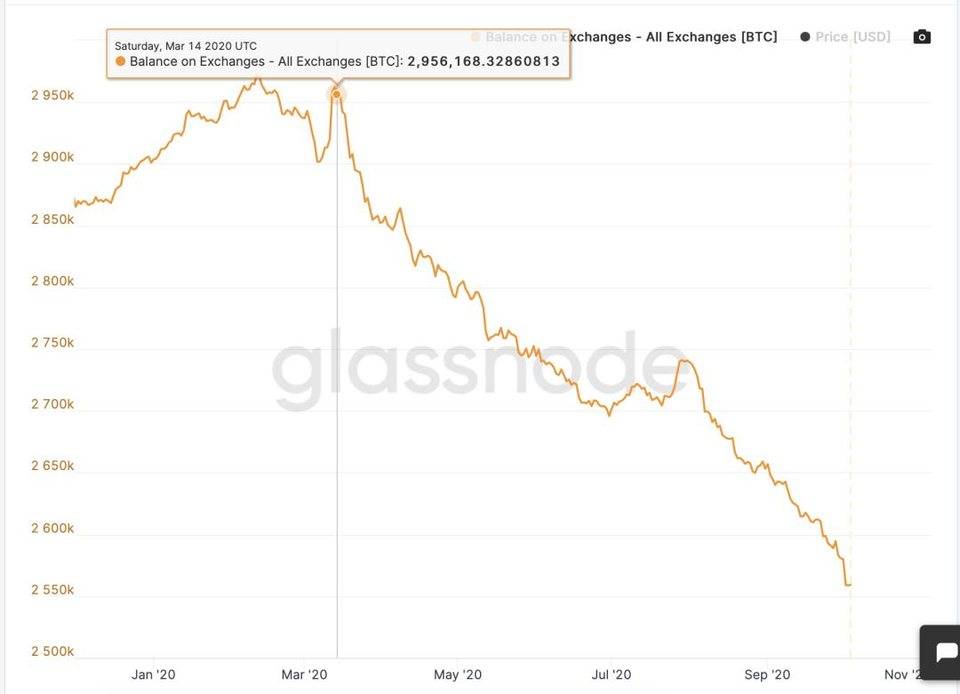
Data from crypto analytics firm CryptoQuant shows Bitcoin outflows from exchanges just hit a new annual record: 30,000 BTC.
Source: Glassnode
According to Glassnode, Bitcoin balances on exchanges have trended downward since the second half of this year, with a steeper decline over the past two months. As of press time, exchange-held Bitcoin stood at 2.4049 million BTC.
Interestingly, crypto analyst "The Moon" on Twitter interpreted the drop in exchange balances as a bullish signal. Analyzing the 12-year historical trend, he forecasts Bitcoin will reach a new all-time high in the next major rally.
As is widely known, Bitcoin's all-time high is $20,052, set in December 2017. Observing the first black arrow in the chart above, we see that before Bitcoin broke $20,000, exchange balances experienced a modest dip—followed by a sustained rally that ultimately breached that level. During the final leg, exchange balances and Bitcoin's price showed a positive correlation.
Now consider the second black arrow. The current market appears to be retracing the 2017 bull run. Once exchange balances reverse their downtrend and begin rising again, Bitcoin's price may set a new record.
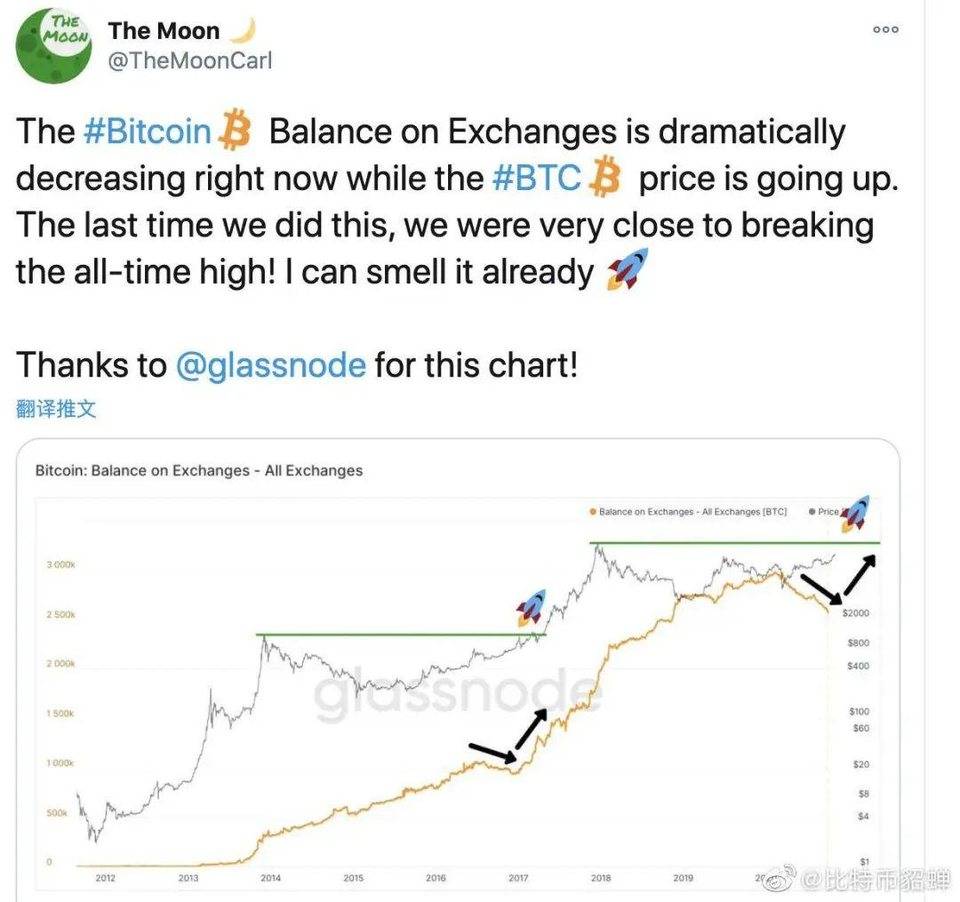
Thus, many view declining exchange balances as a harbinger of an impending crypto bull market.
The Bitcoin Rally Is Here—How Should You Participate?
To participate in this bull market, the first step is choosing a secure, trustworthy, and solvent cryptocurrency exchange.
However, recent black swan events have left investors anxious and uncertain, making the choice of a safe and reliable platform a top concern.
For most investors, security and stability are indispensable criteria—factors also prioritized by traditional institutions entering the crypto space.
Security
The foremost consideration is security—the single most critical factor. Yet most investors aren't exchange insiders and lack visibility into security practices. So how can they assess which exchange is more secure?
In reality, "security" is always relative. Since most investors lack expertise and can't observe internal operations, they must rely on alternative metrics: the exchange's founding date, global ranking, history of successful breaches, and how it handled any theft incidents.
Generally, long-established, well-resourced legacy exchanges tend to offer higher security. Their longevity implies greater experience managing risks. The "Big Three"—Huobi, Binance, and OKEx—are top choices for crypto investors, all being veteran digital asset platforms founded years ago.
Among them, Huobi is the only exchange never to have suffered a successful hack. While Binance has experienced incidents, it immediately assumed full financial responsibility each time—ensuring zero user losses. OKEx, meanwhile, has frequently faced DDoS attacks.
Following OKEx's recent private key management controversy, both Huobi and Binance reaffirmed their frameworks. Huobi co-founder Du Jun stated in a media AMA that Huobi employs 15 private key signatories using a multi-signature mechanism—ensuring platform fund security isn't compromised by any single individual or small group. Huobi Global also announced its wallets use multi-signature and threshold signature technologies; private keys are backed up across multiple people and locations for availability; and proprietary secure hardware guarantees storage robustness.
After OKEx announced its withdrawal suspension, Binance CEO Changpeng Zhao tweeted repeatedly, emphasizing that Binance's wallet system integrates multi-signature, Threshold Signature Scheme (TSS), and other technologies—eliminating any single point of failure.
Considering both technical architecture and historical breach records, Huobi currently ranks highest in reliability and security.
Stability
How do we assess an exchange's stability? Typically, we evaluate its performance during sudden black swan events and extreme market conditions.
Take recent exchange-related black swan events: On September 15, after OKEx announced its withdrawal suspension, many investors panicked and rushed to withdraw funds. However, on-chain data analysis revealed minimal impact on Huobi and Binance.
Immediately after OKEx's announcement, Beijing ChainAn analyzed on-chain data for Huobi and Binance. On the day OKEx suspended withdrawals, net Bitcoin inflows to Huobi and Binance dipped slightly—but soon rebounded and steadily returned to normal levels.
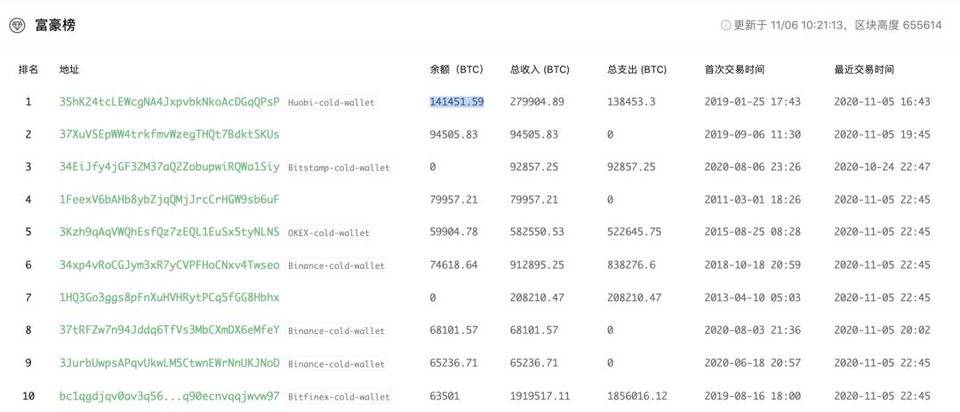
Although Huobi recently faced rumors about "senior executives going missing," no user panic ensued—unlike the reaction to OKEx's incident. According to on-chain data provider chain.info, Huobi's cold wallet BTC balance has consistently ranked #1 globally in recent weeks.
Per the latest chain.info Whale Rankings (as of 11:00 a.m. on November 6), Huobi's cold wallet holds the largest BTC balance at 141,451.59 BTC, while Binance's and OKEx's cold wallets rank fifth and sixth respectively, with balances of 74,618.64 BTC and 59,904.78 BTC.
Source: chain.info
Bituniverse's Exchange Transparency Asset Ranking shows Huobi's transparent assets total RMB 37.8 billion—ranking second globally, behind only Coinbase. Binance and OKEx rank third and fifth respectively.
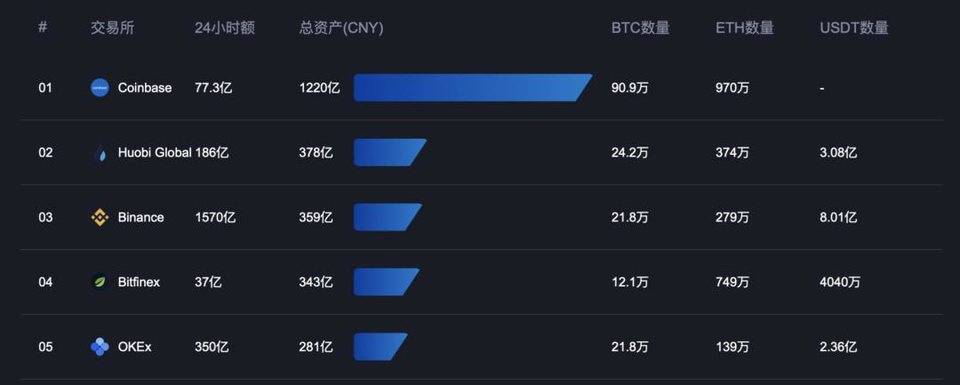
Source: Bituniverse
Adequate asset reserves insulate exchanges from extreme volatility and black swan events—explaining why institutional investors prefer trading on Coinbase and Huobi. An exchange's asset reserve capacity reflects, to some extent, its order book depth—the market's ability to absorb large trades without triggering sharp price swings. Weak depth means large orders significantly impact price.
Finally, returning to Bitcoin's price: Historical analysis suggests this rally may merely mark "the beginning of a new bull market." In the coming days or weeks, Bitcoin could surge further—potentially challenging the $20,000 all-time high.
Some analysts argue that renewed investor interest in Bitcoin stems from its growing appeal as an inflation hedge.
With the COVID-19 pandemic severely damaging global economies, governments and central banks have deployed massive stimulus spending—eroding their currencies' purchasing power. Concerns about accelerating inflation over the next few years have reignited, attracting new converts to Bitcoin.