


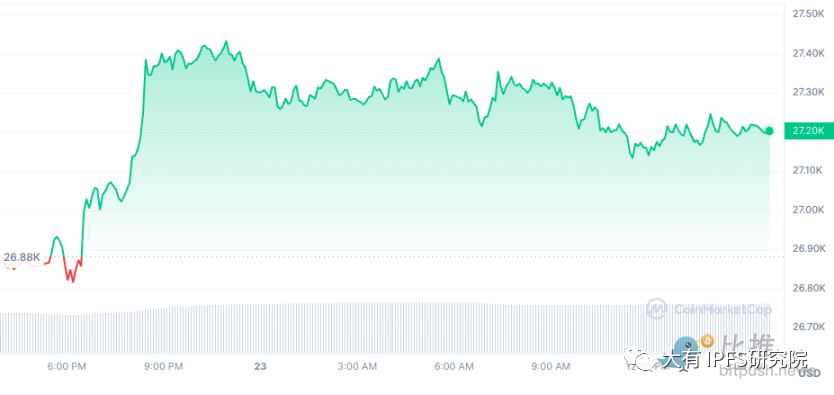
The crypto market responded positively to news from Hong Kong's securities regulator that retail investors will be allowed to trade major cryptocurrencies like BTC and ETH starting June 1. Data from the BitPush News terminal showed Bitcoin climbing over 2% to $27,500 during Asian trading hours, with Ethereum rising nearly 2% to $1,851.91.At the time of writing, the market has stabilized. Bitcoin is trading around $27,200, up 1% over the past 24 hours, while Ethereum hovers near $1,850, moving within a narrow 2% range.
Rebuilding a Fintech Hub
Hong Kong is working to reclaim its status as a leading fintech hub, with embracing Web3 as a key part of that strategy. Allowing retail crypto trading represents a major step forward, as it could boost market liquidity and activity.
Some industry experts believe the new regulatory framework could spark a wave of crypto innovation. In 2021, mainland China banned all crypto trading, prompting many Web3 entrepreneurs to relocate to more welcoming jurisdictions like Singapore.Now, with Hong Kong opening its doors to digital assets, many founders are considering setting up shop there. Western companies also see Hong Kong as a potential springboard for expansion across Asia.

As BitPush News previously reported, Bart Stephens, Founder and Managing Partner of San Francisco-based Blockchain Capital, said he is considering moving to international crypto hubs amid growing regulatory pressure in the U.S."Other jurisdictions—including the UK, the UAE, and Hong Kong—are actively recruiting U.S. entrepreneurs and venture capital firms," Stephens noted. "Crypto is a global, decentralized industry, so we're looking at ways to decentralize our financial and human capital as well."
However, some in the industry remain cautious about Hong Kong's open policy.They point out that despite being Asia's financial center, Hong Kong has historically lacked a strong tech ecosystem and remains cost-prohibitive for many startups. As a result, the crypto businesses it attracts may primarily be those that serve or interface with traditional finance.
Noelle Acheson, economist and author of the "Crypto is Macro Now" newsletter, wrote in a blog post that Hong Kong's green light for retail investors doesn't automatically mean a surge in crypto demand, as local traders may already access markets through offshore platforms. Acheson noted:"This news doesn't mean a flood of retail money will hit the market in early June... However, we could see trading volumes pick up in June."
Oppenheimer analyst Owen Lau described Hong Kong's push to become a crypto asset hub as "very aggressive," stating:"This will continue to capture public attention and attract more companies to set up offices in Hong Kong. While the exact impact is hard to measure, it has long-term implications for capital flows and talent movement."
Could this drive further gains for BTC?
Whether BTC continues to rise depends on multiple factors, including regulatory changes, market sentiment, technological progress, and macroeconomic trends. Hong Kong's new policies have largely been priced in by the market. Currently, the market lacks major catalysts, while regulatory uncertainty and macroeconomic headwinds—such as the ongoing U.S. debt ceiling standoff—are weighing on investor sentiment.
According to Secure Digital Markets, a Canadian digital asset liquidity provider, technical analysis suggests BTC needs to break above key resistance at the Head and Shoulders (H&S) neckline and the 20-day simple moving average around $27,500 to maintain upward momentum.
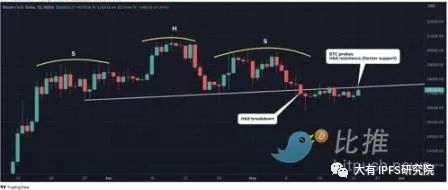
Analysts added: "As long as the price stays below both the [H&S] neckline [horizontal trendline] and the 20-day moving average, we expect further downside toward $25,250—and potentially even $24,000."
Looking further ahead, crypto analyst Inmortal outlined several potential BTC price scenarios for the next one to two years. The most likely scenario, with a 60–70% probability, involves BTC consolidating sideways before a decline, trading in a range between $20,000 and $30,000, with an uptrend beginning in Q4 2023. The analyst predicts BTC would then break above $30,000 and move toward $48,000.
A second scenario, assigned a 50% probability, sees BTC retesting $25,000 after prolonged consolidation near $29,000, before rallying between late 2023 and early 2024.
A third "rollercoaster" scenario, with a 30–40% probability, suggests that after hitting a local top, BTC declines, potentially breaking above $30,000 by late 2023 or early 2024. This breakout could then serve as a springboard for further gains.
With one week left in May, BTC and ETH are on track to post their worst monthly performance of the year, down 7.6% and 3.1% month-to-date, respectively.
IPFS Research Institute will continue to track the latest developments in the Filecoin project.
Whether you're new to the space or a seasoned professional, the DA YOU IPFS Research Institute offers innovative insights and in-depth analysis to guide you. Rooted in openness and inclusivity, we welcome your participation and look forward to learning and growing together.