

What Is Ethereum 2.0?
Ethereum 2.0—also referred to as ETH 2 or “Serenity”—is the next major evolution of the Ethereum blockchain.
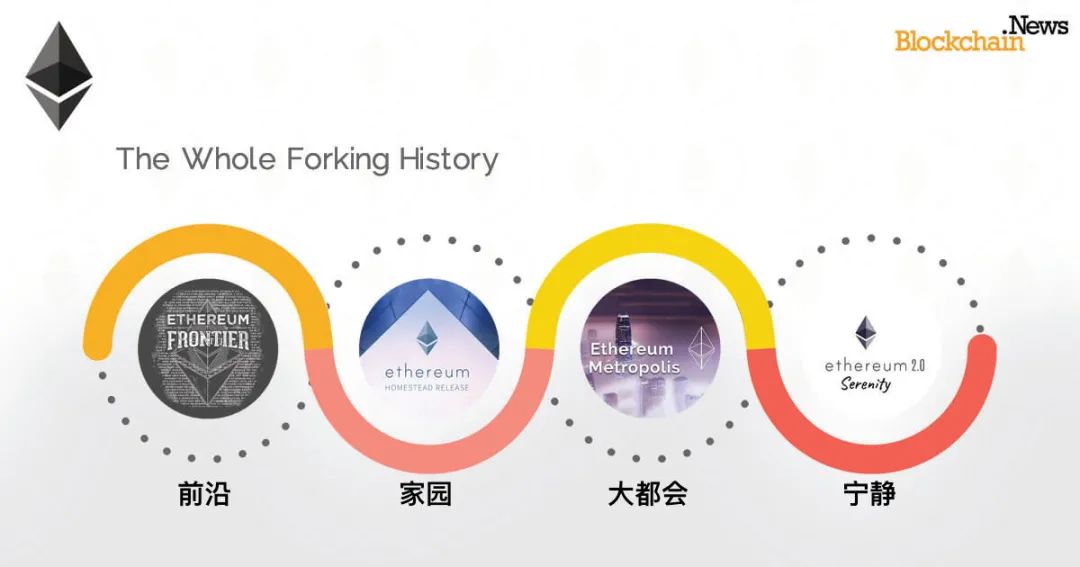
Ethereum’s development has long followed a four-phase roadmap: Frontier, Homestead, Metropolis, and Serenity.
The Frontier phase introduced the public testnet; Homestead marked the official mainnet launch; Metropolis included hard fork upgrades like Byzantium and Constantinople, with the Istanbul upgrade serving as the final step before entering the fourth phase: Serenity.
The first three phases belong to the Ethereum 1.0 era. Each upgrade along the way improved Ethereum 1.0’s performance and laid the groundwork for Ethereum 2.0. Now, Ethereum 2.0 is ready to take over.
Ethereum 2.0 brings two key upgrades over 1.0: Proof-of-Stake (PoS) and Shard Chains.
Proof-of-Stake (PoS): While Ethereum 1.0 relies on Proof-of-Work (PoW)—where miners use computational power and energy to create blocks—Ethereum 2.0 shifts to PoS. This change makes the network more secure, scalable, and energy-efficient.
PoS depends on validators and staked ETH to maintain the chain, and it’s a necessary foundation for sharding. We’ll explain the validator role in more detail below.
Shard Chains: Sharding dramatically improves Ethereum’s scalability and transaction throughput.
Today, Ethereum operates as a single chain of sequential blocks—secure and easy to verify, but requiring every full node to process every transaction. This limits how quickly the network can handle transactions, especially during high traffic.
Shard chains split Ethereum into 64 parallel chains. By distributing data processing across many nodes, transactions can be processed concurrently rather than one after another. Think of it like adding lanes to a highway: more lanes mean more traffic can flow at once.
Sharding boosts Ethereum’s ability to handle transactions, storage, and data in parallel. Conservatively, throughput could increase by 64 times, with the architecture designed to support hundreds of times more data than Ethereum 1.0.
Shard chains are expected to go live in Phase 1 of Ethereum 2.0.
The Existing 1.0 Chain: The Ethereum 1.0 chain will continue running and improving. It will eventually become the first shard within Ethereum 2.0 once Phase 1 launches.
The Future 2.0 Network: The focus is on scalability, throughput, and security. No historical data, transaction records, or asset ownership from Ethereum 1.0 will be lost. The Beacon Chain—the backbone of Ethereum 2.0—will run in parallel with the 1.0 chain to ensure a smooth transition.
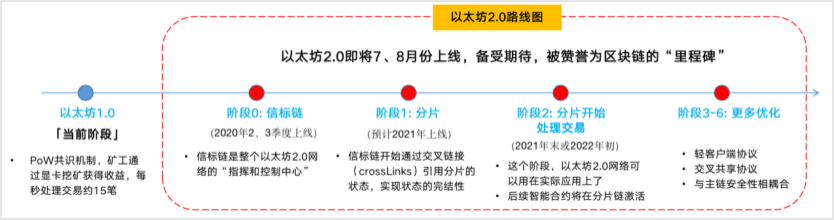
Ethereum 2.0 will roll out in multiple phases: Phase 0, Phase 1, Phase 2, and beyond.
Phase 0 launches on December 1 this year; Phase 1 is slated for 2021; Phase 2 is planned for 2021 or 2022. Each phase will enhance Ethereum’s functionality in different ways.
Phase 0 introduces the Beacon Chain—the core of Ethereum 2.0. It will manage validators, coordinate shard chains, and serve as the foundation for future development.
Phase 1 builds on Phase 0 by integrating shard chains and enabling data to be written to them. Much of the sharding groundwork is already done in Phase 0, making Phase 1 relatively straightforward.
Phase 2 is the execution phase, transforming Ethereum 2.0 from a robust database into a fully decentralized computing platform.
While Phase 2’s details are still being defined, it will include: ETH accounts supporting transfers and withdrawals, cross-shard transfers and smart contract calls, execution environments for scalable applications, and the merger of the Ethereum 1.0 chain into Ethereum 2.0—finally retiring PoW for good.
Development and enhancements will continue even after Phase 2.
No.
ETH holders don’t need to take any action—their assets on the Ethereum 1.0 chain remain untouched. Eventually, the 1.0 chain will become part of Ethereum 2.0, and holders’ ETH will continue to work seamlessly without any intervention.
Ethereum 2.0 won’t issue a new token, so there’s no “Ethereum 2.0 ETH” to buy. However, holders can choose to become validators and earn staking rewards.
To stake, ETH can be deposited into the validator deposit contract on the Ethereum 1.0 chain. This allows holders to become validators on the Ethereum 2.0 Beacon Chain, with the deposited ETH becoming their validator balance.
So, how do you become a validator?
Each validator must stake 32 ETH into the deposit contract and run both Ethereum 1.0 and 2.0 clients.
Depositing ETH into the contract is a one-way transaction—funds cannot be withdrawn until Phase 1 launches, and full withdrawals to a specific shard won’t be possible until Phase 2. This process is expected to take about two years.
Validators are responsible for verifying and proposing new blocks. Once active, the Beacon Chain assigns them tasks. Every 6.4 minutes, validators must submit attestations for Beacon Chain blocks, and occasionally they’ll be chosen to propose a new block. With 100,000 validators, each might propose a block roughly once every two weeks. All of this is automated through software.
Successfully validating a block earns an ETH reward.
Rewards are calculated dynamically at the end of each epoch—a 6.5-minute period on the Beacon Chain. The overall reward rate depends on the total amount of ETH staked and average validator uptime. An individual validator’s yield depends on the total number of validators and their own reliability.
Rewards (minus any penalties) are distributed at the end of each epoch, so actual earnings may vary from expectations.
However, if a validator acts maliciously or tries to disrupt the chain, part or all of their 32 ETH stake can be slashed.
Running a validator involves costs—hardware, operational expenses, and potential penalties for software issues or downtime. Extended instability or malicious behavior could even lead to loss of staked ETH.
Additionally, as mentioned, staked ETH is locked for at least two years, introducing liquidity risk.
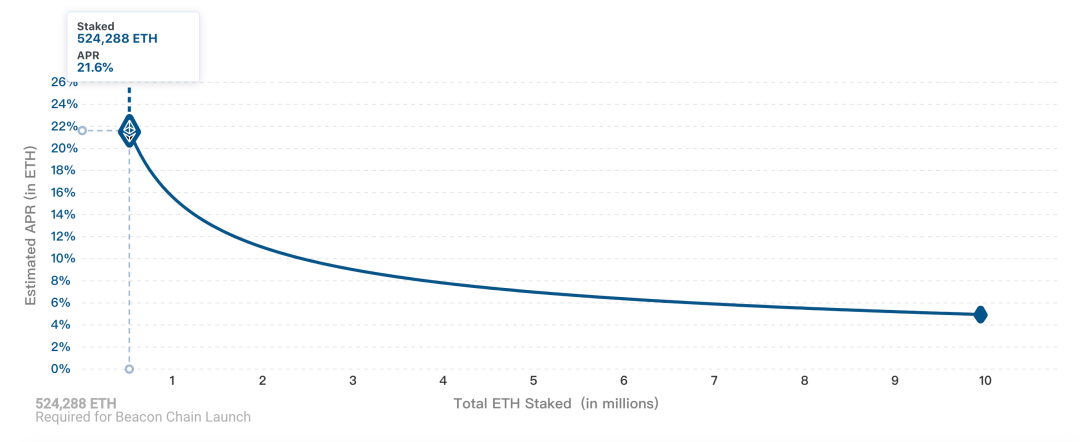
Staking yields also decrease as more ETH is staked. As the chart shows, the initial annualized yield is around 21.6% when staking reaches the Beacon Chain’s minimum threshold of 524,288 ETH. After that, yield declines as total staked ETH increases.
For these reasons, we don’t recommend most users run their own validator. If you want to participate, you don’t have to stake directly—you can delegate your ETH to a staking service provider and earn proportional rewards.
Stay tuned to Cobo for the latest Ethereum 2.0 updates and product announcements!