

Uniswap Labs has launched the beta version of its UniswapX protocol—a non-custodial, permissionless trading system that uses Dutch auctions to create a competitive market among fillers, leveraging both on-chain and off-chain liquidity. By structuring orders as off-chain signatures executable via Permit2, the protocol enables gasless trading for users. UniswapX is also designed to support cross-chain swaps, allowing users to bridge assets from an L2 to its parent L1 almost instantly.
Below is an excerpt from the official blog post by Hayden Adams, founder of Uniswap:
Since the first Uniswap protocol launched in 2018, on-chain trading has seen explosive growth—serving millions of users, enabling hundreds of use cases, and facilitating over $1.5 trillion in trading volume on Uniswap alone.
To further accelerate the growth of on-chain trading and enhance self-custodial swapping, we're excited to introduce a new permissionless, open-source (GPL) protocol based on Dutch auctions for trading across AMMs and other liquidity sources.
Today, we're launching an opt-in beta of this protocol on the Uniswap Labs interface for Ethereum mainnet, with plans to expand to other chains and future Uniswap wallets. You can view the code and read the full whitepaper (https://uniswap.org/whitepaper-uniswapx.pdf).
Over time, UniswapX will improve the swapping experience in several key ways:
· Better prices through aggregated liquidity sources
· Gasless swaps
· Protection against MEV (Maximal Extractable Value)
· No fees for failed trades
· In the coming months, UniswapX will expand to support gasless cross-chain swaps.
The Next Level of Aggregation
On-chain routing is becoming an increasingly critical and complex challenge. Innovation in on-chain trading has led to a proliferation of liquidity pools. New fee tiers, new L2s, and more on-chain protocols have fragmented liquidity. We anticipate thousands of custom liquidity pool designs built on Uniswap v4, making routing even more challenging. Yet as liquidity sources multiply, delivering competitive pricing requires manual integrations and significant ongoing maintenance.
UniswapX tackles this by outsourcing routing complexity to an open network of third-party fillers who compete to execute swaps using on-chain liquidity (e.g., AMM pools or their own private inventory).
With UniswapX, users can trade on the Uniswap interface without worrying about whether they're getting the best price—all trades are transparently recorded and settled on-chain. All orders are powered by Uniswap's Smart Order Router, and fillers must compete with Uniswap v1, v2, v3, and eventually v4 once it launches.
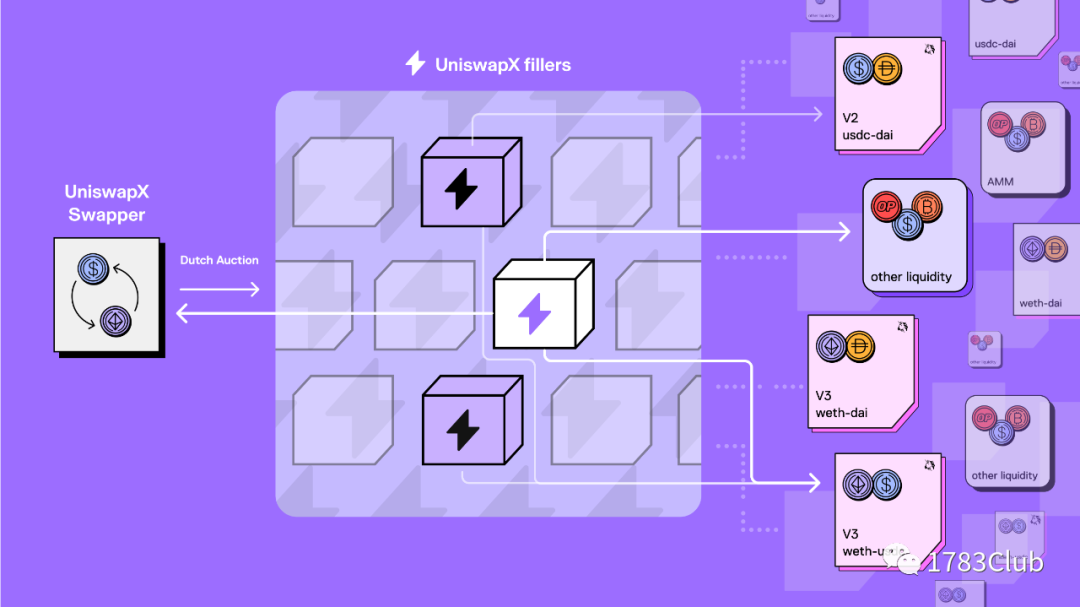
Image source: Uniswap blog
Gasless Swaps — and No Fees for Failed Swaps
With UniswapX, users sign a unique off-chain order, which a filler then submits on-chain on their behalf and covers the gas fee. Since users don't pay gas, they don't need the native network token (e.g., ETH, MATIC) to trade—and they incur no fees for failed trades. Fillers incorporate gas costs into the swap price but can reduce per-trade costs by batching multiple orders to secure better pricing.
Users still need to pay gas in specific cases—for example, during the initial token approval for Permit2. Additionally, wrapping the native network token when selling incurs gas fees.
MEV Protection
MEV remains one of the biggest challenges in on-chain swapping today, often resulting in worse prices for users.
With UniswapX, MEV that was previously captured by arbitrageurs is returned to users in the form of better pricing. UniswapX also helps users avoid more obvious forms of MEV extraction: orders executed from a filler's inventory cannot be sandwiched, and fillers are incentivized to route orders to on-chain liquidity venues via private transaction relays.
Next: Cross-Chain UniswapX
Later this year, we'll launch a cross-chain version of UniswapX that merges swapping and bridging into a single seamless operation. With cross-chain UniswapX, users will be able to exchange assets across chains in seconds. They can also choose which assets they receive on the destination chain—not limited to bridging specific tokens. For more details on the design and benefits of cross-chain UniswapX, please refer to the whitepaper.
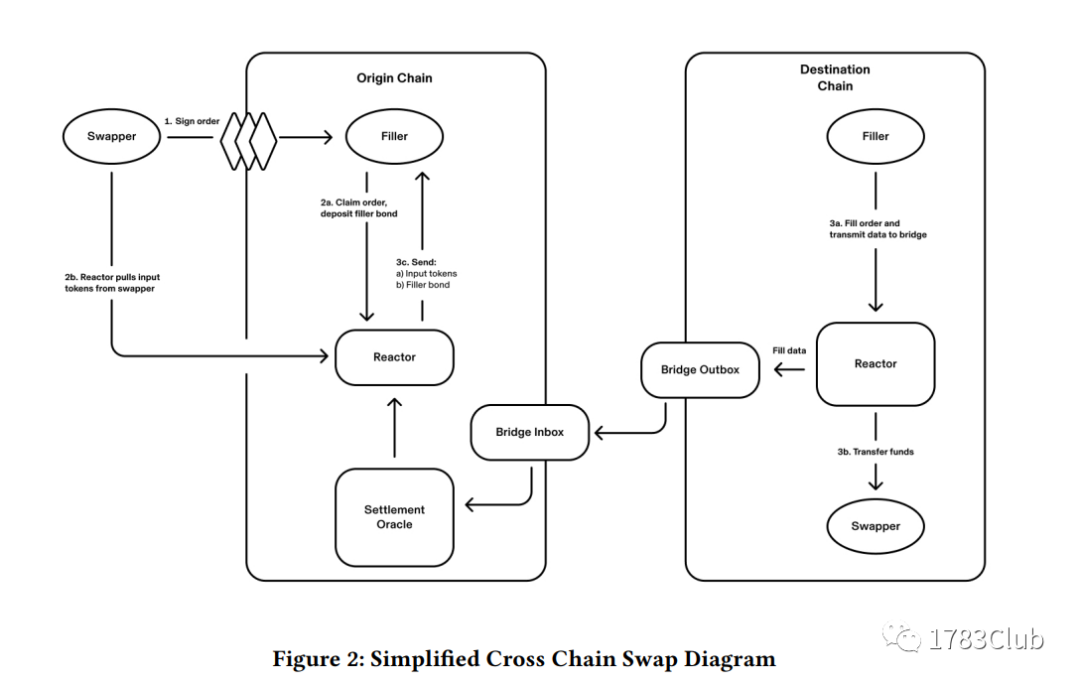
Image source: UniswapX whitepaper
Launching UniswapX on the Uniswap Labs Interface
UniswapX brings DeFi and digital market concepts into a new system built on security, self-custody, and community—principles that have made Uniswap the most trusted brand in DeFi.
UniswapX is an immutable smart contract, fully permissionless. No one—including Uniswap Labs—can modify or pause it. Early fillers are already live to ensure appropriate auction starting prices and fast order execution, and we expect the filler network to scale rapidly as user adoption grows.
Consistent with our commitment to security, ABDK has conducted extensive testing and auditing of the code and offers a bug bounty program. Users retain full control over their funds at all times. Assets only leave their accounts upon successful order execution and receipt of trade proceeds.
Like the Uniswap protocol, UniswapX includes a protocol fee switch that can only be activated by Uniswap governance (Uniswap Labs does not participate in this process).
Dan Robinson, author of the UniswapX whitepaper, provides deeper analysis—highlighting five reasons why UniswapX will change the game for decentralized exchanges, MEV, and interoperability:
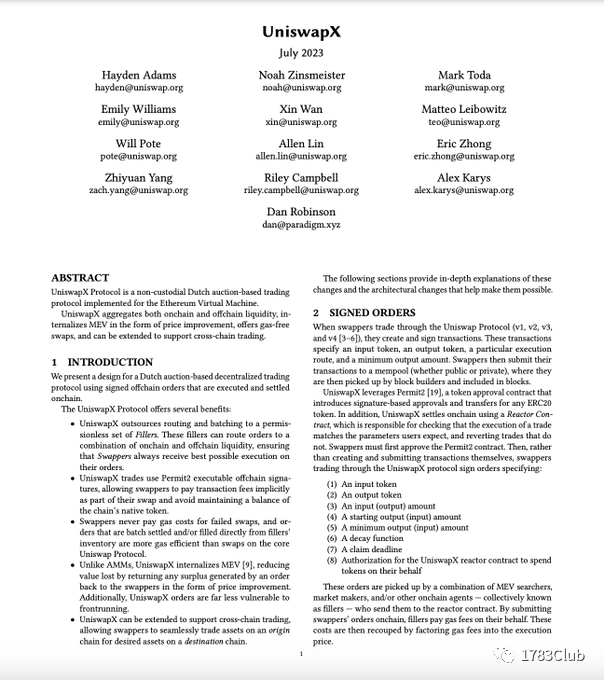
Image source: UniswapX whitepaper
-
This architecture unlocks a vast design space for decentralized exchanges (DEXs). Signed orders—or "intents" in our current terminology—can be more efficient, flexible, and ultimately more powerful than traditional transactions.
It creates a superior foundation for order flow auctions that return maximum extractable value (MEV) to users. Today's auctions are typically built on transaction-based swaps, a clunky structure often requiring multiple transactions and extra on-chain fees. I believe the future of order flow auctions will be built on UniswapX.
We're still in the early days. Significant work remains to improve off-chain order matching—making it as decentralized, competitive, and privacy-preserving as possible. UniswapX is a crucial step toward that goal, but I have many ideas for its further evolution. Off-chain orders are more transparent and mathematically tractable than transactions. They can be aggregated, batched, netted, added, subtracted, compressed, encrypted, sealed, proven, challenged, and verified. This opens the door to true innovation in order matching. Long-term, UniswapX's matching engine could even become an ideal application for decentralized block builders like Flashbots' SUAVE. Once SUAVE launches, I believe UniswapX could be among the first to demonstrate and leverage its full potential.
Seamless cross-chain swaps—especially across Rollups—will be revolutionary. For Ethereum's rollup-centric roadmap to succeed, users need to move between different Rollups cheaply, quickly, and effortlessly. UniswapX is architecturally well-suited for this cross-chain future.
UniswapX complements Uniswap v4, which focuses on sustainably improving passive liquidity through new technologies. This reflects a core belief: improving the Uniswap ecosystem isn't a zero-sum game. If traders don't get optimal execution, they'll go elsewhere. If liquidity providers lose money, they'll leave. We must deliver better prices for traders without taking value from liquidity providers. UniswapX is one path to achieving that.
In summary, I believe v4 and UniswapX chart the course for decentralized exchanges. Not because they are the final word in protocol design, but because they throw the design space wide open.