

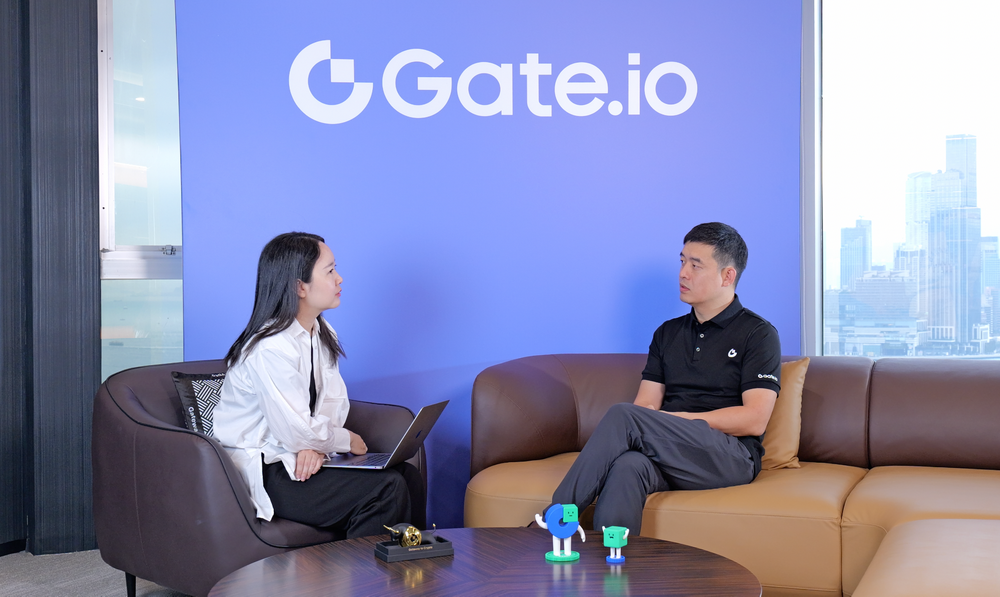
Interviewer: Tong, PANews
Compiled by: Yuliya, PANews
In crypto, founders with technical backgrounds often bring a distinct advantage—deep expertise and a nuanced understanding of the space. Following in the footsteps of industry leaders like OKX's Xu Mingxing and Binance's Zhao Changpeng, Gate.io founder Han Lin is a prime example. He made the leap from academia to entrepreneurship, personally writing the core code for Gate.io's early platform and steering the exchange from a niche player to a top global trading venue. Recently, at the Hong Kong Consensus Conference, Han Lin sat down with PANews for an exclusive interview. He shared his journey from behind the scenes to the forefront of the industry, along with his insights on its future trajectory.
Han Lin's journey into crypto began in 2013 while pursuing a postdoctoral fellowship in optoelectronics in Canada, where he first discovered Bitcoin. His technical background allowed him to quickly grasp its potential. However, when he went to make his first purchase, he found a market lacking secure and transparent trading platforms. This gap inspired him to found Gate.io. His role has evolved from writing the initial code to providing strategic leadership, transitioning from a hands-on developer to an industry leader. While he admits public speaking isn't his natural strength, he has become a more frequent presence at industry events and interviews in recent years, sharing his insights to help drive the sector forward.
In the interview, Han Lin reflected on Gate.io's growth and shared the platform's latest developments in user acquisition, product innovation, and global expansion. He highlighted that Gate.io's user base grew from 13 million at the start of last year to over 20 million by year-end—a jump of more than 50%. He attributes this success to the platform's keen eye for emerging projects and its relentless focus on improving user experience. From early assets like Litecoin and Dogecoin to recent trends in meme coins and AI-related projects, Gate.io has consistently stayed ahead of the curve, offering a diverse range of digital assets.
Han Lin also shared his outlook on industry trends. He believes the blockchain sector has entered a period of relative stability. While the extreme volatility of earlier years is unlikely to return, overall industry adoption continues to grow steadily. He emphasized Bitcoin's role as a deflationary asset, noting its combination of security and scarcity makes it an ideal reserve asset. Should more institutions and nations add Bitcoin to their official reserves, he sees significant potential for further market growth. Additionally, Han Lin stressed the long-term shift toward on-chain trading, revealing that Gate.io began building its on-chain wallet infrastructure and decentralized exchange (DEX) capabilities as early as 2018 to prepare for this future.
Regarding competition, Han Lin stated that Gate.io's core advantage lies in its deep understanding of user needs and its unwavering commitment to innovation. Initiatives like its "100% Proof-of-Reserves" program demonstrate a consistent priority on user fund security and asset preservation. Furthermore, strategic sponsorships with high-profile organizations like Inter Milan and the Red Bull Racing Formula 1 team have significantly boosted the platform's brand visibility and expanded its global influence.
Below is the full transcript of our exclusive interview:
From Academia to Entrepreneurship: Stepping into the Spotlight
PANews: You've kept a relatively low public profile in the past. What prompted your increased visibility at events and in interviews recently? And what currently demands most of your time and focus?
Han Lin: Coming from a technical background, I'm not naturally the best at public communication. But the industry has been moving so fast over the last two years, and I've felt a growing desire to connect with others and share my perspective. That's why I've made a point to attend more events and engage in discussions, both within the crypto space and beyond.
PANews: There was a rumor in the industry that you preferred to stay home coding rather than make public appearances. Was there any truth to that?
Han Lin: I wrote a lot of Gate.io's early code myself—the website and the foundational API work. But that was years ago. Gate.io has been running for 12 years now. As our team has grown and we've brought on more technical talent, my role has naturally evolved toward management and strategy. These days, I focus on overseeing daily operations, setting our direction in the industry, and making sure our product and tech execution meets a high standard.
PANews: What were you doing before you started Gate.io? Was this your first time founding a company?
Han Lin: This is my first venture. My background is in academia, where I researched optoelectronics. I went to Canada for my Ph.D. in 2007 and started my entrepreneurial journey after graduating. I began by developing optoelectronic software, and later discovered Bitcoin and cryptocurrencies, which gradually drew me into the industry. Gate.io officially launched in April 2013.
PANews: How did you first come across Bitcoin?
Han Lin: Back in 2012, I was developing optoelectronic software and ran into a shortage of graphics cards (GPUs). My research revealed that GPUs were in high demand for Bitcoin mining. That discovery sparked my interest in Bitcoin. I dove into the whitepaper and was immediately struck by its groundbreaking innovation. With my technical background, I quickly grasped the underlying technology and its immense potential—and I was hooked.
In Bitcoin's early days, there were few cryptocurrency exchanges. I once bought 100 BTC on a forum, but the seller only delivered 1 BTC, failing to send the remaining 99. That experience was a stark lesson—the industry desperately needed safer, more transparent trading platforms. That's what motivated me to found Gate.io, to provide users with a reliable and trustworthy service.
Innovation and Growth: The Core of Gate.io's Competitiveness
PANews: Gate.io has consistently been at the forefront of listing new projects. Recently, it has rapidly launched numerous Meme and AI projects. Could you share some insights on the growth in new users and revenue?
Han Lin: Spotting promising projects has always been a core strength of Gate.io. Since our founding in 2013, we've listed a wide range of cryptocurrencies, from Litecoin to Dogecoin. Our user growth has been remarkable—we grew from 13 million users at the start of last year to over 20 million by year-end, a jump of more than 50%. Revenue has also seen substantial growth.
PANews: The MEME coin craze has brought many traders on-chain. Is on-chain trading here to stay? What technological and strategic preparations has Gate.io made?
Han Lin: On-chain trading is undoubtedly a long-term trend. Compared to centralized exchanges (CEXs), it gives users greater control over their assets, faster transaction speeds, and—especially for experienced traders—more opportunities to profit.
Early on-chain infrastructure was lacking—gas fees were high, user-friendly wallets were scarce, and trading platforms were subpar. But over the past two years, on-chain infrastructure has advanced rapidly. The user experience on decentralized exchanges (DEXs) is now catching up to CEXs, drawing more users to migrate on-chain.
I've personally dabbled in on-chain trading as well. Gate.io actually started laying the groundwork for on-chain wallets and DEXs back in 2018, launching a multi-asset wallet for storing and trading various crypto assets. When DeFi Summer took off in 2020, we were ready, actively building an integrated platform that combined trading, wallet services, and asset management.
My initial thinking was more centralized, viewing the trading platform as the main gateway. But I came to realize that in Web3, the wallet is the true entry point. It's not just a vault for your assets; it's the foundation for executing trades, swaps, staking, and more, all from within the wallet itself. That realization shifted our focus toward developing a robust Web3 wallet.
We've also been steadily developing the Gate Chain public blockchain. Conceived in 2018 with its native GT token launching in 2019, Gate Chain was built to be different. At a time when many projects were simply forking Ethereum or Cosmos, we wanted to innovate. We dedicated significant resources to building a chain with a core focus on asset security. A key innovation is its ability to help users recover stolen assets. We implemented a transaction lock-up period on-chain, giving users a window to reverse unauthorized transfers.
Later, as the market's focus shifted toward the EVM, we upgraded Gate Chain to be fully EVM-compatible. Since then, our efforts have been directed at boosting the public chain's performance to handle larger scale and support a wider range of applications.
PANews: Gate.io places great importance on user fund security. What prompted you to launch your Proof of Reserves (PoR) initiative back in 2020?
Han Lin: We were one of the first exchanges to implement a "100% Proof of Reserves" system. At the time, many users were questioning the safety of their funds on exchanges and were concerned about potential misuse of assets. To address these concerns, we adopted the Merkle tree algorithm—originally used in the Bitcoin blockchain—as a technical solution to publicly verify that the assets we hold for users match our liabilities in full.
Since zero-knowledge proofs (ZKPs) weren't integrated into the technology initially, we brought in an independent U.S.-based auditing firm to verify our reserves. While we encouraged other exchanges to follow suit, it wasn't until after the FTX collapse in 2022 that the wider industry really started paying attention to Proof of Reserves.
PANews: Which Gate.io products are most popular with users?
Han Lin: Beyond core services like wallets, spot and futures trading, and wealth management, our social features—including live streams, feeds, and chat rooms—are also very popular. They allow users to connect and interact directly on the platform. That said, trading and wealth management products are still the most frequently used features for the majority of our users.
Global Expansion and Regulatory Challenges
PANews: Where are Gate.io's users primarily located?
Han Lin: Gate.io is a global platform that has served users worldwide since its launch in 2013. In the early days, when I was based overseas, most of our users were international. Over time, we've seen significant growth in our user base from Chinese-speaking regions. For the past two years, we've been aggressively pursuing a global expansion strategy, including adding multi-language support. Our group companies have also been securing licenses and building compliant operations in numerous countries and regions across Asia, the Americas, Europe, and the Middle East. Last year, we acquired a licensed entity in Japan, Coin Master Co., Ltd., and plan to launch a fully compliant local trading platform this year in line with regulatory requirements.
PANews: What's your take on Hong Kong's regulatory approach?
Han Lin: Overall, Hong Kong is very supportive of Web3. The government has shown strong policy commitment, and our discussions with local legislators confirm their active push to attract more Web3 businesses to set up shop here. That said, from an asset trading perspective, the approach remains relatively conservative. The range of assets available on licensed exchanges is limited, which some users may find restrictive. Our group secured a Trust and Corporate Service Provider (TCSP) license a couple of years ago, and we're also keen to pursue an Over-the-Counter (OTC) license in Hong Kong down the line.
PANews: Looking back on Gate.io’s journey, what are some of the most memorable moments?
Han Lin: Over our 12-year journey, Gate.io has navigated countless challenges while witnessing the industry's explosive growth.
The early days were marked by a severe lack of infrastructure. For example, with no widely adopted enterprise-grade wallet systems available, exchanges like ours had to build the technology from scratch. This period saw frequent security incidents, with hacks and asset losses being a regular occurrence.
-
Then there are regulatory changes. In the early days, regulators largely took a hands-off or wait-and-see approach. As the industry grew, scrutiny increased, with some jurisdictions imposing outright bans. More recently, however, a growing number of countries have moved to establish licensing or registration frameworks for crypto activities, pushing the sector toward standardization and compliance. This trend signals a healthier, more mature direction for the industry.
PANews: With exchange competition heating up, what would you say is your core competitive edge?
Han Lin: In the past, Gate.io focused heavily on building its infrastructure and developing products, prioritizing user needs by delivering the features and assets they wanted. However, as competition grew fiercer, our lack of brand recognition started to hold back new user growth. To tackle this, we significantly ramped up our brand promotion efforts last year. Many people still don't realize that Gate.io has maintained a "100% Proof of Reserves" policy since 2020. To boost our brand's reach, we've increased visibility through major sponsorships like Inter Milan and the Red Bull Racing Formula 1 team.
We've also launched major optimizations to enhance the product experience. Initially, our priority was building out a full suite of features and assets. Now that our offerings are comprehensive, users care more about smooth performance and ease of use. That's why we've dedicated substantial resources to refining the user experience, aiming to create a seamless and efficient trading environment.
PANews: Does Gate.io have any plans for mergers and acquisitions or bringing in strategic shareholders?
Han Lin: For us, M&A is primarily a strategic move—for instance, to acquire licenses. While the Gate Group started its licensing push early, the application process itself is lengthy, often taking one to four years. That makes acquiring or investing in already-licensed companies an attractive option.
As for bringing in strategic shareholders, while it's a common path for many startups, Gate.io currently has no need for it. Our equity structure remains independent.
Industry Cycles and Future Trends
PANews: Historically, the crypto industry has moved in roughly four-year cycles, but the current one feels different. Is the four-year cycle theory no longer relevant?
Han Lin: I don't believe in a fixed market cycle. In the early days, a four-year pattern seemed to hold—but that was largely because crypto, especially BTC, was still a niche asset class. Back then, market movements were driven mostly by internal events like Bitcoin halvings. These were major industry milestones that captured attention and drove price swings, creating the perception of a predictable cycle.
Today, the landscape is completely different. Bitcoin's market cap is nearing $2 trillion, and the total crypto market is around $4 trillion—a massive asset class that rivals or surpasses most major public companies. Bitcoin has already overtaken silver, though it still trails gold. At this scale, crypto is deeply intertwined with the global economy. Daily price action, for example, often mirrors U.S. equity markets, which exert a powerful influence. So, analyzing market volatility through a rigid four-year lens no longer makes sense.
I think market movements are now driven mainly by two factors:
The first is the external environment—the global macroeconomic landscape. Factors like U.S. stock market performance and broader economic volatility directly influence the crypto market.
The second is internal innovation—the emergence of new concepts and technologies. For instance, Ethereum's rise in 2017 fueled the ICO boom, attracting a wave of new projects and capital.
The DeFi explosion in 2020 sparked another major cycle.
Later, novel concepts like NFTs and GameFi further drove market expansion.
More recently, trends like meme coins and BRC-20 have ignited widespread discussion and participation.
PANews: We haven't seen many groundbreaking new concepts emerge over the past two years. AI appears to be the most promising trend on the horizon—what are your thoughts?
Han Lin: While the blockchain space hasn't seen major conceptual breakthroughs in the last two years, its development has certainly continued.
Infrastructure maturity: Early infrastructure like wallets and trading platforms was quite rudimentary—users often had to download official wallets just to perform basic operations. Today, multi-currency wallets are highly sophisticated, dramatically improving the user experience.
-
-
The Evolution of DeFi Platforms: DeFi platforms have evolved from offering single functions, like simple swaps, into comprehensive, feature-rich ecosystems. The rise of Ethereum L2 networks, for example, has slashed transaction costs while boosting performance and easing congestion. At the same time, newer blockchains like Solana—with their higher throughput and lower fees—are pushing infrastructure optimization even further.
-
Crypto's March Toward Mainstream Adoption: Bitcoin is now a major asset class, and its global adoption continues to grow. In regions like Hong Kong, Singapore, and Dubai, cryptocurrency penetration has surpassed 20%, significantly higher than the global average of around 10%.
-
The Role of Meme Coins: Meme coins have lowered the barrier to entry, drawing in a wave of users from outside the core crypto community. Unlike the industry's earlier days, which required extensive user education, the general public today finds it much easier to grasp cryptocurrency concepts. This has significantly accelerated mainstream adoption and overall industry growth.
-
Future Optimization Goals: For high-frequency trading, gas fees remain a critical bottleneck. The industry still has significant room to drive down costs and improve efficiency in this area.
PANews: What's your outlook for the market? Is the bull run still in play?
Han Lin: The blockchain industry has matured into a more stable phase. While we may not see the extreme volatility of the past, adoption continues to grow steadily. For example, some U.S. states have started passing laws to include Bitcoin in their official reserves—a trend that could inspire other countries and regions to follow suit.
Bitcoin's security and scarcity as a deflationary asset make it an ideal reserve holding. If more institutions and nations integrate Bitcoin into their official reserve frameworks, it could unlock significant further growth for the market.
The blockchain industry continues to demonstrate strong innovation and efficient capital flows, fueling the constant emergence of new projects and sectors. Beyond meme coins, numerous other emerging areas and concepts are also gaining momentum. Gate Ventures keeps a close watch on these trends and actively seeks out promising projects.
PANews: With the launch of Bitcoin ETFs, could their impact be diluted because the funds don't flow directly into the crypto market?
Han Lin: While traditional and digital assets remain somewhat separate, the channels for capital to move between them have become much more efficient. For example, ETFs allow traditional finance users to gain indirect exposure to digital assets. The underlying allocations for these ETFs still flow into Bitcoin or other crypto assets. Over the long term, this capital ultimately finds its way into the crypto market.
Furthermore, mainstream users now have more ways than ever to enter the crypto market—from credit card purchases to bank transfers—making it easier for traditional finance users to get involved. This opens the door to new capital inflows for the industry. The launch of ETFs is undoubtedly a positive development for the sector.
PANews: What advice do you have for users in the cryptocurrency space?
Han Lin:
If you're new to crypto, we recommend first building a solid foundation in blockchain. You don't need to invest directly to get involved—consider joining blockchain-related projects or roles to deepen your understanding. It's a field full of opportunity, and getting in early can give you a significant edge.
-
For those already in the crypto space, especially Gate.io users, we urge you to invest rationally and prioritize risk management. We have several new asset listings coming soon—these could offer compelling opportunities for seasoned users. Newcomers, however, should take a more conservative approach and avoid simply following the crowd.